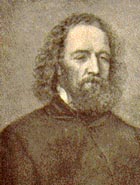
The poem
Half a league, half a league, Half a league onward, All in the valley of Death Rode the six hundred. "Forward, the Light Brigade! Charge for the guns!" he said: Into the valley of Death Rode the six hundred.
"Forward, the Light Brigade!" Was there a man dismayed? Not tho' the soldiers knew Someone had blundered: Theirs was not to make reply, Theirs was not to reason why, Theirs was but to do and die: Into the valley of Death Rode the six hundred.
Cannon to the right of them, Cannon to the left of them, Cannon in front of them Volleyed and thunder'd; Storm'd at with shot and shell, Boldly they rode and well, Into the jaws of Death, Into the mouth of Hell, Rode the six hundred.
Flashed all their sabres bare, Flashed as they turned in air, Sab'ring the gunners there, Charging and army, while All the world wondered: Plunging in the battery smoke, Right through the line they broke; Cossack and Russian Reeled from the sabre-stroke Shattered and sundered. Then they rode back, but not-- Not the six hundred.
Cannon to the right of them, Cannon to the left of them, Cannon in front of them Volleyed and thundered; Stormed at with shot and shell, While horse and hero fell, They that fought so well, Came thro' the jaws of Death, Back from the mouth of Hell, All that was left of them, Left of the six hundred.
When can their glory fade? Oh, the wild charge they made! All the world wondered. Honor the charge they made! Honor the Light Brigade, Noble Six Hundred!
Honestly this poem perfectly illustrates the job description of soldiers. Or patriots. "Theirs not to make reply" "theirs but to do and die". It's sad and humbling. But this shows pure dedication and loyalty. The honor bestowed upon the "noble six-hundred" is unimaginable. The willingness to ride into battle that is predetermined to be lost. They could have questioned authority and lived. But chose to follow tradition, and the path of dignity, to ride into battle and die heroes. Awesome! Honor them!
The Crimean charge took place on 25 October 1854.
Tennyson was inspired to the poem by the line "some on had blundered" in the editorial of "The TIMES".
It's one of the really great poem about honor and duty of warrior. I love it.
I had to memorize a poem for English, found this, and loved it. I think it's great. We should learn from this. All of us. Honor them...the noble six hundred!
OMG this was the most coolest poem i have ever read. We are in English class now and talking about it.
we should all honor the noble six hundred!
this poem has exact allusions and repetitions that makes the poem to look perfect.while reading this poem it makes to feel as though we are in the same battle field visualising and hearing the scenes with awe and wonder at the courage of the soldiers.as a student of english literature i feel everyone will have some effect while reading this beautiful poem.
This poem is great if you want a romantic version of the truth written by a guy who wasn't even there. It was more like 247 that really died. War is not romantic, and this, along with a few other Tennyson poems seems to reflect his frustration at not actually being there. He's a romantic who writes about the past, and while his style is at times beautiful, its also incredibly fake - because he wasn't there.
If you want poems that are about the turth of war, read some Owen...
Yep - I agree with Robert Burns - this poem embodies Owen's sentiments in Dulce et Decorum est. The poem glorifies war and unquestioning dedication to a nationalist cause, something which the war poets showed to be specious and, personally, I cannot help but balk at such a jingoistic attitude. I think it is telling that 2 of the most enthusiastic comments here come from American's....
I do agree with the criticisms posted, in that Tennyson has clearly romanticised the realities of war. He suggests that war is honourable and does glorify it to some extent, without having actually taken part. However, I would argue that this is the job of a poet or writer; to embelish the truth and to write about events that we may not be present for, or indeed, never took place at all. One of the main components a poet needs to capture is feeling and passion in a poem, and in this instance Tennyson un-doubtedly succeeds.
honestly i think we should give Tennyson a break. the fact that he was not even though emphasizes his greatness as a poet even more because of his ability to to use the right diction to evoke vivid visual imagery and appeal to our other senses so well. big ups to Lord tennyson!!!!!!!!!!!!!
CHARGE OF THE LIGHT BRIGADE
I was intrigued by the varied comments on the charge of the light brigade. I think that for those that read poetry it is important to understand that Tennyson was very much trying to inspire with his words,but I also believe that this poem is also trying to tell the reader (at least my take on it) that although the brigade charged into HELL, they did so under the command of foolish general officers. The phrase…
Read the whole commentI was intrigued by the varied comments on the charge of the light brigade. I think that for those that read poetry it is important to understand that Tennyson was very much trying to inspire with his words,but I also believe that this poem is also trying to tell the reader (at least my take on it) that although the brigade charged into HELL, they did so under the command of foolish general officers. The phrase (paraphrased here for space) ours is not to reason why,ours is but to do or die has been echoed in the tenor of every soldier's voice for over a century. I would challenge you to read it again with a slant toward sarcasm and I think that you might take away something a little different. As with all great art, it means something different to different people at different times...just a thought.