The poem
And the just man trailed God's shining agent, over a black mountain, in his giant track, while a restless voice kept harrying his woman: "It's not too late, you can still look back
at the red towers of your native Sodom, the square where once you sang, the spinning-shed, at the empty windows set in the tall house where sons and daughters blessed your marriage-bed."
A single glance: a sudden dart of pain stitching her eyes before she made a sound . . . Her body flaked into transparent salt, and her swift legs rooted to the ground.
Who will grieve for this woman? Does she not seem too insignificant for our concern? Yet in my heart I never will deny her, who suffered death because she chose to turn.
This isnt too shabby for a russian
This is a question. You don't indicate the translator. This is important. Who translated this poem? Joan
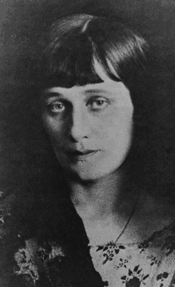
This version of Lot's Wife was translated by Max Hayward, a Russian language scholar, and Stanley Kunitz, an American poet. It is by far the best English translation of a very difficult style of poetry. Ahkmatova was an Acme-ist, and tried to capture large events in the smallest of gestures. Her poems were also tightly structured and metred. This translation is so good (in English) because it captures more of the…
Read the whole commentThis version of Lot's Wife was translated by Max Hayward, a Russian language scholar, and Stanley Kunitz, an American poet. It is by far the best English translation of a very difficult style of poetry. Ahkmatova was an Acme-ist, and tried to capture large events in the smallest of gestures. Her poems were also tightly structured and metred. This translation is so good (in English) because it captures more of the lyrical qualities. Those translators (DM Thomas, Coffin or Amanda Haight, for example) who have tried to manage the metre and structure more end up with poems that sound rather clunky and awkward in English. I believe the quality here is the result of using a poet to fashion the translation. Others tried similar combos later, especially with poems by Yevtushenko and
Brodsky (both of whom lived in the US in their later years) All the poems in this volume are wonderful, and if you can actually find one, I would get it.
Peter Maffly-Kipp--thanks for posting your comment! Translations do make such a difference. This poem adds a wonderful twist of the event by focusing on Lot's wife. That one look cost her everything. Ironic how there are so many examples of "one decision" that carried steep penalties (Moses striking the rock more than once, Adam and Eve's action with eating the fruit,...). The last two lines are so moving, because the poet has embraced the wife as almost a type of patron saint. By this embracing, Akhmatova somehow absolves the disobedience, and deems it as a noble act.