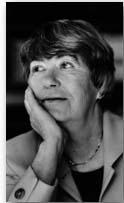
The poem
Doctor, you say there are no haloes around the streetlights in Paris and what I see is an aberration caused by old age, an affliction. I tell you it has taken me all my life to arrive at the vision of gas lamps as angels, to soften and blur and finally banish the edges you regret I don't see, to learn that the line I called the horizon does not exist and sky and water, so long apart, are the same state of being. Fifty-four years before I could see Rouen cathedral is built of parallel shafts of sun, and now you want to restore my youthful errors: fixed notions of top and bottom, the illusion of three-dimensional space, wisteria separate from the bridge it covers. What can I say to convince you the Houses of Parliament dissolves night after night to become the fluid dream of the Thames? I will not return to a universe of objects that don't know each other, as if islands were not the lost children of one great continent. The world is flux, and light becomes what it touches, becomes water, lilies on water, above and below water, becomes lilac and mauve and yellow and white and cerulean lamps, small fists passing sunlight so quickly to one another that it would take long, streaming hair inside my brush to catch it. To paint the speed of light! Our weighted shapes, these verticals, burn to mix with air and change our bones, skin, clothes to gases. Doctor, if only you could see how heaven pulls earth into its arms and how infinitely the heart expands to claim this world, blue vapor without end.
I came across this poem first in Anne Lamontt's new Book, Plan B. I really like this poem since it points to seeing beyond our physical world. The imagery holds together for me well until. I get to "small fists passing sunlight/ so quickly to one another/ that it would take long, streaming hair/ inside my brush to catch it./ To paint at the speed of light!/ The clarity of the poems begins to break down here for me.…
Read the whole commentI came across this poem first in Anne Lamontt's new Book, Plan B. I really like this poem since it points to seeing beyond our physical world. The imagery holds together for me well until. I get to "small fists passing sunlight/ so quickly to one another/ that it would take long, streaming hair/ inside my brush to catch it./ To paint at the speed of light!/
The clarity of the poems begins to break down here for me.
and finally
/Our weighted shapes, these verticals,/ burn to mix with air and change our bones, skin, clothes/ to gas/
changing our bones to gas is a hard thing for comprehend.
Aside from those to comments I think the poem does a great job of capturing the essence of Monets paintings.
David Perrings
I first read this poem in 2003 . I was immediately touched by it and for a long time I had been in a mood created by this poem.It is the very intonation of the narrator that captured me.
I really like this poem .
The Gift of Time I read Lisel Mueller’s poem, “Monet Refuses The Operation,” aloud, over and over, day after day, as my mother slowly slipped away. I found comfort here but also strength. At first it seemed about a different way of seeing – a way quantum physics also suggests, as I understand it. The solid objects we think we see actually consist of rapidly moving particles with lots of space in between. Cells that…
Read the whole commentThe Gift of Time
I read Lisel Mueller’s poem, “Monet Refuses The Operation,” aloud, over and over, day after day, as my mother slowly slipped away. I found comfort here but also strength. At first it seemed about a different way of seeing – a way quantum physics also suggests, as I understand it. The solid objects we think we see actually consist of rapidly moving particles with lots of space in between. Cells that have been separated by thousands of miles still long for each other. In other words, reality is not necessarily what we see.
As I thought more about it, the central issue seems to be one of time. Will we have time to mature into a different way of seeing the world? To experience aging not as just a series of losses but also as an opportunity for an expanding perspective and capacity to empathize and love. In 1996, when Mother was 90 years old, she had a quadruple heart bypass operation. As she regained her strength after that shock to her system, I realized we had all been given an amazing gift.
Now, looking back, I find myself considering how Mother used that gift of time. For her children and grandchildren, she had been ambitious and demanding, but by the time she became a great grandmother, she was playful and loving and always enthusiastically supportive. Each of her great grandchildren became one of her “shafts of sun.” She left her need to be judgmental far behind. When given a choice, she chose to participate rather than to observe – eager to go and do. Once she dropped her need to be proper, she could be hysterically funny when playing charades (her routine for the word, Kilimanjaro, is still a family legend) or setting up her grandson, Eric, to be straight man for her one-liners.
Her ability to savor and truly enjoy things she had loved all her life seemed to deepen: praying and attending church services, playing the piano, reading or listening to poetry and her Bible, enjoying the beauty around her, watering her garden, surrounding herself with flowers, and spending time with family and friends. Somehow she managed “to soften and blur and finally banish” the sharp elbows and edges of earlier coping and achieving, and was left with a seemingly endless capacity to express love, gratitude and joy. For someone who in her younger years had emphasized intellectual abilities, she became much more interested in matters of the heart
Her last years seemed to be a lesson in how to emulate the Chinese sage or the Zen search for the essence, the heart of the matter. And in this era when age is to be disguised at all costs, it’s heartening to think, instead, of the opportunities aging can bring: the softening and welcoming, the loving and grateful heart and, most of all, the joy. She used her gift of time well until “heaven pull[ed her] into its arms.”
Margaret Harrell
TO Margaret,
thank you for your post. I think is is as beautiful as the poem by Mueller. Poetry is important because there are people like your mother who live it.
thank you.
david perrings