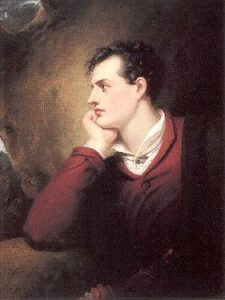
The poem
To sit on rocks, to muse o'er flood and fell, To slowly trace the forest's shady scene, Where things that own not man's dominion dwell, And mortal foot hath ne'er or rarely been; To climb the trackless mountain all unseen, With the wild flock that never needs a fold; Alone o'er steeps and foaming falls to lean; This is not solitude, 'tis but to hold Converse with Nature's charms, and view her stores unrolled.
But midst the crowd, the hurry, the shock of men, To hear, to see, to feel and to possess, And roam alone, the world's tired denizen, With none who bless us, none whom we can bless; Minions of splendour shrinking from distress! None that, with kindred consciousness endued, If we were not, would seem to smile the less Of all the flattered, followed, sought and sued; This is to be alone; this, this is solitude!
(Part of a TPCASTT analysis, Grade 9 English) Connotation: In the first stanza, the narrator introduces us to the boundless beauty of nature; to its forests, valleys, rivers, mountains and everything else that it has to offer. This beauty is not possessed by man; on the contrary, it remains true and unspoilt with the absence of human presence. This symbolises freedom in its truest sense. The narrator also puts…
Read the whole comment(Part of a TPCASTT analysis, Grade 9 English)
Connotation: In the first stanza, the narrator introduces us to the boundless beauty of nature; to its forests, valleys, rivers, mountains and everything else that it has to offer. This beauty is not possessed by man; on the contrary, it remains true and unspoilt with the absence of human presence. This symbolises freedom in its truest sense. The narrator also puts emphasis on the extreme isolation of the setting in the poem (“And mortal foot hath ne’er or rarely been;”, etc.): usually this would also entail extreme solitude, but the poem continues on to disprove that this isn’t exactly what solitude is all about. Lord Byron says that being alone in nature is anything but solitude, it is only to experience Nature as it was meant to be experienced; untouched and alive. ‘Nature’ in this context could also symbolise Mother Nature, so that the individual in nature is not alone because he or she is in the presence of the spirit of living things. “Converse with Nature’s charms,” personifies ‘Nature’s charms’ as something capable of having a conversation with. This could also mean that the person in question is not alone, for he has the plenitude of life all around him to commune with the roots of his existence; to commune with the depths of human spirituality within himself and within other living things. In this sense, this is not solitude.
Continuing with the second stanza, the poem shifts to a place where there is obviously a multitude of bustling crowds, everyone in a hurry to get where they need to go. The narrator refers to the senses: “To hear, to see, to feel and to possess,” to describe the experiences felt by someone standing alone in a large crowd (“the shock of men”). In the poem, we discover that to have no friends, family or community is what it means to truly be alone. It’s all about connections and the ability for a person to build relationships with others, to display reciprocity towards one’s fellow man. If one does not possess any lasting social ties with any other human being, one is in utter solitude, for the soul needs to communicate with another that understands who one is. “…kindred consciousness” refers to someone else who can relate to one’s plight and share sympathy and advice, giving the caring and love that all of us need. To envy the honoured, the popular, the desired and the loved (“Of all the flattered, followed, sought and sued;”) is shown to be fruitless, for they could obviously could care less if one was in existence or not. It is inferred that at least in the midst of nature, one has the ability to commune with other living things; but in a world where one has no spiritual connections to another being, one is truly in the depths of solitude. In essence, if nobody cares about an individual and they do not care about anyone else, this is the true meaning of solitude; the absence of caring souls in a whole world of men. This is what it means to be more alone then in a remote site in the wilderness with no man around for miles.
Very good poem....love it!!!!
Why isn't there anymore good poets nowadays....most of them lived back then?
Love it.....a little hard to understand at first?
What wuld it be like....
What would it be like to live by ureself.......I am legend the movie can be compared to this poem.
I'm doing this poem in class for a project.......Can someone help me fully understand it?
Sorry sarah i wish i can help......i'm doing the same thing for my class lol. Can you help me with my poem :D?
*And you to Madison.....
Thanks Leon......I do need help really bad lol......maybe you can help sarah :)
He wrote good poetry and death was on his mind for those he loved.
hiiii. this poems so cool . it makes me feel lonely
this poem subjigates that being alone is an ellusive yet subtle being. It shows
that no matter what you think about life and how alone you are life is
never to busy to stop for you and make yu listen
Comparing Poets
The meaning I take from Frost's poem is a very literal one. Someone has cut down a birch tree and suggested he come and clean up the branches because he can use them to set his peas to climb on them in his garden. He is a natural observer of nature's ways and he sees that if he doesn't remove the downed brush soon, it will impede the growth of the new flowers that are already coming up beneath them. He is killing…
Read the whole commentThe meaning I take from Frost's poem is a very literal one. Someone has
cut down a birch tree and suggested he come and clean up the branches
because he can use them to set his peas to climb on them in his garden. He
is a natural observer of nature's ways and he sees that if he doesn't
remove the downed brush soon, it will impede the growth of the new flowers
that are already coming up beneath them. He is killing two birds with one
stone, both cleaning up for the sake of what's beneath, and taking home
what can be utilized. It can be a metaphor for thriftiness, good
stewardship, environmental awareness, etc, etc, and definitely is a poem
that emphasises that we should make hay while the sun shines, not just let
things go to seed. Don't procrastinate, keep working, the good work of the
world revolves on such principles. I find it to be an upbeat and pragmatic
message.
Fresh Breath of Air
I have to write a response on this poem and the other comment says that is
very hard to analyze. I learned that it means that cutting down birch
trees is crushing the wild trillium flowers. So, stop to take a look at
nature!
it is very hard to analyze
Comment Wars....lol, jus joking......this site needs to be for info only not a chatting room
Lord Byron is a very good poet one of the best poets back then...during his era. Nobody can match his talent, really sad he died at such a very young age.
???????? Can somebody break this poem down for me?
Solitude is a fresh breath of air.......what would it be like to leave alone, what if we all just stoped and listen to what mother nature has to offer us.
love how nature can sing...and makes you want to go outside and listen for a while! =D