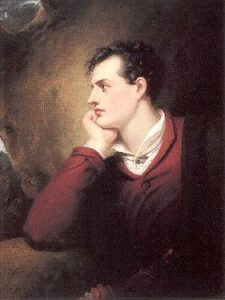
The poem
Oh, talk not to me of a name great in story; The days of our youth are the days of our glory; And the myrtle and ivy of sweet two-and-twenty Are worth all your laurels, though ever so plenty.
What are garlands and crowns to the brow that is wrinkled? 'Tis but as a dead flower with May-dew besprinkled: Then away with all such from the head that is hoary! What care I for the wreaths that can only give glory?
O Fame!—if I e'er took delight in thy praises, 'Twas less for the sake of thy high-sounding phrases, Than to see the bright eyes of the dear one discover She thought that I was not unworthy to love her.
There chiefly I sought thee, there only I found thee; Her glance was the best of the rays that surround thee; When it sparkled o'er aught that was bright in my story, I knew it was love, and I felt it was glory.
Sweet two-and-twenty seemed so far away when I fell in love with this poem at eighteen. Now, at the age of sixty-four, I still love it, though ever so nostalgic whenever I read it.
In the peoem Bryon talkes about how he found fame and glory. How so?
Byron was the Paris Hilton of his day. His works were widely read; his private life was rifed with scandal; he was supposedly chased by women all the time ("Don Juan" in the flesh); he was a natural conversationalist--quite charming, etc. Think Pamela Anderson and other famous people that are constantly being hounded because their "antics" which seem to entertain the interest of the masses (as in sales, tv…
Read the whole commentByron was the Paris Hilton of his day. His works were widely read; his private life was rifed with scandal; he was supposedly chased by women all the time ("Don Juan" in the flesh); he was a natural conversationalist--quite charming, etc. Think Pamela Anderson and other famous people that are constantly being hounded because their "antics" which seem to entertain the interest of the masses (as in sales, tv coverage...)and you have--Byron.
In the poem, he is reflective of his success, but convinces himself that love is the greater mark of true success.
If you haven't read about Byron's background, I'd suggest you do. Try not to get turned off from his literary work. Fair warning: HE WAS A DOG! (an epitaph)
The mentioned poem is definitely a love poem where the poet is craving for the inspiring power of love.