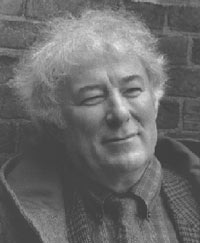
Biography
Seamus Heaney (b. April 13, 1939, d. August 30, 2013) was a poet, writer and lecturer from Northern Ireland. He was considered one of the most widely known and important poets working in English, or perhaps any language, in the late 20th century.
Heaney was born, the eldest of nine children, on a farm called Mossbawn, in County Derry thirty miles to the Northwest of Belfast, in Northern Ireland. He was brought up a Catholic. As a child he remembered watching American soldiers practising for the D-Day landings. The family left the farm in 1953. He was educated at the local primary school and St. Columb's College, a Catholic boarding school in Derry to which he was awarded a scholarship. At St Columbs he was taught the Irish language. He then attended Queen's University, Belfast.
In the sixties Heaney trained as a teacher and worked in schools in Belfast and Ballymurphy. It was at this time that he first started to publish poetry, beginning in 1962. His first book, Death of a Naturalist, was published in 1966. It met with much critical acclaim. In 1965 he met and married Marie Devlin. (Devlin is a writer herself and in 1994 published Over Nine Waves a collection of traditional Irish myths and legends.) They had three children.
Read the full biography
Throughout the sixties, he was working, at formal meetings, with a number of writers including Michael Longley, Derek Mahon, and Philip Hobsbaum. In the seventies younger poets attended these meetings, now run by Heaney, including Paul Muldoon and Frank Ormsby. In 1968, with Michael Longley, Heaney took part in a reading tour called 'Room to Rhyme', this lead to quite a lot of exposure for the poet's work. He was appointed to the Arts Council in the Republic of Ireland in 1974. He became an elected Saoi of Aosdána. In 1972 Heaney left his lectureship at Belfast and moved to the Republic, working at a teacher training college in Dublin. In 1984, Heaney was appointed Boylston Professor of Rhetoric and Oratory, at Harvard University. In 1989, he was elected to be Professor of Poetry at Oxford University, which he held for a five-year term to 1994 (not requiring residence in Oxford).
Throughout this time he was publishing prolifically and dividing his time between Ireland and America. He also continued to give public readings, which were very popular. So well attended and keenly anticipated were these events that those who queued for tickets with such enthusiasm have sometimes been dubbed 'Heaneyboppers' suggesting an almost pop-music fanaticism on the part of his supporters.
He was awarded the Nobel Prize for literature in 1995.
This article is licensed under the GNU Free Documentation License and uses material adapted in whole or in part from the Wikipedia article on Seamus Heaney.
On Mid-Term Break
On Requiem for the Croppies
On Anahorish
On The Grauballe Man
On Exposure
On The Tollund Man