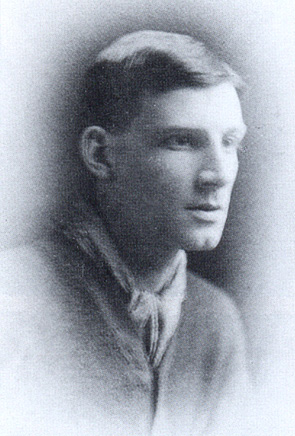
The poem
I found him in the guard-room at the Base. From the blind darkness I had heard his crying And blundered in. With puzzled, patient face A sergeant watched him; it was no good trying To stop it; for he howled and beat his chest. And, all because his brother had gone west, Raved at the bleeding war; his rampant grief Moaned, shouted, sobbed, and choked, while he was kneeling Half-naked on the floor. In my belief Such men have lost all patriotic feeling.
we have been doing this at school. It is quite hard to understand, but has references to both the pain of war and the poets attitude. Take, for example, the final line. 'In my belief, such men have lost all patriotic feeling' although we know that Sassoon was against the war, here it seems that he is also sympathysing with the man who has lost his brother. It is almost written from his point of view as his brother was killed in the war. It is very graphic yet realistic.
Lamentations is an insightful poem, which we have discussed in school. The fact that lamentations is a funeral song makes the poem seem that much more symbolic. He talks about the way officiers can't understand why a soldier cries really explains his feelings as he was a soldier and couldn't cry.
Siegfried Sassoon's poem, "Lamentations," is the commonplace interplay between two of the war's most disconnected participants. The immediate irony, however, is that this irreparable schism does not span enemy lines. Rather, the acutest separation of rationale, comprehension, and understanding occurs between the English field soldier and his highest ranking officers. The stoic, I, in this poem is the English army's…
Read the whole commentSiegfried Sassoon's poem, "Lamentations," is the commonplace interplay between
two of the war's most disconnected participants. The immediate irony, however, is that
this irreparable schism does not span enemy lines. Rather, the acutest separation of
rationale, comprehension, and understanding occurs between the English field soldier and
his highest ranking officers. The stoic, I, in this poem is the English army's administrative
officer, while the character that endures wanton dissection at the hand of the officer is
England's gallant son. And the lasting effect of this juxtaposition between experienced,
knowing soldier and oblivious, unscathed commanding officer is that it is the trifling
perception of the officer that is lamentable.
The poem is saturated with images that intimate, and define the gulf of disparate
experiences distancing the two critical players. The opening line places the happenstance of
officer and soldier in the guard-room with the connotation, understood from the officer's
narration, that the soldier is in a manner of being detained. The guard-room, then, takes on
the quality of a guarded room, and the suggestion that the soldier is unfit in his condition to
be left unsupervised locates the first trace of pitiable irony. In essence, the soldier who
knows what war is about and what it means is kept under watch while the officer who is
naive of the war's very nuances has free reign to conduct the most important of tactical
affairs. The exasperation of this absurd situation is intensified if it is believed that the
officer has ordered this detainment as a pertinent injunction at the cost of further ignoring
the situation of international war which is more important.
The next image strengthening the insurmountable gulf between soldier and officer is
more of a representative manifestation of the space occupying the gulf, itself. The officer
recalls, "From the blind darkness I had heard his crying..." Though unlikely that the
officer is consciously admitting to being in the dark as regards his soldier's plight, it is
exactly where he is. The fact that the officer attests to hearing his soldier's cries can be
interpreted as a misapprehension on the grounds that because he is veiled in darkness,
whatever reaches the officer's senses has been altered by the not wholly permeable veil.
On account of his senses being dimmed by the darkness of ignorance, the officer can not
fully apprehend in truth the meaning or form of what registers on his senses. It follows
wonderfully, furthermore, that the officer continues his recollection by noting that he
blundered in upon his soldier. Indeed, the clumsily intrusive manner of blundering is the
only entrance that the officer could accomplish since the darkness which surrounds his
comprehension of the situation would naturally foil an assuaging and calming entrance.
The event which occurs next is likely most telling on the division of experience
between officer and soldier primarily because, at first, it does not seem to fit the reading of
the poem as done up to this point. The officer tells how a sergeant, all the while
maintaining a puzzled, but patient face, watches over the soldier who howls and beats his
chest. Initially, the dearth of emotion on behalf of the attending sergeant does not appear to
make sense because a sergeant is a member of the fighting league of army combatants, and
would thus, expectedly, show some compassion or comprehension at another fighting
man's travails. It would make sense of the officer to bear such an unemotional
countenance in the presence of extreme grief because his tasks are so far removed from the
field where grief consumes men, but not the sergeant. It is here that the prior conclusions
of the poem up to said event, once again take their familiar and intelligible shape.
Effectively, the officer, unable to process the outward manifestation of internal strife in the
soldier is likewise dumbfounded at recognizing compassion towards the horror-stricken
comrade in the face of the ministering sergeant. Able only to call on his limited sensations,
and relate in these terms as well, the officer transposes his confoundedness at the
convulsions of the soldier onto the attending sergeant.
The officer shows himself to be completely inept at rationalizing the soldier's
condition when towards the close of his recollection, he utterly separates the soldier's
consuming grief from the soldier's dejected body. Here, again, the officer has effected a
transposition, but this time in the finality of himself upon the soldier. The soldier is to be
solely of sound body like himself. The officer is nowhere near perceiving how such
mental bankruptcy could enter upon the soldier's character. This conviction puts the officer
in the position to sum his recollection into a definitive standpoint on the worth of soldiers
like the one he has observed. The officer appears to finish by saying, "In my belief/ Such
men have lost all patriotic feeling." Reading this last sentiment in the fashion of the entire
poem, however, calls up a little skepticism that it is indeed the officer who speaks this last
line. Rather, the officer's recollection seemingly fits ending with his picture of the
soldier's body lying apart from mental anguish, and it is Sassoon's voice that decidedly
takes up the final verdict. The disdain for unpatriotic men thus falls upon the ignorant
officer who bears no fervent compassion for his patriotic soldiers, and it is this apathetic
position of the officer that is lamentable.