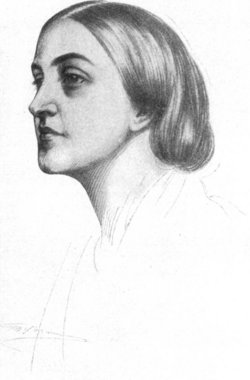
The poem
One face looks out from all his canvasses, One selfsame figure sits or walks or leans; We found her hidden just behind those screens, That mirror gave back all her loveliness. A queenin opal or in ruby dress, A nameless girl in freshest summer greens, A saint, an angel; -- every canvass means The same one meaning, neither more nor less. He feeds upon her face by day and night, And she with true kind eyes looks back on him Fair as the moon and joyfull as the light; Not wan with waiting, not with sorrow dim; Not as she is, but was when hope shone bright; Not as she is, but as she fills his dream.
one face looks out, is the inportance of the picture to the painter. also does not matter the other paintings, he cares for that one. she seets, walks or leans. that means there is more than one picture of her, maneless girl in a green dress, ruby, or opal.
A saint , an angel; she is dead, fair as the moon, not wan, sorrow dim. she is definelly dead. he fantasies over her pictures when she was alive.
I think it is more about the vampiric relationship between the artist and his art. "He feeds upon her face" is a reference to the artist's insatiable lust for the aesthetically ideal woman in the painting. He is fascinated by his own power to create art and to shape his subjects according to his own desires and tastes, “not she as she is but as she fills his dreams”. The poet is also making a larger comment about art in general; an artist can never truly depict reality as it is, (art is an artificial medium) but he/she is usually very good at depicting reality as he/she thinks it should be –whether it be a fantasy or just an inspired subject.
This poem is a reference to Christina's brother and his studio. He repeated these portraits of the lady whom he later married, Miss Siddal, so I dont believe that she is dead. He is so absolutely in love with this woman that he depicts her as "a queen...a saint...an angel" in his art, because that is how she appears in "his dream"s.
My interpretation of this sonnet is that it is very romantic and warming, yet deeply upsetting at the same time. I see the artist who Rossetti is writing about as a man, madly in love with a woman who only exists in his dreams and he is so deeply in love with her that his heart is steadily becoming insatiable. I believe this woman exists in a dream that broke his heart, simply because he had to wake up and i think…
Read the whole commentMy interpretation of this sonnet is that it is very romantic and warming, yet deeply upsetting at the same time. I see the artist who Rossetti is writing about as a man, madly in love with a woman who only exists in his dreams and he is so deeply in love with her that his heart is steadily becoming insatiable. I believe this woman exists in a dream that broke his heart, simply because he had to wake up and i think that on waking up and realising he was dreaming almost caused him to die of a broken heart. Furthermore i also believe that given the opportunity, he would have chosen not to have woke up at all, but to have spent the rest of his life in a sweet love-filled state of unconsciousness with the "nameless girl" he loves. She has had such a profound affect on him that he cannot forget her face.So he paints her. In several different poses, to reconstruct his dream as best he can maybe?as many of us would keep photographs and letters from our partners to keep us from losing our special memories? Only, instead of keeping these precious sentiments in a shoebox or a safe, he keeps them stored in his studio.
It could possibly be a recurring dream because "he feeds upon her face by day and night" suggesting to me that when he is not staring at her paintings, he is asleep dreaming about her once again.
Then again, this sonnet is so ambiguous that it could be a variety of things and it could be a mixture of them all. It could even be all of them.
I believe that this is about Christina's brother Dante Gabriel Rossetti. His wife committed suicide due to an overdose. So this could be about how he dealt with the aftermath of her death.
I don't have much time now, for otherwise I would have submitted a more comprehensive analysis. I'd just like to point out something which I find absent in the posts. This poem has a fairly strong feminist message. In fact, Ch. Rossetti was critical of the 'male gaze', so to speak, and this poem is, among other things, a criticism of that chauvinistic approach of the painter who objectifies women. I know this sounds incomplete, and that's because it is.
I agree with most of what is being said in this page. I just wanted to add, that is it possible that perhaps CR was making a multi-tier commentary about women's objectification by the male gaze. Firstly, there is the critique of the unnamed artist and his infatuation with his unnamed subject - which forms the context of the poem. Then there is the general critique of all men - especially during the Victorian times -…
Read the whole commentI agree with most of what is being said in this page. I just wanted to add, that is it possible that perhaps CR was making a multi-tier commentary about women's objectification by the male gaze. Firstly, there is the critique of the unnamed artist and his infatuation with his unnamed subject - which forms the context of the poem. Then there is the general critique of all men - especially during the Victorian times - and their fascination and preoccupation with over-idealized beauty: "...every canvas means / The same one thing, neither more nor less." That is, not only were all the paintings by artist the same and of the same woman; but also possibly that all other paintings of women done by men in Victorian England of the same nature showing a preoccupation with idealized beauty. And lastly, yes I do believe CR was critiquing her brother Dante G Rossetti as well, for having been so in love with Siddal. She was said to be a feminist, a cynic, and suffering from depression, so it makes sense that she should not understand and critique her own brilliant brother for falling into these 'baser' emotions of (over-zealous) love.
The biographical fallacy
Please remember to read the poem in its own right, and aside from any background information you may have reaped from lit-crit or wikipedia.
Where is the evidence for all these accusations of Christina's distaste for this woman, or unhappiness at her brother's extreme love? READ THE POEM! WHERE OH WHERE IS IT?!!?!?!?
on the poem
This poem seems to be one on a topic that Ruskin would absolutely abhor. Several of the ideas that he set forth in his numerous essays can be seen within the poem. These ideas include nobility of subject as well as nobility of the artist him/herself. This poem seems to give an example of a man who may in fact believe that he has found a noble subject, but on closer inspection, it seems that he has, in fact, not…
Read the whole commentThis poem seems to be one on a topic that Ruskin would absolutely abhor. Several of the ideas that he set forth in his numerous essays can be seen within the poem. These ideas include nobility of subject as well as nobility of the artist him/herself. This poem seems to give an example of a man who may in fact believe that he has found a noble subject, but on closer inspection, it seems that he has, in fact, not fulfilled Ruskin’s requirements for art.
The first two lines of the poem inform the reader that the painter paints numerous works with the same subject put into new settings and clothes. Based on these lines, a reader may infer that she is a subject with the nobility that Ruskin believed to be so pivotal in the creation of ideal art. The possibility of the woman in the poem being a noble subject is eliminated in line eight, when Rossetti notes that all of the paintings with the girl have “The same one meaning, neither more nor less.” If the girl were truly a noble subject, then it is reasonable to believe that she would not be one-dimensional, and that she would, in fact, be transferred to canvas with multiple meanings to go with her multiple settings and dresses. Additionally, Rossetti notes that the woman is not being painted as she truly is in lines thirteen and fourteen. Instead, she states, the woman is being portrayed as she was “when hope shone bright” and “as she fills [the painters] dreams.” If a subject had nobility, I would think that she would be painted to reflect the nobility rather than being altered in accordance with the painter’s dreams or the way she may have been in the past.
The poem also addresses the nobility of the painter. At first, it may seem that he is dedicated to painting his subject; however, it is also quite evident that he is obsessed with the subject. On this point, Rossetti points out that the painter “feeds upon her face by day and night” in line nine. Additionally, he is not even paining his subject as she appears, but rather how he imagines her. It seems that he is idealizing the woman he is painting, which would probably make Ruskin’s hair fall out. Rather than creating a realistic depiction, as was what Ruskin believed should be painted, the painter is idealizing and altering his subject. This idealization may be a statement on the part of Rossetti in that this is something of a romantic trend, while the Victorians were moving towards realism. By this, Rossetti creates a painter that is not following the proper progression of art.
Based on her depiction of the artist being a painter who was not providing Ruskin’s “greatest amount of good for the greatest number of people,” Rossetti exposes a truth about artists in the Victorian age. She suggests that someone may become enamored or caught up in a romantic style despite the movement towards realism, and in showing this Rossetti is realistic. She presents a possible fallacy of idealizing one’s subject to the point that one is no longer of the proper nobility to paint something of worth in the society. Additionally, she suggests that perhaps by partaking in this fallacy the painter will eliminate the nobility of the subject as well.