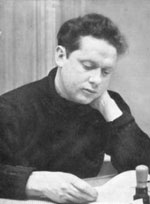
The poem
And death shall have no dominion. Dead mean naked they shall be one With the man in the wind and the west moon; When their bones are picked clean and the clean bones gone, They shall have stars at elbow and foot; Though they go mad they shall be sane, Though they sink through the sea they shall rise again; Though lovers be lost love shall not; And death shall have no dominion.
And death shall have no dominion. Under the windings of the sea They lying long shall not die windily; Twisting on racks when sinews give way, Strapped to a wheel, yet they shall not break; Faith in their hands shall snap in two, And the unicorn evils run them through; Split all ends up they shan't crack; And death shall have no dominion.
And death shall have no dominion. No more may gulls cry at their ears Or waves break loud on the seashores; Where blew a flower may a flower no more Lift its head to the blows of the rain; Through they be mad and dead as nails, Heads of the characters hammer through daisies; Break in the sun till the sun breaks down, And death shall have no dominion.
EVERY time I read this, I get the distinct feeling that Dylan was trying to put across a point of great importance (to him), but wanted to disguise it as well as he could. What is it??? I can never put my finger on exactly what he was trying to convey! Can anyone help?
Thanks, Sam in Sri Lanka.
To me it means there is no death. That part of me that is ME, beyond the body, beyond the mind, beyond the emotions, lives on; the body is a shell put on for the experiences of mind, emotions, body. Perhaps it is the Soul.
I think it means that if you have lost someone whom you haved loved above all else, and that if the only thing left for you is a never ending agony this anguish thrashing may thrust you to a place where you be reunited with you lost love. (Hitting the rock bottom of emotions and wishing they would take you further)
I think this poem touches on all aspects of death, but mainly the two major ones.
1) Your own death: Death may control your body, but it will have no dominion over your soul.
2) The death of a loved one: "Though lovers be lost, love shall not." Even if the person is dead, the love that you have for them is not.
As for Thomas disguising a hidden message in this poem, I have no idea. It was written in 1936, so perhaps there's a World War-connection?
I agree with Toni and yet, in a more expanded way. Death shall have no dominion says it all. What is Death? The affirmation of life. It is nothing more than change, not the end. It has no dominion. Some things change like the weather, some things are eternal like love, and death does not stop us from existing and continuing. He seemed to be conveying the idea that life goes on so don't give up, because even if you do the world keeps on turning, for death has no dominion.
I agree with Rachel, this poem is read in the film Solaris, a very haunting film about the deep pain of loss and the immortality of love beyond matter, space and time-the movie is inspired by the poem-
A part of this beautiful poem is also recited by Sean Penn's character in the movie "The weight of water", but this of course doesn't give us any more clues to what Dylan Thomas wanted to say with the poem. I just love it, to me it's a very powerful poem, with qualitys beyond the romantic framework of -Love-. Toni describes that just fine.
The meaning is
b e y o n d
what our minds are able to fully grasp.
i think this poem is about how people llearn to live and love without death overshadowing it, because death is not the end
I think that this poem also implies a Christian orthodoxy. It is Christ, who "being raised from the dead dieth no more; death hath no dominion over him". So, presumably the poem is not only about the Platonic, eternal love but also about Christian beliefs, resurrection, etc.
This poem speaks of how Christianity explains dying
and death. I just sent it to a friend of mine who
had a loved one die after a long illness and I read
it a lot after my Dad passed. Death will cause the
most horrific sadness and despair. It can rip your
heart in two but in Christianity it the body that
dies and the soul lives on in complete joy and peace.
Death (logically) cannot take over us. But we are
only too human and must deal with death in our own
frail ways.
where better to disguise it than in plain sight? "death shall have no dominion"
Have you noticed how descriptive the second stanza is when it comes to expressing torture, pain and torment as attributes of death? It's almost as if taken out from Bosch's paintings. And yet, as in two others there is the notion of perseverance. Of what? Some may say that of human spirit... some that it's a metaphorized idea of resurrection at the end of time. But then again, I love this poem for that powerful certainity that a part of us is beyond death. And it can consume our bodies but cannot rule us wholly. Even if it puts the sun out.
I think that this poem talks more about how death as a Christian is so much better than death of any other religion because if you are a true Christian and you accept Christ as your savior, you'll go to Heavan. This poem blows!
"death as a Christian is so much better than death of any other religion" how can you write such a silly thing Grant?! So jewishes and muslims won't go to heaven ?? what about those who don't believe in these stuffs ? we're all destined to hell for you ??Look at what your religion led us : a war in iraq in the name of god!!! Let's mind by ourselves (It means WITHOUT god) just a minute.
Beautiful poem.
I am completely in agreement with Lew. I don't think that at any point in the poem Thomas refers specifically to Christian death, only the idea of resurrection. As for the idea that those of other religions do not go to heaven, surely that is a particularly unchristian idea as christ taught us to love and respect those around us and surely if they have deserved to go to heaven, that is where they will end up. Anyway, back to the poem. I find this poem particularly interesting as it explores the idea that we are all part of something greater and shall one day rise and take our rightful places. I think the strong spell like rhythm adds to this, giving it a sense of continuance.
This poem is not about the christian views of death. This poem however is about life and death. If you understand the work of Dylan you will know instantly from general knowlege he is not a religious man. He uses religous refrences to express certain viewpoints. Dylan Thomas' father however was highly religious but Dylan was not. This poem is closely related with The Force That Through The Green Fuse Drives The…
Read the whole commentThis poem is not about the christian views of death.
This poem however is about life and death. If you understand the work of Dylan you will know instantly from general knowlege he is not a religious man.
He uses religous refrences to express certain viewpoints.
Dylan Thomas' father however was highly religious but Dylan was not.
This poem is closely related with The Force That Through The Green Fuse Drives The Flower. "Heads of the characters hammer through daises..." is a quote from death Shall Have No Dominion which basically explains itself why it is related.
The tone and sounding of this poem shows Thomas' Welsh background written in the way of a 'hwyl' which is the welsh term given to a poem written in this style.
I could explain further but I don't feel the need to.
I just smoked a lot of drugs and read this sweet poem. And Death Shall Have No Dominion took away all the boundaries thank you Dylan Thomas and rock on. I salute you
Thank you Sarah, for your insightful comments. I for one wish you would continue. I don't know much about Thomas, but I recognize power when I see it, and this poem is explosive. I seems to me a bit of a companion piece to "Do Not Go Gently Into That Good Night", only far more complicated. In this poem, it seems to be Dylan himself that is doing the raging. I don't get all the references and I'd be fascinated if anyone could explain more of it for me.
I'm not much of a poetry critic I'm afraid but was nonetheless moved by its potency. It seems for all the world to me that it is describing a spirit of emotional intensity (between to people?) that cannot be extinguished even by something as enduring as death. In many ways it even seems to be mocking the ostensible finallity of the concept. That was my take on it anyway.
"...And the internet said to men,
Kneel before me and I shall give
my kingdom!!!"
...We all fell
My reading was that Dylan Thomas constructed the poem to challenge the view that death is the end, but not in the sense that there is an after-life. I believe Thomas was depicting the fact that life on earth continues through a clever use of binary oppositions (i.e. "Though lovers be lost love shall not" and "Though they go mad they shall be sane") I believe that Dylan Thomas was opposed to those who glorify or romanticise death and believed it to be somewhat controlled. Please reply if you understand, agree (or disagree). Yet, I see the poem as a portrayal of Thomas's belief that no power or authority can control death, only life itself...
i dont think the dylan was refering to death at all. He used it as a metaphore to describe our greatest gift to nature. Love. The entire poem is defined by the line in the first stanza, "though lovers be lost, love thall not". With the rest of the poem he illuminates how the gift of love humans have bestowed upon the universe not only makes us immortal (not individually but metaphorically) but adds something unique to the universe which no power can ever take away.
"Through" in the fourth from last line. . . Shouldn't it be "Though?"
Im sorry. I know this will probably irritate some people but i feel compelled to speak. I have read all comments posted to date and 99% seem to view the work as a simile for religion and life after death. All, or most at least seem transfixed by the concept/hope that after death a weightless, massless, invisible ethereal 'image' of our physical selves will continue to exist in a state of eternal bliss, on streets…
Read the whole commentIm sorry. I know this will probably irritate some people but i feel compelled to speak. I have read all comments posted to date and 99% seem to view the work as a simile for religion and life after death. All, or most at least seem transfixed by the concept/hope that after death a weightless, massless, invisible ethereal 'image' of our physical selves will continue to exist in a state of eternal bliss, on streets paved with gold; 95% of the worlds population believe in some form of religion. Yet all recorded history is filled with war, hatred and terrorism in the name of god. 99% of all species that have existed in earths 4.5 billion year history are extinct. The universe is a very complicated ballet, yet never is it out of balance. e=mc^2. mass changes to energy, and visa versa, but the balance never fails. The atoms in our body come from exploding stars, and will return from whence it came as energy and mass continue to dance. the poem is an abstract metaphore for humanities one great gift to the the universe, adding to its whole, yet leaving its balance undisturbed.
this poem is not about death, it is about love
I hate to be pedantic but... Having read Dino's comment, I also felt compelled to 'get my two cents worth' in. Now, I think poetry, like all art, is a deeply personal release. No two persons thought processes are identical, they may be similar but never identical. The way I percieve a certain subject or situation will be different to the next man's. So to preach about the hidden meanings applied to a piece of art or…
Read the whole commentI hate to be pedantic but... Having read Dino's comment, I also felt compelled to 'get my two cents worth' in. Now, I think poetry, like all art, is a deeply personal release. No two persons thought processes are identical, they may be similar but never identical. The way I percieve a certain subject or situation will be different to the next man's. So to preach about the hidden meanings applied to a piece of art or poetry is a selfish imposition. Especially when your own grasp of semantics, grammar and spelling leave a lot to be desired. My own personal thought is that Dylan Thomas's imagination was not constrained to one focal point but encompassed many aspects of life and death. Of course, it is impossible to ignore the references to the unity of the universe but there are also specific references to life after death. Who knows what Thomas meant except Thomas? Maybe we should ask the daisies.
What a word, dominion. Hmmmm....
Who asked anyone for meaning, explanation? If this poem meant something to you, then that is why one shares poems. Take it for face value! AND sharing of ideas about the cool facets is ENTIRELY the point. But not propagandist conclusions and supposition of deeper meaning for you to conclude with. I like red wine and cheese! Appreciate that of me...Don't tell me what it means! And for everyone that was touched by this poem, feels good doesn't it? Peace!
4ilu, Bella
This is a powerful poem. I don't know much about Christian orthodoxy ,but the title seems to come from Paul's Letter to the Romans, at chapter 5 verse 14 "... death exercised dominion from Adam to Moses ...and see verse 21 "...so that, just as sin exercised dominion in death, so grace might also exercise dominion through righteousness"
The power of the poem to me is that it shows the inadequacy of language to deal with powerful mystery. Dylan is somewhere on the other side of words in this work.
The poem has all the possibilities commented on above. On reading Rachel's email, i thought she was right and that Thomas does, to some extent(but not entirely i feel)appear to reject the more proverbial representation of death in art, which is primarily shaped by religious teachings. This idea is ironised by the repetitve, sermon-like structure of each stanza, beginning and ending with "And death shall have no…
Read the whole commentThe poem has all the possibilities commented on above. On reading Rachel's email, i thought she was right and that Thomas does, to some extent(but not entirely i feel)appear to reject the more proverbial representation of death in art, which is primarily shaped by religious teachings. This idea is ironised by the repetitve, sermon-like structure of each stanza, beginning and ending with "And death shall have no dominion". The first stanza introduces the romantic idea of love all enduring as a conqueror of death, but then Thomas mixes symbols of nature, purity and fragility, with harsh, aggresive images ("twisting on racks"), and doesn't allow the reader to settle into a predictable pattern of poetic cliches. There is a definite sense of an ongoing cycle, or a circle of life (for want of a better expression) as in "heads of the characters hammer through daisies", but this is made brutal by the hammer, which invokes the image of hammering nails into a coffin. The poem is fascinating, there is no definite or clear meaning, but it is intensely provoking.
Though lovers be lost love shall not;
I can't count the number of times I've lived this phrase....
As the poem was writen in 1946, just after the Second World war, imagine how poweful it was to confort millions of desperate people who had lost their loved ones!!! It is really an awesome poem because it emphasis the function of poetry itself, that is capable of beaulding from dust men and nations!!!
I don't think this poem is specifically about any afterlife at all. It's more about the endurance of memory and love on Earth for a dead person.
"Though lovers be lost love shall not" refers directly to love while "Heads of the characters hammer through daisies" (I think) refers to the characters of a person's name "hammering" out from the gravestone into the sunlight, even as it is slowly consumed with undergrowth.
I've loved this poem for years for its beauty and symbolism. I'm not sure if all of it has a direct meaning but would be interested if anyone knows what the "unicorn evils" refers to.
I think this poem is mocking religion, 'unicorn evils' a unicorn is a self thought myth, so is he mocking those who believe? Also, Thomas being a great believe of pantheism being a 'creator and creature of his own world', isn't he rejecting the idea of religion? The idealistic heaven 'they shall have stars at elbow and foot' also seems to be mocking this perfect idea of the after-life. I think Thomas believes love endures death and religion, and that it makes us immortal.
ok im doing this poem for my english courswork and find it very confuseing, does anyone have ant links or websites with a good analasys?
If you don't want people to tell you what a poem means or what they think it means, then don't come onto a web forum entirely set up for just that purpose. What's the point of discussing ANYTHING if we just take it at face value? Thomas didn't write this poem with face value in mind, so should we just dismiss some of the possibly greater meanings? Your logic is consistent with reading the novel Animal Farm and…
Read the whole commentIf you don't want people to tell you what a poem means or what they think it means, then don't come onto a web forum entirely set up for just that purpose. What's the point of discussing ANYTHING if we just take it at face value? Thomas didn't write this poem with face value in mind, so should we just dismiss some of the possibly greater meanings? Your logic is consistent with reading the novel Animal Farm and saying, "well...what an interesting commentary about life on a farm. I wish I had ME one uh dem pigs." There is a happy medium between face value interpretations and overly effusive tangents to sound intelligent. I suggest you look for the balance.
I think what's brilliant about this poem is that it's ambiguous in many ways, and not limited to one DEFINITE opinion. And yes, I am saying some poems really have a limited number of main themes. Donne's sonnet 10 is very similar to this one--it asserts the continuity of life over the seeming permanence of death. I love this poem regardless of what others think, though I am still interested to hear what they say because I respect the opinions of others more than or as much as my own.
THE POEM APPEALS TO THE HEART OF THE READER AND DEMANDS A COMPARISON WITH JOHN DONNE'S "DEATH BE NOT PROUD".
-NAKUL KUNDRA,B.A.
DOABA COLLEGE,JALANDHAR CITY, PUNJAB (INDIA)
I'm no critical expert, but i somehow find myself understanding what this poem says (it might be right, it might be wrong: watevr). I think people are focussing way too much on a line and ignoring the rest or this poem.I understand that love is a very common theme in poems, but people are resorting to it too quickly. "though lovers be lost love shall not" does not define the entire poem. The first stanza, i…
Read the whole commentI'm no critical expert, but i somehow find myself understanding what this poem says (it might be right, it might be wrong: watevr). I think people are focussing way too much on a line and ignoring the rest or this poem.I understand that love is a very common theme in poems, but people are resorting to it too quickly. "though lovers be lost love shall not" does not define the entire poem. The first stanza, i automatically related with the final couplet of "death be not proud" by John Donne. It speaks of how dieing is juat an instant of bad followed by an eternity of good (afterlife). Thomas's insistance on using "and" i found quite intriguing. After having thought about it, i finally decided that it meant that there are so many reasons why death shall have no dominion, that he could not possibly name them all and just took some to put in this poem. The "and" implies that there is more. The second stanza, i found quite the same, as he is describing ways to die, "but they shant crack" or "they won't matter" because death shall have no dominion.
The third stanza, i found most intriguing, and this i must put in a new paragraph to emphasize it importance. I found a complete chang in mood in which at first, he is completely 100% sure that death shall have no dominion, but then he sways and says that all this good of life is gone: seagulls+seashores=ocean=peace=happiness, and since death ends the oceans, it symbolically ends happiness, so he is admitting that death in fact DOES have dominion. Towards the end, however, he tries to convince himself that death has no dominion so that he can live in peace.
Given all of this, at the end i was finally able to conclude one very important thing: the audience. We are not Thomas's audience, he is his own audience. In many of his poems, you can see that he has a problem with death and all of its uncertainties, which actually becomes a sort of obsession. In this poem, he is not trying to convince us that death shall have no dominion. He is actually trying to convince himself that death shall have no dominion so that he can live in peace and know that death will not controll him and that he WILL have an afterlife.
This poem's subject is transcendence, any way you slice it. The yearning for transcendence is older than Christianity, older than Judaism, older than all religions ever constructed. Thomas erects obstacles to this transcendence and deals with them in turn; less successfully, the impression is given, as the poem progresses. It's rich, complex and mysterious; just as its subject deserves. We live with this as an innate characteristic of our human condition, and regularly fail to articulate it. Thomas at least tries.
Contrary of what has been said, this poem was written around the year 1934 as it was published in Dylan's first volume of poetry "18 poems" It was pre- II world war, and Dylan Thomas was well known to differ from the typical poets of his era; he was a romantic writer.
It is also known he was an alcoholic, and as we know many poets and writers use alcohol to be creative. What I´ve come to think of this poem is that through the state of being drunk Dylan was able to open up his inner most thoughts and meanings to himself, and wrote it down for people to know his essence and beliefs although they are too much abstract and personal for anyone to know it's real meaning.
Thank you for this wonderful website!
Though english is not my mother tongue, I want to add some ideas to all your interesting oppinions:
Doesn't Dylan Thomas infact paint a picture of death's dominion?
Doesn't he fall from stanza to stanza deeper into this abyss of death?
Or should I say: Doesn't he discribe death more vividly in every stanza until death is like life? Or better: Until death IS life?
Isn't the last picture whith the breaking heads in the sun the strongest picture of death and life at the same time?
I would dearly love to believe that Thomas was correct, that death has no dominion, that it is a transitional event and not a terminal place.
But whilst I'd love to believe him, I don't.
Yet in spite of my disbelief the poem helps.
I have no explanation for this contradiction.
I believe Thomas wrote this at a time he had lost his faith. He desperately wanted to believe in the hope of an afterlife, as shown in the first verse. However, as we move into the last stanza, the poem shows a materialistic view that, in the end, after the universe runs down, even death will no longer hold sway. It's a sad ending without hope.
In response to the comments that Thomas is professing views rooted in the Christian faith, considering his well documented agnoticism: In utlilising overt chrisitan allusion and the hywl (welsh sermon-like delivery) is he not merely using the familiar (themes of death, immortality and time) to present the unfamiliar (Thomas's unique interpretation of said themes)?
I think Thomas would be disappointed to see his work interpreted in an overtly Christian light.
My english teacher has made us study and analysis tons of poems and Thomas is definately one of the more difficult poets. I love this poem because it is reassuring that even if there is no God (unfortunately my faith is not as strong as some) we will continue to live on in matter and energy everywhere. Not only that, but all the most important figures in history are still a part of us, along with the rest of nature.…
Read the whole commentMy english teacher has made us study and analysis tons of poems and Thomas is definately one of the more difficult poets. I love this poem because it is reassuring that even if there is no God (unfortunately my faith is not as strong as some) we will continue to live on in matter and energy everywhere. Not only that, but all the most important figures in history are still a part of us, along with the rest of nature.
A lot of people focus on the line "Though lovers be lost love shall not". I do find this to be a very important line. Because of the missing comma, the line can be read in more than one way. Even so, the line still has the same meaning in the different ways it can be read.
The chiasmus and antithesis in the poem makes it seem that we focus too much on only one view of the world. Things are not usually as we see them.
Everything in the poem is blended together just as everything in the world is blended together. The line "With the man in the wind and the west moon" is simply a mix up of the man in the moon and the west wind. They are transposed to be made into one thing.
I could go on and on about different aspects of this poem but these are just a few of my opinions on the meaning.
No one noticed "dead mean naked" instead of "dead men naked"?
Maybe someone could proofread and correct it?
It's ironic, friends... but positive. He's quoting Romans 6:9 loosely in the first line, then deliberately undermining it throughout. Thomas was an agnostic; more of a 'spiritual materialist' -- believing, like Blake, in a kind of Eternal energy or divine oneness -- than an atheist. The original biblical line referred to Christ's resurrection, which Thomas slightly mocks with lines referring to the torture chambers…
Read the whole commentIt's ironic, friends... but positive. He's quoting Romans 6:9 loosely in the first line, then deliberately undermining it throughout. Thomas was an agnostic; more of a 'spiritual materialist' -- believing, like Blake, in a kind of Eternal energy or divine oneness -- than an atheist. The original biblical line referred to Christ's resurrection, which Thomas slightly mocks with lines referring to the torture chambers of the Catholic Inquisition and the almost comical image of heads hammering up through daisies when the supposed Revelation comes. His images are meant to show the absolute finality of death, yet, in their horror, to set the tone for the underlying peaceful notion that the eternal oneness our spirits rejoin at the end of their journey is far more vital (in its literal sense) than earthly life. This transcendental/pantheistic approach is consistent with his trademark neo-romantic leanings and is perhaps hinted at by deliberately jumbling Shelly's 'west wind' with the fairytale 'man in the moon' early on. There is a foreboding sense in that line that he will be mocking all myths that attempt to explain metaphysics in trite, easily grasped stories and images, putting them on the same level as the fairytales (man in moon) we tell children.
In response to some of the other comments, where the poem says "heads of the characters hammer through daisies", isn't he referring to the letters of the person's name on the gravestone forcing themselves into the light? It doesn't refer to the heads of the dead people. If it did, then the use of the word "characters" is inapropriate, we use this word for fictional people, not each other.
To Whom It May Concern :
Once and for all - " dead mean naked " should read " dead men naked" If anyone has any doubts about this listen to any D.T. video where the man recites the same.
The rage of Dylan Thoms
Reading "And Death Shall Have No Dominion", is such a gut wrenching experience, it takes you pain over the death of a loved one, an howls that Death is never triumphant. As a matter of fact Death could not exist without Life, not true for the vise versa, since life is eternal, created miraculously and never designed as a fixed time project. LIfe is the essence of being human, as a great philosopher termed as "The…
Read the whole commentReading "And Death Shall Have No Dominion", is such a gut wrenching experience, it takes you pain over the death of a loved one, an howls that Death is never triumphant. As a matter of fact Death could not exist without Life, not true for the vise versa, since life is eternal, created miraculously and never designed as a fixed time project. LIfe is the essence of being human, as a great philosopher termed as "The great Chain of Being". Death, this is just a word, a limited definition: EEG waves cannot be detected, no pulse no breathing. That's it! It's basically an interruption of the never ending chain of life, for us as humans, for the perpetuity of the mission that we are here to accomplish, even that would be one of the hardest thinks to figure out. And if we die, our true essence is seperated from the shell that is what others expects us, wants us to be. So of course Death Shall Have no Dominion, all it does is turn off the lights. Big deal. Life on the other hand is an eternal journey, both for us individually but just as much for the continuation of that Great Chain of Being, which cannot be interrupted by an individual death or in any way.
Thomas is mad. He is mad at the over indulgence and religions attempt to glorify death, whether a lover, a soldier, or an alcoholic from liver cirrhosis. The body is rotten, gone, but the spirit will grow in the daisy field, in the everlasting of the legacy of each individual human being.
Death Shall Have No Dominion- it never had any, and do not allow it to trick you into attributing powers to it which do no exist. Death is only a pause in the never ending journey of humanity
It must have been of heck of an idea for Thomas, 'cause (at least I sense it) he in pretty angry, if not enraged.
and death shall have no dominion
mis print:
3rd verse; line 6 should read
THOUGH they be mad and dead as nails
typo
misprint line 2:
should read Dead men [not Dead mean}