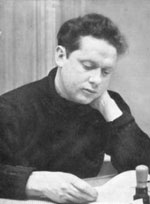
Dylan Thomas

Portrait of Dylan Thomas
Dylan Thomas 1914–1953
1914Born

Welsh poet, short-story writer, and playwright, renowned for the unique brilliance of his verbal imagery and for his celebration of natural beauty.

Thomas was born in Swansea, Wales, on October 27, 1914. After grammar school he moved to London where, in 1934, his first book of poetry, Eighteen Poems, was published. At this early age, he revealed unusual power in the use of poetic diction and imagery; the volume won him immediate critical acclaim. Thematically, these poems and virtually all that followed seem obscure because they contain elements of surrealism and personal fantasy. But the freshness and vitality of Thomas's language draw the reader into the poems and reveal the universality of the experiences with which they are concerned. This introspective tendency is less apparent in Deaths and Entrances (1946) and In Country Sleep (1951), which are generally regarded as containing his finest writing. Thomas's other works include Twenty-five Poems (1936) and The Map of Love (1939), containing both poetry and prose. A Portrait of the Artist as a Young Dog (1940) is a group of autobiographical sketches, and Adventures in the Skin Trade (published posthumously, 1954) contains an unfinished novel and other prose pieces. During World War II (1939-1945) Thomas wrote scripts for documentary motion pictures.

After the war Thomas was a literary commentator for BBC radio. Under Milk Wood (published posthumously, 1954), a play for voices, was originally written for radiobroadcast; when Thomas read it for its first public performance in Cambridge, Massachusetts, in 1953, it was still unfinished. The work became his most famous piece; it evokes the lives of the inhabitants of Llareggub, a small, Welsh seaside town. Noted for his readings of his own verse, Thomas became legendary in the United States, where he gave many lecture tours and gained a wide following. Nevertheless, his last years were shadowed by an increasingly tragic view of his own tempestuous life. His death in New York City on November 9, 1953, was brought on by alcoholism.

From readers

What readers say about Dylan Thomas

  1. On Do Not Go Gentle Into That Good Night

    “In the poem, the narrator was trying to tell his father to fight against the horror of death and be strong when facing it. The father represents all of us who are scare by the ending of our lives. Dylan was trying to tell us to believe in God and not to lose the believe that there's another life…”

  2. On And Death Shall Have No Dominion

    “I don't think this poem is specifically about any afterlife at all. It's more about the endurance of memory and love on Earth for a dead person. "Though lovers be lost love shall not" refers directly to love while "Heads of the characters hammer through daisies" (I think) refers to the characters…”

  3. On Fern Hill

    “Thomas expresses belief in nature itself - its innocence and beauty. Religion is used for its metaphors - and it inevitably colours the language of one brought up in the world of Welsh chapels, but it extends further to ideas of reincaration or resserection. "The sabbath" is significant because on…”

  4. On A Refusal To Mourn The Death, By Fire, Of A Child In London

    “I teach High School literature and we took this poem apart as part of a unit on Modern Poetry. Thomas has a theology, expressed in this work, which is cyclical in nature. When we die, we return to nature as our component atoms. "enter again the round Zion of the water bead and the synagogue of the…”

  5. On Light Breaks Where No Sun Shines

    “The sexual imagery is obvious on a first or second reading, but I think Thomas is digging for something a little deeper than a strictly physical meaning. Although I have not worked out the complete interpretation, I believe he is commenting on the connection between our human bodies and the earth.…”

  6. On Ears In The Turrets Hear

    “The poet is using two metaphors without mixing them, both of them images of his whole person, not merely his body. His person as house can welcome the unknown hands at the door and take the risk of receiving poison or grapes; as island, where ships bring foreign, i.e. unknown, objects in their…”

Where readers gather

Most discussed

  1. Do Not Go Gentle Into That Good Night86 comments
  2. And Death Shall Have No Dominion52 comments
  3. Fern Hill26 comments
  4. A Refusal To Mourn The Death, By Fire, Of A Child In London16 comments
  5. How Shall My Animal14 comments
  6. Poem In October14 comments
  7. Light Breaks Where No Sun Shines6 comments
  8. Poem On His Birthday5 comments
  9. Clown In The Moon4 comments
  10. In My Craft Or Sullen Art4 comments

All 65 poems

18 Poems · 1934 · 4 poems
25 Poems · 1936 · 1 poem
Deaths and Entrances · 1946 · 2 poems
Country Sleep · 1952 · 1 poem
Other poems · 57