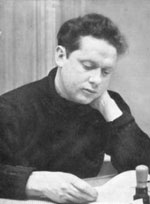
The poem
It was my thirtieth year to heaven Woke to my hearing from harbour and neighbour wood And the mussel pooled and the heron Priested shore The morning beckon With water praying and call of seagull and rook And the knock of sailing boats on the net webbed wall Myself to set foot That second In the still sleeping town and set forth.
My birthday began with the water- Birds and the birds of the winged trees flying my name Above the farms and the white horses And I rose In rainy autumn And walked abroad in a shower of all my days. High tide and the heron dived when I took the road Over the border And the gates Of the town closed as the town awoke.
A springful of larks in a rolling Cloud and the roadside bushes brimming with whistling Blackbirds and the sun of October Summery On the hill's shoulder, Here were fond climates and sweet singers suddenly Come in the morning where I wandered and listened To the rain wringing Wind blow cold In the wood faraway under me.
Pale rain over the dwindling harbour And over the sea wet church the size of a snail With its horns through mist and the castle Brown as owls But all the gardens Of spring and summer were blooming in the tall tales Beyond the border and under the lark full cloud. There could I marvel My birthday Away but the weather turned around.
It turned away from the blithe country And down the other air and the blue altered sky Streamed again a wonder of summer With apples Pears and red currants And I saw in the turning so clearly a child's Forgotten mornings when he walked with his mother Through the parables Of sun light And the legends of the green chapels
And the twice told fields of infancy That his tears burned my cheeks and his heart moved in mine. These were the woods the river and sea Where a boy In the listening Summertime of the dead whispered the truth of his joy To the trees and the stones and the fish in the tide. And the mystery Sang alive Still in the water and singingbirds.
And there could I marvel my birthday Away but the weather turned around. And the true Joy of the long dead child sang burning In the sun. It was my thirtieth Year to heaven stood there then in the summer noon Though the town below lay leaved with October blood. O may my heart's truth Still be sung On this high hill in a year's turning.
This poem is totally boring. Mr. Thomas must have been under serious drugs while he wrote this
The other two writers of the comments are obviously illiterate. The poem is such a beautiful poem that is one of the best I have ever read
This poem is about a man who has turned 30, and goes out to have a walk, reflecting on life. He reflects about how his inner child is now gone. "Year to heaven" could possibly mean that he beliefs it is his thirtieth year in his journey to heaven. He first describes the harbour and whe woods, which are by his house. In the shore there is a heron, which is a black, elegant bird with long, thin legs. He describes the…
Read the whole commentThis poem is about a man who has turned 30, and goes out to have a walk, reflecting on life. He reflects about how his inner child is now gone. "Year to heaven" could possibly mean that he beliefs it is his thirtieth year in his journey to heaven. He first describes the harbour and whe woods, which are by his house. In the shore there is a heron, which is a black, elegant bird with long, thin legs. He describes the shore as "heron priested" probably meaning that it is nicer, just with the presence of the heron. The water is praying(personification). This is probably because of the heron, because as a priest has to do with religion, the water is "praying". Then he talks about other birds, "seagull and rook". After describing the scene, the man goes out of his house, the town "still sleeping"(personification). The town is not really sleeping, it is the people in it.
In the next stanza, we realize that, indeed, it is his birthday. He describes the trees being "winged". This gives an impression that the trees are alive, but actually they are not; they are probably being blown by the wind, and moving, so they look as though they are flying. He says "trees flying my name". Dylan, the name of the author, is welsh, and means tide or sea, so probably "flying my name" means that they are being blown by the tide. Then, he keeps on walking "in a shower of all my days". This means that it is raining hard. The tide rises, and the heron dives into the water. Then, he turned("I took the road over the border") and the gates closed behind him, ast the people awoke.
In this stanza he talks about a "springful of larks in a rolling cloud". Larks are birds, so this probably means that there is a large quantity of birds, flying all clusteres todether, so it looks like a cloud of birds which is "rolling", because the birds are moving. At the roadside there are "bushes brimming with whistling blackbirds". This means that there is all along the roadside a line of bushes, with birds singing. It is sunny. He is on the "hil's shoulder", which means that he is at the top of the hill. He looks back, and sees the wood below him, with the "rain wringing", meaning that the rain is making a sound.
In the next stanza, he says that he pursued his birthday
Dylan was one of the greatest poets who ever wrote in English, and moreover he is the one of only two big masters who ever wrote this way. The other is T.S.Eliot, they both knew well what to do with the words and lines to create a mood of the imaginary reader - but they never had this goal for itself. In his Poem in October and another one, written to his birthday, Dylan Thomas does the thing that may look rather…
Read the whole commentDylan was one of the greatest poets who ever wrote in English, and moreover he is the one of only two big masters who ever wrote this way. The other is T.S.Eliot, they both knew well what to do with the words and lines to create a mood of the imaginary reader - but they never had this goal for itself.
In his Poem in October and another one, written to his birthday, Dylan Thomas does the thing that may look rather strange for the illiterate view; he describes his inner world and the outer world as a death-like landscape, and his "life through death" mood is astonishing. One must be a philosopher not to tremble thinking about sad things on his own birthday; people prefer to take birthdays for a joyful and happy event, but they are NOT. Everyone who was ever born must go to the dust as ashes go to ashes, and Dylan Thomas encounters his foreseen fate with wide open eyes.
In the one of the greatest poem ever.
Thomas often allows his ear to take over a poem, making the sense obscure for the sake of his music. But this poem is marvelous with meaning. I heard the recording of his reading of it and it was mesmerizing. How many birthdays have I whispered that last line, "oh may my heart's truth still be sung on this high hill in a year's turning"?
Bob Dylan, your a geniouse, not only can you sing, play the guitar, become an icon, but you can bore the nation as well. Well done Bob. The times they are a changing.
for robert:these poem is much better than anything that you could do you swinethese poem is much better than anything that you could do you swine!
Sam: this poem is fabulous, althoug i really dont understand the second line. Could you explain it to me please?thanx
this poem is horrible!!!it's soooo bored do I really mind for what a man does when he wakes upp????!!!!
Dylan Thomas and his poetry are the non plus ultra in campestrian pseudo-intellectualism. His poems are all form devoid of any substance or transcendental meaning. It is literary sugar for your average weak-minded English college professor: literary eunuchs, who mercilessly subject their helpless students to Thomas' pedestrian mental diarrhea. Nearly masturbatory narcissism permeates Dylan's work, which plays well…
Read the whole commentDylan Thomas and his poetry are the non plus ultra in campestrian pseudo-intellectualism. His poems are all form devoid of any substance or transcendental meaning.
It is literary sugar for your average weak-minded English college professor: literary eunuchs, who mercilessly subject their helpless students to Thomas' pedestrian mental diarrhea.
Nearly masturbatory narcissism permeates Dylan's work, which plays well with his obsession with form.
We find onanistic exuberance of empty, meaningless imagery fed to the reader to elicit a sense of grandeur that leaves the discerning mind with only the lingering stench of a grotesque, faux, musty portrait of nature, as seen from the egocentric view of the writer.
Make no mistake, Dylan Thomas was just a rococo Dadaist of sorts and his 'poems' just the putrid ramblings of a talentless wanker.
this poem, beautifully written but it is sad he is looking back on his life from death not fixing his life while living...
“Poem In October" by Dylan Thomas is a poem written on his thirtieth birthday. He expresses his joy at being alive and at being almost one with Nature, which he reveres to the point of worship. [Note the use of religious verbs and nouns some of them created through poetic license such as "priested", "praying", "parables" and "chapels".] He also seems to shun humanity and human companionship and instead actively…
Read the whole comment“Poem In October" by Dylan Thomas is a poem written on his thirtieth birthday. He expresses his joy at being alive and at being almost one with Nature, which he reveres to the point of worship. [Note the use of religious verbs and nouns some of them created through poetic license such as "priested", "praying", "parables" and "chapels".] He also seems to shun humanity and human companionship and instead actively seeks out nature. For instance, he leaves the town asleep and ventures out into the countryside.
Note also how cleverly he incorporates all of the four seasons into this poem. He mentions spring in "springful of larks", summer in "the sun of October/ Summery/ On the hill's shoulder" as well as in "the listening/Summertime of the dead" and " It was my thirtieth/Year to heaven stood there then in the summer noon". Autumn appears in "the town below lay leaved with October blood" and also in "I rose/ In rainy autumn/ And walked abroad in a shower of all my days". Winter also gets a mention in "the rain wringing/ Wind blow cold/ In the wood faraway under me". The four seasons are of course symbolic and represent different stages in life. Thomas considers that he is in the summer of his life on this his thirtieth birthday and this is expressed as the peak of existence; filled with joy and peace and still highlighted by the exuberance of youth which would of course be spring. Although his birthday happens to fall in reality in autumn; in his heart and mind and soul he basks in "the summer sun" while winter [old age/death] is "the rain wringing... faraway".
Dylan Thomas love of Nature is reflected at two levels in this poem. First and primary is the immediate setting of the poem. He wakes to the sounds of nature, he walks through the sights of nature and this prompts him to the second level, which comprises of a flashback to his childhood where he was also in communion with nature. He reflects that on this day and with this powerful connection to nature he can recall and feel with accuracy the emotions of his youth: "That his tears burned my cheeks and his heart moved in mine".
this poem is sooooo boring.... ok i really dont know if the poem is about a man who is dead and looking back or if he is talking on his 30th b'day! dylan has just made this poem soooo..... confusing and boooring!!
Dylan Thomas is one of the greatest poets of the twentieth century and probably all time. This poem is one of his best. It makes me sad to see people discrediting the poem and not understanding it; it's fairly simple. Look at the reverence he provides for nature, look at the way he mocks religion, look at the use of seasons, look at the pattern of movement, look at the different numbers of syllables in each line. It isn't as difficult as you are making it out to be. Also, please learn how to use correct grammar and spelling. If this is how the next generation of the world is educated, we should all be very afraid.
Logan, I must emphatically disagree with your opinion that he mocks religion. In fact, I believe that he praises it in his references to chapels, parables, etc... I get the feeling that Thomas is thanking God to be alive at this point in life. I think perhaps your opinion is biased due to your own religious preferences. I encourage you to be more open-minded. Dylan Thomas praises women waiting til they are married…
Read the whole commentLogan, I must emphatically disagree with your opinion that he mocks religion. In fact, I believe that he praises it in his references to chapels, parables, etc... I get the feeling that Thomas is thanking God to be alive at this point in life. I think perhaps your opinion is biased due to your own religious preferences. I encourage you to be more open-minded. Dylan Thomas praises women waiting til they are married in "On the marriage of a virgin" referencing there to two of Christ's miracles. I don't think a religion bashing poet would do such a thing. Anyways I want to also encourage you to not "hate" on the next generation, I am 18 and like many others who left comments am writing a paper for college on Dylan Thomas. Not every member of my generation is an idiot, and i would bet a fair amount of money on the fact that your generation did indeed have its fair share of idiots as well or uneducated.