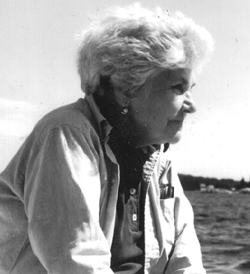
Biography
Elizabeth Bishop was born in Worcester, Massachusetts in 1911, but spent part of her childhood with her Canadian grandparents after her father's death and her mother's permanent hospitalization in a Nova Scotian sanitarium.
She attended two different boarding schools, the North Shore Country Day School in Swampscott, Massachusetts, and Walnut Hill School in Natick, Massachusetts, where she contributed to the school newspapers, The Owl and Blue Pencil, respectively.
Bishop graduated from Vassar College in 1934. In addition to working on the student newspaper, The Vassar Miscellany, she founded a literary magazine, Con Spirito, with fellow students Mary McCarthy, Eleanor Clark, and Muriel Rukeyser. It was as a Vassar student that Elizabeth Bishop met Marianne Moore. They first met in 1934 when Fanny Borden, the Vassar librarian, arranged an introduction, and their friendship continued until Moore's death in 1972.
Read the full biography
Elizabeth Bishop traveled extensively in Europe and lived in New York, Key West, Florida, and, for sixteen years, in Brazil. She taught briefly at the University of Washington, at Harvard for seven years, at New York University, and just prior to her death in 1979, at Massachusetts Institute of Technology.
Elizabeth Bishop won virtually every poetry prize in the country. Her first book, North & South, won the Houghton Mifflin Poetry Award for 1946. In 1955, she received the Pulitzer Prize for Poems: North & South -- A Cold Spring. Her next book of poetry, Questions of Travel (1965), won the National Book Award and was followed by The Complete Poems in 1969. Geography III (1976) received the National Book Critics Circle Award. In 1976, Bishop became both the first American and the first woman to win the Books Abroad/Neustadt Prize for Literature.
In addition, she translated a famous Brazilian diary, The Diary of Helena Morley; coedited and co-translated An Anthology of Contemporary Brazilian Poetry (1972); was a prolific contributor to The New Yorker; and was the recipient of two Guggenheim fellowships. She received honorary degrees from a number of universities, including Brown and Princeton, as well as from Smith and Amherst Colleges. Bishop was a chancellor of the Academy of American Poets, a member of the American Academy of Arts and Letters, and a consultant in poetry to the Library of Congress in 1949-50.
Bishop died on October 6, 1979. Posthumous works include The Complete Poems, 1927-1979 (1983) and The Collected Prose (1984).
Source: http://projects.vassar.edu/bishop/
On One Art
On Sestina
On Insomnia
On The Fish
On Sonnet (1928)
On Five Flights Up