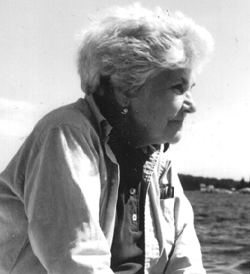
The poem
The art of losing isn't hard to master; so many things seem filled with the intent to be lost that their loss is no disaster.
Lose something every day. Accept the fluster of lost door keys, the hour badly spent. The art of losing isn't hard to master.
Then practice losing farther, losing faster: places, and names, and where it was you meant to travel. None of these will bring disaster.
I lost my mother's watch. And look! my last, or next-to-last, of three loved houses went. The art of losing isn't hard to master.
I lost two cities, lovely ones. And, vaster, some realms I owned, two rivers, a continent. I miss them, but it wasn't a disaster.
--Even losing you (the joking voice, a gesture I love) I shan't have lied. It's evident the art of losing's not too hard to master though it may look like (Write it!) like disaster.
this poem is really neat and I AM THE FIRST to comment
yay
ya it is very sweet like candy. yah
this is an incredibly insightful poem. It seems to not only be about loss but about writing itself facinating.
our class discussed this poem and came to the conclusion that she was talking about someone with alzeheimers and if you see the rhyme it goes slant, straight, slant, straight, just like the beginning stages of the disease you go in and out of it...maybe we're completely wrong or right on the dot..who knows???
Karan from Barbados, I totally agree with you on believing this poem is about someone with alzheimer's. It is obvious that the author believes that although losing little things isn't a disaster, when you lose something big like for instance your childrens' names, then you are experiencing a true disaster.
I really enjoyed this poem, but i do not believe that this poem is about a disease. Maybe i just need more explaination, but no matter how i look at it I don't see that. I think that although losing things may look like a problem, it is really not that big of a deal.
I think this poem is about getting used to loosing things including a loved one. If you are used to loosing things than maybe it wont be so hard when you loose something or someone special.
The theme in this poem is biographical. She had a life of loss and displacement. She lost her father before she was one, her mother was commited to an institution due to her mental instability, and her lover commited suicide. I really dont think it has anything to do with Alzheimer's. Almost all of her short stories and poems have been connected to her personal life. Her loses where things that she had no control over which is why it is not hard to master. It just happens.
I think "One Art" is actually about realizing that you actually don't own anything..don't control anything..not even your own life....So, when you lose something, the loss won't be so hard do deal if you are already prepared to it...
My teacher said "One Art" isn't about Alzheimers. I think it's about a deeper, broader subject.
Mindy from the United States hit it right on! If you have studied and reasearch Elizabeth Bishop's life you will find she experienced a temendous amount of loss from her father and mother, to her lover. She never seemed to have a home because of her travels, and she didn't have parents in her life. Most of her work is reflected in her experiences in her life. But not only is this poem about her losses in her life, I think it's about overcoming/"mastering" them. Bishop was a sucessful writer and recieved different awards for her works. And that my friends is what this poem is referring to I believe.
This villanelle by Bishop can be interpreted in many different ways through many different view points. What my thoughts about the poem is that I see a drying women looking back through her life and discribing the evens of her life and her last few moments left to live is fill with loses of memories of her life and the fact that her death coming to her.
I completly disagree with the notion that this poem is depicting alzheimers disease. The whole poem seems to be based on the idea of losing things- whether important or irrelevant. The author was trying to depict the possble reactions or feelings one can have to losing things during different stages of ones life, and how age and experiences can effect how they see the loss.
I believe you can't take this poem literally, as many commentators seem to be doing in their comments. See the last line of the poem with the comment "(write it!)"; she's figuratively gritting her teeth as she writes this. The point of the poem is the opposite of the simple interpretation - losing someone, or a part of your life, or a place you used to live is always terrible, and not made easier by practice.
It's true that loss sometimes is like disaster.However,when you look back to that tragedy,you will feel differently and more optimisticly.I know that well and I like this poem .
This poem was the poem of the day on the day before my son died. My 25 yr old son died on October 21,2004.The word disaster in the poem rings true, oh so true.
The poem “One Art” This lovely poem is written in a difficult form -the Villanelle. This poetic style is named for the French poet Francois Villon ([phone removed]). The construction of a villanelle is straightforward, however very hard to master in my opinion. It consists of five stanzas of three lines each. These five stanzas have the first and third lines rhyming (rhyme scheme A B A). A sixth and last stanza is…
Read the whole commentThe poem “One Art” This lovely poem is written in a difficult form -the Villanelle. This poetic style is named for the French poet Francois Villon ([phone removed]). The construction of a villanelle is straightforward, however very hard to master in my opinion. It consists of five stanzas of three lines each. These five stanzas have the first and third lines rhyming (rhyme scheme A B A). A sixth and last stanza is in the form of a quatrain with three out of the four lines rhyming (rhyme scheme A B A A). In addition to the specific rhyme scheme, the first and third lines alternately recur throughout the poem, and are repeated as the last two lines of the final quatrain.
The primary challenge of the villanelle is to continue to hold the reader's interest, even as you reuse the first and third lines from the originating stanza. Thinking up lines that can be used repeatedly without becoming boring or repetitive can be a challenge, so making them meaningful is a must. Also, reusing the lines demands that you find a array of words to rhyme with them - words that do not violate the meter of the verses, or strain the lines with too many or too few syllables.
Bishop begins with what seems to be, in effect, a 'handbook' on dealing with progressively greater losses. Initially the poem seems to be humorous, even as the losses become greater and greater. In the last stanza however, the cover of humor and exaggeration are dropped just enough to give us a glimpse of the speaker's true anguish, and the poem is revealed to be a love poem.
I agree with John from the United States. Re-read the last paragraph and note that she is forcing, literally forcing, herself to write that the loss of a loved one only looks like a disaster. She is forcing herself to write it in the desperate belief that once it is on paper, it might actually be true. That if it is written down to the contrary, she might lose some of the anguish and desperation that rings so clear in her poem. Re-examine the phrase "the art of losing isn't hard to master"; she is stating that the annoyance, the fluster, and at times the abosulute tradgedy of losing is something that occurs beyond your control, and you can only achieve the art of losing.
A poem is like a pact between reader and poet. There is the poem the writer thinks he/she wrote, and the poem the reader experiences or hears. Both the writer and reader brings personal experiences to the poem, and so the poem will never be the same for all readers, nor should it be. In its broadest sense, it is a poem about the difficulty of loss, but in its most specific sense it can be personalized by each…
Read the whole commentA poem is like a pact between reader and poet. There is the poem the writer thinks he/she wrote, and the poem the reader experiences or hears. Both the writer and reader brings personal experiences to the poem, and so the poem will never be the same for all readers, nor should it be. In its broadest sense, it is a poem about the difficulty of loss, but in its most specific sense it can be personalized by each reader. Having just lost my husband after 32 years of marriage, my understanding of the poem is that all the foregoing losses paled in signifcance to the loss of love. For someone who might have a loved one with Alzheimers, this poem could certainly relate to the loss of shared history and connection.
I abhor it when someone tells a person a poem can't mean what they felt. Sometimes we must ripen before we are ready for a poem. The same poem can mean something entirely different depending on where we are at that moement in time. When you are 19, The Love Song of J. Alred Prufrock will not have the same meaning as when you are 50.
Why can't a literary discussion of poetry allow all viewpoints, supported of course by which parts of the poem evoked those feelings?
I just love this poem....
I had never heard of Eliza Bishop until I saw the movie in her shoes with Cameron Diaz and Toni Collette where it is read in the movie and I loved it and had to come and find it here on line!
I just think that this poem can effect anyone that has lost something even if it is a person that we loved or such something that we owned and dealing with losing something is something that we all deal with everyday of our lives!!
"one art" reinforces the poem by that one art being love, and that love aka one art was the one thing that could bring disaster
Before seeing the movie, I had never heard of Ms. Bishop...nor had I ever thought of losing as art...wow. This work is important.
Mastering an art is a very hard thing to do, usually requires effort and years of practice and experience. What the writer is saying though, is a paradox: the "art of loosing" isn't hard to master. In other words, "losing is easy". You can lose things and not realise.. You might lose materialistic things, houses, rivers, continents even... It's easy to do, it's "not hard to master losing"... But when it comes to…
Read the whole commentMastering an art is a very hard thing to do, usually requires effort and years of practice and experience. What the writer is saying though, is a paradox: the "art of loosing" isn't hard to master. In other words, "losing is easy".
You can lose things and not realise.. You might lose materialistic things, houses, rivers, continents even... It's easy to do, it's "not hard to master losing"...
But when it comes to losing a beloved one... That's when although it's been so "easy" and out of one's control possibly (perhaps because one did not value enough what one had?) then, although this "art" is perhaps "mastered", one is no master... He's suffered a disaster!
So through the contrast of being a master, a master of losing (in general being a master would be considered a success, something to be proud of), this is actually so disastrous... Cause it's really hard to keep something valuable like love - although easy to lose...
the poet should have wished to master the art of losing, and successed in most of it, overcome the loss of so many things. now i wonder if she could have successed in mastering the art of losing love. the poem evokes huge grief she suffered from by losing it. she must have written the poem right in the middle of grief, with earnest desire to overcome it. the poet was tough cos she knew she was weak and struggled to get over the weakness.
Frankly I've never heard Ms. Elizabeth Bishop and her poem "One Art" before the film. It was really impressive to me when I've heard the poem in the film of "In her shoes". Today I watched the film, "In her shoes". And I got the name of the poet and poem. I checked in internet, and I got it. Thanks to the writer of the film that s/he brought this beatiful work to us. We lost my dad last year after twelve years of…
Read the whole commentFrankly I've never heard Ms. Elizabeth Bishop and her poem "One Art" before the film. It was really impressive to me when I've heard the poem in the film of "In her shoes". Today I watched the film, "In her shoes". And I got the name of the poet and poem. I checked in internet, and I got it. Thanks to the writer of the film that s/he brought this beatiful work to us. We lost my dad last year after twelve years of health battle. Losing a loved one is a disaster, true. The feelings change and transform, but it catches you up everyday. It is so in my case. This sense is with me until the very end. However, life goes on with or without us. As always, I know. I think and pray everyday for all we loved and for all we lost. Now I've got also Bishop's beatiful "One Art" in my hand. Really good work.
Bishop describes the exactly feeling that becomes when you loose someone you love, its so hard, but we have to go on, we have to look as we are ok, even when inside we are just crying... trying to think loose its easy.
Last Monday I went with my boyfriend to watch In her shoes. I have to say that I couldn't help crying while watching it!! But when Cameron started reading the poem I just loved it! Besides the setting she chose to read it (sitting on an old man's bed) was just perfect!, immediately I thought: "I must read it to my friends and family!" (of course I had to translate it, because my native language is Spanish)
Anyway, I loved it!!!!!!
Congratulations Elizabeth!!!!!
I saw that movie on a flight to Zyprus. When reading the story and the cast I did not expect more than just a diversion from my latent fear of flying. When getting into the story I really loved it. I have no sister but I liked the way the conflict was played in this movie. When Cameron reads that poem of Elizabeth Bishop I was so touched. I was on my way to my first vacation with my boyfriend and it is not too long…
Read the whole commentI saw that movie on a flight to Zyprus. When reading the story and the cast I did not expect more than just a diversion from my latent fear of flying. When getting into the story I really loved it. I have no sister but I liked the way the conflict was played in this movie. When Cameron reads that poem of Elizabeth Bishop I was so touched. I was on my way to my first vacation with my boyfriend and it is not too long ago that we both had big losts of beloved in our lifes. I instandly knew that when I will be on my PC I will look for this poem. Now I found it and I have to say that I am sorry for all the time I missed the work of Bishop and Cummings. Thanks to the author of the play to bring it to all of us!
i love one art in "in her shoes". it is an absolutely perfect moment while cam was sitting on an old mans bed. lizzie did a spectacularly awesome job!!!!!!!!! You go Girl!!!!!!
I found this poem in this site after watching In her shoes movie. a very impressive poem...it really caght me!!!Thank you Ms. Bishaop...just the art of losing beloved ones IS hard to master, not easy, but sometimes you must master it!
This poem was really nothing until almost half the female population saw the movie "In Her Shoes." Simply amazing. So few words with what seems so little meaning can really change the way you look at the world, and life. Who would have thought that there was so much to loosing. I've lost some loved ones along the way and I am truly glad that this poem was brought to my attention...it's helped me get through a lot in the past while. Thank you Ms. E Bishop, it is truly a sincere and wonderful poem.
I'm glad to hear that In her shoes at least serves one useful purpose (that of making Elizabeth Bishop's poetry known) I encourage you to read Marilyn Hacker's "From Orient point", a poetical response to "One art". The complementary focus offered by Hacker is always enriching (overall the way in which she points to life's ultimate and bare essentials: "trust your art")
Actually, the use of the poem in the film lessend its meaning for me. But anyway, this is one of my favorites. I love how she makes it somewhat trivial to loose things, and how the art of writing in comparison to the art of loosing is that through her writing she wishes to loose her emotion in it.
When I hear this peom, I feel I am lost, for my friends who are currently on another continent called Asia, and for my famliy, my grandma my litter brother and sister, my parents, I lost them even I've forgotten to call them for such a long time. Well, but I have them there in my heart, I know I love them and they are caring me even every second. That's life, it's always filled with lost and found. losing old stuffs and finding new ones. I lost two years time with them, but i found them've never gone, they are here, in my heart!
I thought the poem touched a bit upon the zen outlook of suffering. An attachment to anything caught in time results in suffering. The "art" would then be to bring yourslf closer to the unifying force or "god". Just an idea however.
I love this poem, she starts out talking about the keys and then moves on to what could be a lost love. elizabeth truely touches the depths of the human soul, we push everything that hurts or may hurt us away. instead of grieving and recovering we push away our loses and pretend they never existed.
When I last looked at it this website the poem was viewed some 37,000 times. I disagree with the statement "this poem was nothing until almost half the population" saw the movie and read it. This poem has always been and will always be remarkable.
It's not just a poem, it's a life story. This is easily noticable when you read through Elizabeth Bishop's biography. I was ignorant of it until today, and now I regret it. It was w sad life she had...
“One Art” is written in the repetitive structure of the villanelle to reinforce the habitual nature of the speaker’s losses. The effective repetitions of the villanelle also supports the perspective of the poem. Bishop reviews, or puts into perspective, a lifetime of losses. Some of the losses are minor - “the lost door keys, the hour badly spent”, the memories. Some of losses are major, like houses, cities and a…
Read the whole comment“One Art” is written in the repetitive structure of the villanelle to reinforce the habitual nature of the speaker’s losses. The effective repetitions of the villanelle also supports the perspective of the poem. Bishop reviews, or puts into perspective, a lifetime of losses. Some of the losses are minor - “the lost door keys, the hour badly spent”, the memories. Some of losses are major, like houses, cities and a loved one. In looking back at all these losses, Bishop emphasizes through repetition that none of them, in perspective, amounted to “disaster” -lines 3, 4, 12 and 19. To Bishop the “art of losing” – lines 1, 6, 12 and 17 – is natural for everyone because it is inherent in the nature of things and people that there is an “intent to be lost” – lines 2 and 3. The art of losing then is so natural for humans that it is not a hard one to “master” – lines 1, 6, 12 and 18.
The speaker’s attitude is one of acceptance despite the emotion and time wasted looking for what we have lost. Sometimes we spend so much time looking for lost items like “door keys” we get frustrated and it seems like a disaster at the time.
At the end of the poem Bishop has convinced herself that her repetitive losses can be survived. With their slight but suggestive variations, the repetitive descriptions of loss - and the realization that they are not disasters - become the method by which Bishop’s lesson can be passed through to us as well as to the speaker herself.
The formal structure of the villanelle actually increases the emotional tone of the poem and makes us understand the personal sense of loss that Bishop feels in writing this poem.
Finally, in “One Art” Bishop talks about the need to write about losses, demonstrating an understanding that writing puts these losses into perspective. This way, in recognizing our losses we can come to terms with them and prepare ourselves for the future losses that must naturally come.
this poem is a copy. rent the movie , "in her shoes". u will know what i am talking about.
I disagree wth peoples comments that this poem was nothing until the movie, it just gave a new audience a chance to make their own veiw of it. Does it matter where people find out new things as long as they find them??
The poem to me is one that shows how easy things are to lose, that no matter how much we pretend it doesnt matter. That despite that ease, if we care about it & even if we act like it doesnt, somewhere inside it will always be...a disaster.
"one art" is a beautiful poem.i love it because its meaning is so natural and pure.we all lose things or ppl we love in life ...and the worst part is that we cant change it nor can we control how things happen.
and then there comes a point wen weve lost so many times at the hands of life and fate that we get used to the pain.and its a "disaster" no more.it ceases to hurt where it used to bleed.
and so we realise, that the art of losing isnt so hard to master after all.tear!
The poem is profound. One can see the reminiscences of life's little losses. However, if one were to loose these things by design, by design to give up, these "losses" can help everybody to conquer material and physical bonds. Developing on this thread, the poem "if" by Rudyard Kipling describes how to give up things without ruminating.
Only Americans can write poetry! I like the plea to a greater stoicism implicit in the poem. It contradicts the modern derogatory connotation of "the loser". To be practiced in the art of losing is essential in life.
I never heard of this poem until I saw the movie in her shoes wl Cameron Diaz & Toni Collette. Now it's my favorite poem!!!!
I first came across this poignant poem in Melissa Bank's short story collection "The Girls' Guide to Hunting and Fishing." It went well with the theme of the book, and I've loved the poem and have been curious about Bishop ever since.
one art
at first this poem really meant nothing to me but as i read it,it really encouraged me not to lose hope even if lose something or someone important to me.
One Art
Poems like this one, often have a deeper meaning and can have an effect on the reader - making them feel a certain way. Although the poem can be expressed as though what’s written is factual, they are simply Elizabeth Bishop’s own thoughts on the genre of loss. I believe this poem is telling the reader that the art of losing is hard to deal with, though everyone is good at it. It’s easy to relate to because everyone…
Read the whole commentPoems like this one, often have a deeper meaning and can have an effect on the reader - making them feel a certain way. Although the poem can be expressed as though what’s written is factual, they are simply Elizabeth Bishop’s own thoughts on the genre of loss. I believe this poem is telling the reader that the art of losing is hard to deal with, though everyone is good at it. It’s easy to relate to because everyone has lost something whether it be a small, simple object or an important one. The writer is telling us it’s not such a disaster, and to just let it go. In the last line of the poem she says ‘(Write it!)’ I believe she added this to tell herself to write her emotions down. She has obviously lost someone close to her, it is evident in her last stanza. There is a deeper meaning to this poem. It’s not just the art of losing small things like her mother’s watch that matter so much, but the importance of losing someone and the comparison between them (which is seemingly what inspired her to write this). Elizabeth Bishop is admirable in writing this poem, putting on a ‘brave face’ and showing bluntly that the art of losing isn’t hard to master. As the poem progresses you can see how much she has lost.
Her poem begins in a blunt, factual way. Commencing with advice and what happens when you lose something. It ends powerfully and emotionally based on Elizabeth Bishop’s own experiences. The whole poem is a transformation from the mundane to emotional. The first stanza is blunt and direct, just telling the reader briefly what the poem is about, the art of losing. The second stanza is saying the art of losing is not a big deal and the small things like losing door keys and wasting time, is something you can put up with. The third stanza is becoming slightly more urgent as it describes the loss of more and more things. By the fourth stanza the poem is becoming melancholic. It is now listing the things lost. The second last stanza is telling the reader that even the dolefulness of losing two lovely cities, rivers and a continent can be put up with. She has experienced them all, but it’s not the worst yet. The last stanza is the worst she has had to deal with. It is serious and emotional, she has to face losing someone. The last line ‘Thought it may look like (Write it!) a disaster.’ is a bit incredulous because she has to tell herself it’s not a disaster, although it looks like it. Which is why she says ‘(Write it!)’ to convince herself.
One Art
One Art by Elizabeth Bishop is so much more than what it seems. To completely understand this poem, the reader has to read it a few times at least, and decipher the true meaning behind it. At first glance it seems to be just about losing things generally. However the poem is a whole process of a routine of losing things, to the emotional side of losing a loved one (personally to Elizabeth Bishop). Instead of this…
Read the whole commentOne Art by Elizabeth Bishop is so much more than what it seems. To completely understand this poem, the reader has to read it a few times at least, and decipher the true meaning behind it. At first glance it seems to be just about losing things generally. However the poem is a whole process of a routine of losing things, to the emotional side of losing a loved one (personally to Elizabeth Bishop). Instead of this poem just being about loss, it’s a transformation from the blunt and insignificant to the specific and sentimental. I believe this villanelle is sombre but it didn’t affect me personally. It can have a deep emotional effect on certain readers depending on their past. So many readers have different interpretations on this poem that it’s hard to know exactly what the writer was thinking of when she wrote One Art.