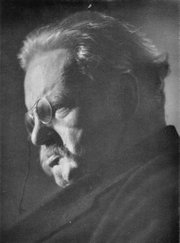
The poem
A Book of verses underneath the bough, Provided that the verses do not scan, A loaf of bread, a jug of wine and Thou, Short-haired, all angles, looking like a man.
But let the wine be unfermented, Pale, Of chemicals compounded, God knows how-- This were indeed the Prophet's Paradise, O Paradise were Wilderness enow.
The New Omar
This is one of Chesterton’s shorter poems; however it is much more difficult to understand. Once again, Chesterton uses the motif of bread and wine. This motif is usually Chesterton’s way of expressing Eucharistic devotion. In the poem he focuses on the concept of transubstantiation. He shows how difficult it is for the prophets and modern Christians alike, to even begin to understand this great miracle. The purpose of the poem is to show that to those with true faith, the Eucharistic banquet is a taste of paradise.
This is a parody
This is a parody of a verse from the Rubaiyat of Omar Khayaam (translated into English by Fizgerald) which was very famous in England at the start of the 20th century when Chesteron did most of his writing. The original verse goes "Here with a Book of verse beneath the Bough, A Jug of Wine, A Loaf of Bread—and Thou Beside me singing in the Wilderness— Oh, Wilderness were Paradise enow!" Chesterton used a parody of…
Read the whole commentThis is a parody of a verse from the Rubaiyat of Omar Khayaam (translated into English by Fizgerald) which was very famous in England at the start of the 20th century when Chesteron did most of his writing. The original verse goes
"Here with a Book of verse beneath the Bough,
A Jug of Wine, A Loaf of Bread—and Thou
Beside me singing in the Wilderness—
Oh, Wilderness were Paradise enow!"
Chesterton used a parody of this famous verse to attack modern fashions in verse ("does not scan") and clothes ("all angles looking like a man")
Chesterton was a fervent Catholic one of his most famous poems is about the Battler of Lepanto where the Turkish fleet was defeated by a catholic admiral - Don John of Austria. Lepanto can be found on this site and is a great poem if you love rythm and excitement.
Once you know it is a parody the meaning of the poem and its humourous intent become obvious.
Nick