The poem
Batter my heart, three-personed God; for you As yet but knock, breathe, shine, and seek to mend; That I may rise and stand, o'erthrow me, and bend Your force to break, blow, burn, and make me new. I, like an usurped town, to another due, Labor to admit you, but O, to no end; Reason, your viceroy in me, me should defend, but is captived, and proves weak or untrue. yet dearly I love you, and would be loved fain, But am betrothed unto your enemy. Divorce me, untie or break that knot again; Take me to you, imprison me, for I, Except you enthrall me, never shall be free, Nor even chaste, except you ravish me.
The person knows he is a sinner, knows he had sided with the devil – but now this person is willing to accept God’s punishment. He is praying/asking God (trinity) to abuse him, to do as he will with him.
look at the conceit in line 5. The speaker is comparing himself to an usurped town.
Also, Look at the oxymorons in this sonnet.
Line 4: Break me-Make me new.
Line 13: Enthrall me- Make me free.
Line 14: Caste-ravish.
Donne knew of the Ignatian Excercises and this poem is a colloquy
This is one of the great poems, I feel, of all time. But not because it is about punishing a sinner, as the other comments suggest. But because it opens to us the side of the Divine that is powerful in execution and accomplishment, even to the point of violence, and relates it absolutely directly--as we all know can happen in love--to the most intimate of all of the physical aspects of a human relationship, ecstatic consummation in sexual communion.
I consider Donne a great literary innovator of his age and the most remarkable representative of the METAPHYSICAL school. this poem deals with the poet's love of God through strikingly original images
My first read would have confirmed prior comments. Now, though, Donne is sarcastically mocking religious indocrination, perhaps hinting at his times. I find his interpretation to be humanistic and defiant of the supernatural. Screw this silent, hostile, Holy Master!
The poem Batter My Heart, Three-Personed God by John Donne is a prayer to God from the poet. The prayer is a desperate cry from a struggling sinner who wants God in his life and longs to be what God desires him to be. He seems to have tried everything and all of his efforts have failed. His prayer is that God would make this change a reality in him, even if it is difficult and painful. The poem sometimes uses…
Read the whole commentThe poem Batter My Heart, Three-Personed God by John Donne is a prayer to God from the poet. The prayer is a desperate cry from a struggling sinner who wants God in his life and longs to be what God desires him to be. He seems to have tried everything and all of his efforts have failed. His prayer is that God would make this change a reality in him, even if it is difficult and painful. The poem sometimes uses outlandish and violent imagery to convey the poet’s deep-felt desire and anguish.
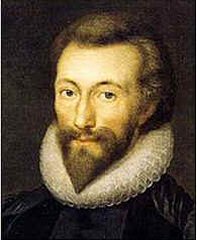
The poem’s theme is the poet’s relationship with God. By his use of the word “my” in the first line one can conclude that John Donne himself is the person praying. The content, structure, and figures of speech the poet uses in this poem work in harmony to reveal to the reader the depth and complexity of God, the poet, and the poet’s relationship with God. The content of this poem is a monologue, expressed as a prayer to God. The form of the poem is dramatic, but the poem moves forward through an expository structure.
The poem begins by telling us who Donne is praying to, and sets the emotional tone of his prayer. He refers to God as the “three-personed God,” an allusion to the Bible and its teaching of God as the Father, Son, and Holy Spirit. The Bible reveals God as a loving heavenly Father, reveals Jesus, God the Son, as a kind and good Shepherd, and reveals God the Holy Spirit as One called alongside to help us. His use of the word “batter” and his linking that word to God is an example of a hyperbole. He obviously does not want God to beat and abuse him, but rather Donne is using a word in an exaggerated way to convey his extreme desire to have God transform his life.
Donne lays out three quick images in line two which show what God is doing: God “knock(s)” on his door, “breathe(s)” on him, like in Genesis 3:3 where it says “God… breathed…the breath of life,” and “shine(s)” his penetrating light on him. In the third line of the poem we see that the goal of God’s work in Donne’s life is to “mend,” to “make…new,” and to cause him to “rise and stand” in his relationship with God. In line four we see a progression in the intensity of how the poet wants God to deal with him. He no longer wants God to “knock” on his door, but is now asking Him to “break” it down, not to simply “breathe” but to “blow,” and not to “shine” but to “burn.” Donne uses alliteration and a paradox here to help explain the way God works. By using three words with the same consonant, “break, blow, burn,” he draws attention to the severity of the words and their meanings. Donne uses a paradox when he says God will use these actions to “make me new.” How can someone break and burn a person and at the same time make him new? Donne’s three-personed God does this type of work.
In the middle six lines of the poem Donne explains his thoughts and feelings about his own spiritual condition and struggle. Donne wants God in his life, and he has strenuously thought through the situation and diligently worked toward this goal. In all his efforts to be what God wants him to be, Donne has failed. He is exasperated and overwhelmed.
In line six the poet relates how exhausted and frustrated he is. Donne struggles to let God in his life, but “Oh, to no end.”
In the next two lines the poet shows the reader how even his mind has failed him in his attempts to know and be close to God. Donne’s use of personification in lines seven and eight helps us to understand his discouragement that even his strengths, in this case his reason, fail him. His “reason” should be fighting for him in this battle and defending him, but instead is captured, shows weakness, and even lies to him.
Donne takes a pause in line nine to reflect on something good, his love for God and God’s love for him. Even though Donne’s spiritual condition is not what he would like it to be and his life is full of struggle, he tells God “yet, dearly I love you.” The poet has deep affection for God. He also wants to be loved by God.
After just praying that he loves God “dearly,” the poet returns to shocking imagery in line ten by saying he is engaged to the devil! Donne uses a paradox here by connecting the words “betrothed” and “enemy.” He is not actually, as God’s maiden, going to marry the devil, but he feels unwillingly more connected to God’s enemy and his ways than to God and God’s ways.
Staying with the image of a maiden and her lover, the poet now asks God to “divorce” him, to “untie or break” this marriage “knot” with the devil. The poet asks God to “imprison,” to “enthrall,” and to “ravish” him.
At the end of his prayer, Donne uses two paradoxes to explain to the reader how powerful and beyond understanding God’s ways of changing a man are. He asks God in line twelve and thirteen to “imprison” him in order to make him “free,” and in line fourteen to “ravish” him in order to make him pure. The imagery of being ravished by God has caused some to see this poem as being crude or profane.
However, it seems as though John Donne is simply using extreme, exaggerated, and even shocking language to convey the mystery, power, and intensity of this three-personed God and what it is like to have a relationship with him.
It seems after having read this poem that John Donne is simply explaining, albeit in somewhat blunt and even coarse language, his own relationship with God. He wants to be “free” from the devil, his sins, and all of his weaknesses. He has made every attempt on his own and failed. He knows that his own reason is too weak and that his heart needs help. He has come to the conclusion that he is sinful to the core and just as likely to marry the devil as to love God. He knows that unless God does a powerful work in his heart and life he will never change. However, if he allows this loving God to do whatever it takes, even if it means pain and the loss of his very freedom, he knows God can bring him into a close, loving relationship with Him and make him into the person he should be. So he can pray, “Batter my heart,” “break, blow, burn,” “imprison me,” “enthrall” and “ravish” me, for he knows God is a loving, pure, kind, and just “three-personed God” and he trusts Him with his very heart, soul, and life.
John Donne is opening his heart to God in prayer in this poem. He is being honest with the reality of his sinful heart and revealing the desperate struggle within him to love God, when all that comes naturally is to hate and despise the Triune God. It is a cry for the Trinity to change his sinful heart in the way only God can and in the way man will never be able to. It is beyond us.
i read this sonnet and hollow men by elliot at the same time when i was 13. i clung desperately to the sonnet, needless to say. i believe donne is a desperate man, filled with vanities, angers, remorse, pride, and righteous anger at institutional church fads all at the time. he is succumbing to and fighting against his own super knowledge that you must please God with Holiness, which is purely impossible. He is…
Read the whole commenti read this sonnet and hollow men by elliot at the same time when i was 13. i clung desperately to the sonnet, needless to say. i believe donne is a desperate man, filled with vanities, angers, remorse, pride, and righteous anger at institutional church fads all at the time. he is succumbing to and fighting against his own super knowledge that you must please God with Holiness, which is purely impossible. He is driven mad that only a dichotomy is left for him, thus all of the zepelin phrases. It is an excellent sonnet, because it reflects what we do when we don't realise just how god-damn much God really loves us.
I believe, though, this sonnet is more of a discussion within his head, than with God--it is one sided. I believe that at the first word "Batter..." God would be saying "shhh...child, you don't have to work so hard." But I am still glad Donne didn't let a word in edgewise. The sonnet has saved my ass many times, even tho i believe in a less harsh God.
with love,lovingly: rams/ and yes i have lived this poem to every splintered bone. "...tho Thou slay me/i will still love Thee..."
i must say that i'm impressed with your interpretation Scanlon from United States! Good writing for good reading- ha. any way your insights are truly helpful for everything from understanding this sonnet to the actual meaning behind all the symbols and words! Again Wow, and good interpretation.
This is a beautiul portrait of mankinds relationship with god. For we are forever attempting to reach god yet consistently failing. This is a poem about much more than simply one man and his god, it is about all men and all gods. Human nature is irrevocably flawed yet we are forever trying to acheive a holiness that our very nature rails agaisnt.
All the comments are very knowledgable and clever. Mine is purely based on feelings.
This poem is about a passionate relationship between John Donne and God . Donne, a man who has come to know the Father the Son and the Holy Spirit. As you read you want to know that same relationship yourself. A very exciting poen!
John Donne is a great Metaphyical poet who uses great skills in combining the physical things with that of the spiritual(divinely)through the use of image,a unification of disparate ideas.
Donne's "Batter my Heart" is one of the greatest poem ever recorded in history to use paradox as a metaphysical coceit, of asking for holy salvation from his God through harsh contradiction of war-like imageries.
Explanation
How do you all explain the transferrence from the formal, capitalized You to the less formal lowercase you halfway through the poem? Is it possible he is referring to reason towards the end?
analysis
Batter my heart three person God by John Donne
comment on Batter My Heart
The analysis is really good to read.This is the first time I am reading this poem I was in a mess actually but after reading your comment I am alright with the poem. I can even suggest my students to read this thank you very much