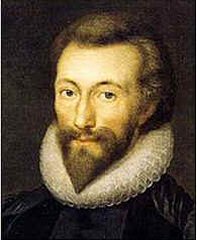
Biography
John Donne (pronounced "Dun"; 1572 - March 31, 1631) was a major English poet and writer, and probably the greatest of the metaphysical poets. His works include love poetry, sermons and religious poems, latin translations, epigrams, elegies, songs and sonnets.
Donne was born and raised in a Roman Catholic family. Two of Donne's relatives had been punished for their Catholicism; his brother had died of a fever in prison after harboring a priest, and an uncle, a Jesuit, executed by being hanged, drawn, and quartered. Queen Elizabeth's government, though by contemporary standards tolerant, still uniformly burdened Catholics with harassment and financial penalties.
Donne was educated at both Oxford (Hertford College) and Cambridge. As a young man he travelled on the Continent and in 1596-1597 accompanied the Earl of Essex on his expeditions to Cádiz and the Azores. On his return he became secretary to Baron Ellesmere and began to achieve a reputation as a poet. His writings of this period include many of his songs and sonnets, and they are notable for their realistic and sensual style. Donne also composed many satirical verses that betrayed a searching and sometimes caustic outlook.
Read the full biography
The account of Donne's life in the 1590s that comes down to us through Donne's own poems and an early biographer, Izaak Walton, gives us a picture of a young rake. Scholars believe this picture almost certainly misleading, since the account was given by the older Donne, after he had been ordained; he may have wanted to separate, more cleanly than was possible, the younger man-about-town from the older clergyman. Walton tells us that Donne, after making a diligent study of theology, converted to Anglicanism at some point in the 1590s.
After taking part in Essex's military expeditions in 1596-7, he became secretary to Sir Thomas Egerton, a prominent member of the royal court, but he fell in love with Egerton's niece, Anne More, and secretly married her. When More's father found out, he used his influence to get Donne and two of his friends, one who presided over the wedding, another who witnessed it, imprisoned, albeit briefly. Egerton fired Donne.
It was around this time that the two "Anniversaries," An Anatomy of the World (1611) and Of the Progress of the Soul (1612) were written; they reveal that his faith in the medieval order of things had been disrupted by the growing political, scientific, and philosophic doubt of the times.
When released from prison, Donne, reunited with his bride, settled on land owned by More's cousin in Surrey. The couple struggled with their finances until 1609, at which point Donne and his father-in-law reconciled and Donne finally received his wife's dowry. This must have been helpful, since, as Walton tells us, Anne "had yearly a child." His growing family prompted him to seek the favors of the King, and in 1610 and 1611, he wrote two anti-Catholic polemics. One of them was the Galileo. King James was pleased with Donne's work, but refused to offer him anything but ecclesiastical preferments. Donne resisted taking holy orders. After a long period of financial uncertainty and esperation, though, during which he was twice a member of Parliament (1601, 1614), Donne heeded the King's wishes and was ordained in 1615. With the death of his wife in 1617 the tone of his poetry deepened, particularly in the "Holy Sonnets".
After his ordination, Donne wrote a number of religious works, such as his Devotions (1624) and various sermons. Several of these sermons were published during his lifetime. Donne was also regarded as one of the most eloquent preachers of his day. In 1621, Donne was made dean of St. Paul's, a position he held until his death.
The story of Donne's death, as Walton tells it, at least is justly well known. Suffering through the illness that would kill him only days later, in front of an audience many of whom, according to Walton, said that Donne seemed to be preaching his own funeral sermon, he gave an address called Death's Duel, one of the high points of seventeenth-century English prose. "We have a winding sheet in our mother's womb," he told his listeners, "which grows with us from our conception, and we come into the world wound up in that winding sheet, for we come to seek a grave." He then retired to his quarters, and had a portrait made of himself in his funeral shroud. This portrait he placed near his bedside, where he meditated on it until his death.
No man is an island, entire of itself; every man is a piece of the continent, a part of the main. If a clod be washed away by the sea, Europe is the less, as well as if a promontory were, as well as if a manor of thy friend's or of thine own were. Any man's death diminishes me because I am involved in mankind; and therefore never send to know for whom the bell tolls; it tolls for thee.
from "Meditation XVII"
This article is licensed under the GNU Free Documentation License and uses material adapted in whole or in part from the Wikipedia article on John Donne.
On Holy Sonnet XIV: Batter My Heart, Three-Personed God
On The Good-Morrow
On The Indifferent
On The Flea
On For Whom The Bell Tolls
On Holy Sonnet X: Death Be Not Proud