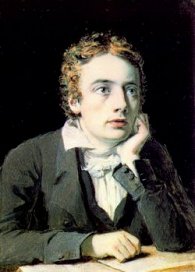
The poem
When I have fears that I may cease to be Before my pen has glean'd my teeming brain, Before high-piled books, in charactery, Hold like rich garners the full ripen'd grain; When I behold, upon the night's starr'd face, Huge cloudy symbols of a high romance, And think that I may never live to trace Their shadows, with the magic hand of chance; And when I feel, fair creature of an hour, That I shall never look upon thee more, Never have relish in the faery power Of unreflecting love;--then on the shore Of the wide world I stand alone, and think Till love and fame to nothingness do sink.
to fully understand the poem it is essential that we understand the circumstances the poet was in during that period .here was a young man in love and far from his love ,aware of of his impending death ,and yet finding the courage and conviction to write this most defiant of poems on death and love .the trade mark rich sensuous imagery so typicalof keats is on full display.
The wholeethos of Keats is is love of beauty and sorrow at beauty passing: "Then glut thy sorrow on a morning rose..." In this sonnet he expresses concisely, and with a beauty of language which is so typical of all his work, his fears that he will achieve all he wishes. The will not have time to pen all his thoughts, to acquire the knowledge in the "high piled" books, to fulfil his dream of love and even that he will lose the tranisstory pleasure he finds in beauty of all sorts. But surely the ending is the summation of the sonnet - laying his fears to rest as he percieves himself as "nothing" in the vast scheme of things?
John Keats composed this poem on January 31, in1818, it is one of his the most beautiful sonnets. He in this poem describes the insignificance of love, fame and other ideals. He fears before death that he will die prior to the realisation of the motive behind his poetry. He will no more see the face of his beloved. Love and fame appear to him vain and every worldly thing loses its charm. John Keats, the poet in this…
Read the whole commentJohn Keats composed this poem on January 31, in1818, it is one of his the most beautiful sonnets. He in this poem describes the insignificance of love, fame and other ideals. He fears before death that he will die prior to the realisation of the motive behind his poetry. He will no more see the face of his beloved. Love and fame appear to him vain and every worldly thing loses its charm. John Keats, the poet in this beautiful sonnet anticipates his death and apprehends different fears. He might have written this sonnet anticipating that he might die at any moment as he died of consumption at the early age of twenty-six when he had sublime and dignified ideals in front of him to be achieved. That is why he fears that he might die before the realisation of his ideals. His apprehension of death may have deprived him of the joy of looking at his beloved’s charming face. When death encroaches quite near, he realises the nothingness of love and fame. No doubt death is the time of sleep but it awakens the poet and he is revealed that fame, love and wealth which had been the centre of his activities in fact are nothing and nothing will sink into nothingness. He feels repentance that he neglected death which is the ultimate reality.
One must keep in his mind that the poet is not merely afraid of death, but his is afraid of death before the expression of his teeming brain, he is afraid because he finds himself standing on the shore of the world all alone, unaccompanied, without love and fame. Death without any achievement makes him worried, he knows that sooner or later he has to crease but before his death he wants to capture the beauties of night starred face, and huge floating clouds of sublime romantic thoughts. He finds the whole universe in front of him as a field of full-ripened grain; he is merely afraid of death before collecting and gathering the harvest and saving it in the bins to be relished by the coming generation. The poet is willing to die; he prefers death to life where love is unreflecting, he only loves objects of permanence. He is revealed while standing alone on the shore of the world that love and fame which are pursued blindly by Man or in fact to sink into the ocean of nothingness. The poet is of the opinion that permanence can only be achieved in the form of gleaning sublime romantic thoughts, creating things of beauty, pouring out the teeming brain. Keats' poetry was mainly concerned with beauty, love, romance and fame. This sonnet contains all these elements. All his life he cherished in his mind the idea of beauty, according to him “a thing of beauty is a joy for ever.” Despite praising and enjoying beauty he led a dejected and melancholy life. He feared that he might miss the beauty of his thoughts, of romantic ideas, in case death approaches him untimely. He demands a span of time enough to harvest and collect the scattered grain of poetic lofty ideals and then wishes to die in contentment after fulfilment of his mission.
Keats narrative sonnet is a masterful reminder of life's fragility. The reader is allowed insight to his youth and quandry within about life soon to end. He exposes his fear of incompletion in a mind he has only gleaned the surface of. Published works "garner (stand high) the full ripen'd grain" as these works are editions composed by those who've benefitted from establishing their characters and fulfilling a long,…
Read the whole commentKeats narrative sonnet is a masterful reminder of life's fragility. The reader is allowed insight to his youth and quandry within about life soon to end. He exposes his fear of incompletion in a mind he has only gleaned the surface of. Published works "garner (stand high) the full ripen'd grain" as these works are editions composed by those who've benefitted from establishing their characters and fulfilling a long, rich life unlike his own threatened life. The following lines infer sleepless nights with thoughts of love and companionship as revealed in the next line when considering opportunity as: 'the magic hand of chance'- is lost without reminders/memories as in: shadows.
His love deeply professed, 'fair creature of an hour', is brief for his circumstance is impending. His love is deep enough to wish/want for reflecting/lasting/lifelong love, but where he stands, he stands alone. In that moment of fallibility, he ponders what, if anything, has he left behind?
In the moment, as he stood and thought about his life ending, he thought for us all. In so doing, he did not die in vain, but lives on in the veins of the poet.
I have to do this poem for research for a teacher and it's really hard because it's so short and I have to write 1000 words on it.
i really need help on this poem b/c i have to do a research paper. and i dont know how to start it off.please help me
seriously, just think about that first line... When I have Fears That I May Cease to Be.... how powerful is that? John Keats is my favorite poet by far.
WHAT SOLUTION DOES KEATS EXPRESS IN THE COUPLET AT THE END? IS IT SATISFACTORY?
A lot of people have good interpretations, but just to be clear:
Keats was entirely unaware of his impending death when he wrote this. He was young, seemingly healthy, and far from the pale frailty most people ascribe to him, he was small and stocky - being known as a tough fistfighter in his youth. The literary themes of impermenance are there, of course, but its not as easy at is seems to make the biographical connection. Just sayin'