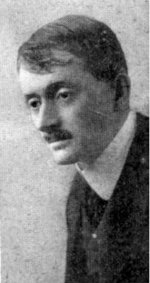
The poem
Out of the earth to rest or range Perpetual in perpetual change, The unknown passing through the strange.
Water and saltness held together To tread the dust and stand the weather, And plough the field and stretch the tether,
To pass the wine-cup and be witty, Water the sands and build the city, Slaughter like devils and have pity,
Be red with rage and pale with lust, Make beauty come, make peace, make trust, Water and saltness mixed with dust;
Drive over earth, swim under sea, Fly in the eagle's secrecy, Guess where the hidden comets be;
Know all the deathy seeds that still Queen Helen's beauty, Caesar's will, And slay them even as they kill;
Fashion an altar for a rood, Defile a continent with blood, And watch a brother starve for food:
Love like a madman, shaking, blind, Till self is burnt into a kind Possession of another mind;
Brood upon beauty, till the grace Of beauty with the holy face Brings peace into the bitter place;
Prove in the lifeless granites, scan The stars for hope, for guide, for plan; Live as a woman or a man;
Fasten to lover or to friend, Until the heart break at the end: The break of death that cannot mend;
Then to lie useless, helpless, still, Down in the earth, in dark, to fill The roots of grass or daffodil.
Down in the earth, in dark, alone, A mockery of the ghost in bone, The strangeness, passing the unknown.
Time will go by, that outlasts clocks, Dawn in the thorps will rouse the cocks, Sunset be glory on the rocks:
But it, the thing, will never heed Even the rootling from the seed Thrusting to suck it for its need.
Since moons decay and suns decline, How else should end this life of mine? Water and saltness are not wine.
But in the darkest hour of night, When even the foxes peer for sight, The byre-cock crows; he feels the light.
So, in this water mixed with dust, The byre-cock spirit crows from trust That death will change because it must;
For all things change, the darkness changes, The wandering spirits change their ranges, The corn is gathered to the granges.
The corn is sown again, it grows; The stars burn out, the darkness goes; The rhythms change, they do not close.
They change, and we, who pass like foam, Like dust blown through the streets of Rome, Change ever, too; we have no home,
Only a beauty, only a power, Sad in the fruit, bright in the flower, Endlessly erring for its hour,
But gathering, as we stray, a sense Of Life, so lovely and intense, It lingers when we wander hence,
That those who follow feel behind Their backs, when all before is blind, Our joy, a rampart to the mind.
This is a beautiful poem the first stanza of which has been in my thoughts for over 50 years. It is a brilliant summation of the nameless feeling that arises when we contemplate Life and Infinity. Indeed "Passing Strange" as Masefield so aptly writes.
It benefits us to contemplate that which cannot be grasped by the finite thinking mind. (For example try to picture "nothing". Every attempt is a "something")
Masefield, in eloquent language, has given us not only a beautiful description of this state of mind that occurs when facing the deep mystery of life, but his poem, at 3am, will propel an open reader into a state of wonder.
An admirable accomplishment for any poet.
Sam
The Passing Strange
I discovered John Masefield's "The Passing Strange" at age 10 and now, at 74, lines like "the rhythms change, they do not close" still haunt me and I still have most of it memorized. The poem expresses my inexpressible religious beliefs--Evolutionary Panentheism, or Process Theology--which philisohopers like Whitehead and Hartshorne have difficulty putting into prose. I wonder if the poem steered me to believe in…
Read the whole commentI discovered John Masefield's "The Passing Strange" at age 10 and now, at 74, lines like "the rhythms change, they do not close" still haunt me and I still have most of it memorized. The poem expresses my inexpressible religious beliefs--Evolutionary Panentheism, or Process Theology--which philisohopers like Whitehead and Hartshorne have difficulty putting into prose. I wonder if the poem steered me to believe in the evolutionary process as the creative source of all being, my definition of God? This was certainly the first great poem I'd ever read--vastly beyond the simplified schoolbook verses we were given. I still wonder why they gave us Emerson's "Concord Hymn" and Whitman's "O Captain! My Captain!", two fine poets' worst poems, when we could have been given their best: "Hamatreya" and "When Lilacs Last. . ." or even "Song of Myself" if it could have passed the censors. I did not UNDERSTAND "The Passing Strange" rationally, and in the poems I've written from age 11 onward and the ones I love to read I've concluded that great poetry shouldn't be understood, certainly not "analyzed". It should enter us more like music than prose. The emotional impact should outdistance the rational, as does "The Passing Strange," which is why the slightly mad Christopher Smart and William Blake remain my favorite Enlightenment poets, not Alexander Pope. Masefield got my literary taste off to a good early start.