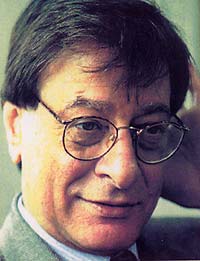
The poem
I come from there and I have memories Born as mortals are, I have a mother And a house with many windows, I have brothers, friends, And a prison cell with a cold window. Mine is the wave, snatched by sea-gulls, I have my own view, And an extra blade of grass. Mine is the moon at the far edge of the words, And the bounty of birds, And the immortal olive tree. I walked this land before the swords Turned its living body into a laden table.
I come from there. I render the sky unto her mother When the sky weeps for her mother. And I weep to make myself known To a returning cloud. I learnt all the words worthy of the court of blood So that I could break the rule. I learnt all the words and broke them up To make a single word: Homeland.....
yes austaz Darwish we are all came from there and remmeber.
A Soldier Dreams Of White Lilies By Mahmoud Darwish Interpreted by Torre DeVito He dreams Of white lilies, An olive branch, And her breasts In evening blossom. He dreams of a bird, He tells me, And of lemon flowers. He does not intellectualize About his dream. He understands things Only as far as he Senses and smells them. He tells me: "For me, my country is this: Drinking my mother's coffee, And coming home safely…
Read the whole commentA Soldier Dreams Of White Lilies
By Mahmoud Darwish
Interpreted by Torre DeVito
He dreams
Of white lilies,
An olive branch,
And her breasts
In evening blossom.
He dreams of a bird,
He tells me,
And of lemon flowers.
He does not intellectualize
About his dream.
He understands things
Only as far as he
Senses and smells them.
He tells me:
"For me, my country is this:
Drinking my mother's coffee,
And coming home safely at dusk."
"And your homeland?"
"I don't know a homeland," he said.
"I don't feel it in my flesh and blood,
The way they describe in the poems."
Suddenly I saw the land through his eyes
As one might see a grocery store,
a street, or a newspaper.
"But don't you love your homeland?"
I ask him.
"My love is a picnic," he said,
A glass of wine, a love affair."
"Would you die for your country?"
"No!
All my attachment to my country
is no more than a story
or a fiery speech!
They taught me to love it,
But I never felt it in my heart.
I never knew its roots and branches,
Or the scent of its grass."
"But what about patriotism?
Doesn't it burn in you like suns and desire?"
He looked straight at me and said:
"I love my country with my gun,
Not by unearthing feasts
In the garbage of the past.
Patriotism is a deaf-mute idol,
Whose age and meaning
Are unknown."
He told me about leaving for the war,
How his mother silently wept when they
Led him to the front,
How her anguished voice gave birth
To a new hope in his flesh:
That doves might flock
Through the Ministry of War.
He drew on his cigarette
And said, as if fleeing
From a swamp of blood:
"I dreamt of white lilies,
An olive branch,
A bird embracing
The dawn in a lemon tree."
"But what did you see?"
"I saw what I did:
Not an olive branch, but
A blood-red boxthorn.
I blasted men in the sand....
In their chests....
In their bellies."
"How many did you kill?"
"It's impossible to tell.
I only got one medal."
Pained, I asked him to
Tell me about one of the dead.
He shifted in his seat,
Fiddled with the newspaper,
and then said, as if chanting:
"He collapsed like a tent on stones,
Embracing shattered planets.
His high forehead was crowned with blood.
His chest was empty of medals.
He was not a well-trained fighter,
But seemed instead to be a peasant -
A worker, or a peddler.
Like a tent he collapsed and died,
His arms stretched out
Like dry creek-beds.
When I searched his pockets
For a name, I found two photographs,
One of his wife, the other of his daughter."
"Did you feel remorse?" I asked.
Cutting me off, he said,
"Mahmoud, my friend, remorse is a white bird
That does not come near a battlefield.
For a soldier, remorse is a sin.
In that place, I was like a machine:
Spitting hellfire and death,
And turning space into a black bird.
He told me about his first love,
and later, about distant streets,
about reactions to the war in the
radio and the press.
As he hid a cough in his handkerchief
I asked him: "Shall we meet again?"
"Yes, but in a city far away."
When I filled his fourth glass,
I asked jokingly:
"Are you leaving? What about war and victory?"
"Give me a break," he replied.
"I dream of white lilies,
Streets of song,
A house of light.
I need a kind heart,
Not a bullet.
I need a bright day,
Not a mad, fascist
Moment of triumph.
I need a child to cherish,
A day of laughter,
Not a weapon of war.
I came to live for rising suns,
Not to witness their setting."
He said goodbye
And went looking
For white lilies,
And a bird
Welcoming the dawn
On an olive branch.
He understands things
Only as far as he senses
And smells them. "For me," he said,
"My country is To drink my mother's coffee,
Or to return to my home safely, at dusk."