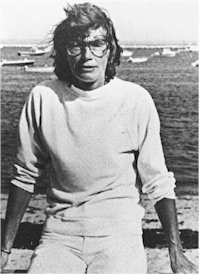
The poem
When death comes like the hungry bear in autumn; when death comes and takes all the bright coins from his purse
to buy me, and snaps the purse shut; when death comes like the measle-pox
when death comes like an iceberg between the shoulder blades,
I want to step through the door full of curiosity, wondering: what is it going to be like, that cottage of darkness?
And therefore I look upon everything as a brotherhood and a sisterhood, and I look upon time as no more than an idea, and I consider eternity as another possibility,
and I think of each life as a flower, as common as a field daisy, and as singular,
and each name a comfortable music in the mouth, tending, as all music does, toward silence,
and each body a lion of courage, and something precious to the earth.
When it's over, I want to say all my life I was a bride married to amazement. I was the bridegroom, taking the world into my arms.
When it's over, I don't want to wonder if I have made of my life something particular, and real.
I don't want to find myself sighing and frightened, or full of argument.
I don't want to end up simply having visited this world.
A very moving poem, even though I found the last line somewhat jarring. After shedding or dismissing all the trivialities of life, she ends with the rather pedestrian, "I don't want to end up having simply visited this world." It's a common sentiment to be sure, but it neither flows from the preceding verses nor is expressed in a very poetic way. Except for what I feel is a flat-footed ending, it's a brilliant poem. Do you disagree?
We used this poem today in a professional development session for teachers. We found the quality of the poem to be excellent and a great example of the use of similes. Although the subject matter is a little jarring, we thought it fit in well with other literary pieces we have read, especially "5 People You meet In Heaven", which had been shown as a t.v. movie the night before. Congratulations, Ms. Oliver!!!!
Yes, a brilliant stirring poem and I agree ( it feels so sacriligious) that the last line does not serve the effort. But is is only a minor flaw in an otherwise perfect diamond.
Yes, the ending leaves one hanging, (as does Death, so it seems) But I love this poem for these two lines especially:
When it's over, I don't want to wonder
if I have made of my life something particular, and real.
How much time we waste trying to Be Something, Do Something, and miss out on Living. What she wants is to live Her life fully,embracing it as a bridegroom!
This poem is by far touching. It really hit home. My step son's grandfather passed away a year ago today. This poem really express how death feels when you loose a loved one.
Violet
To make life meaningful - the poem touches on life and death in the tone of the last line, while unbreaking the heart and delivering the soul.
The last line does leave the reader feeling that the poem is somewhat unfinished but maybe that's the intention. The line could almost have been punctuated with a question mark. Maybe it's up to the individual to add a line expressing what they want out of this life and this world?
I know it was jarring, but isn't the very truth of our souls always that way. Sometimes we write a beautiful poem not just for its beauty but for its acceptance, and applause, which I gladdly give. I am christian, lets jut get that out of the way. But even the most humble of all christians stumbles, questions, and whos heart sometimes skips a beat. We are all doubting thomas at least for a fraction of a second. Ps. I am illiterate, but I do know something of feelings
This poem is unbelievably moving. Everytime I read it, I can't stop the tears from running down my face. Earlier this year I lost someone very close to my heart and struggled greatly to deal with my loss. This poem comforts me as I fear death, not of myself, but of everyone whom I love. I love the lines "and I look upon time as no more than an idea,
and I consider eternity as another possibility," as they give me the hope of something better after this life, for all my loved ones who deserve better...x
Wow. This poem is horrible. The poet uses boring, cliched adjectives and never reaches a point. Is it a stroy? What she's thinking about? A bunch of random statements about death? I don't know. She seems to change her standpoint on death too. I'd say this creatively challenged poet was in it for the money but I can't see a poet making a lot of money.
In Mary Oliver poems there are always questions (sans punctuation marks). This is an important part of the pleasure in reading her work. The questions are private, personal, and little surprises that awaken your imagination. Rewarding and thoughtful.
This is a poem that does throw the reader. The images at the beginning seem not to connect, with the strongest lines of her wonderment of going through the doors of death. However, the lines and images do all work together. Death is never an easy subject, especially if there has been a recent departing in one's circle of friends or family. Poets take on the challenge of giving a framework of emotions that help heal--or to at least to ponder.
I would encourage everyone not to rush through this poem, but try to join the poet as she weaves her journey to the unknown. You may also want to read Langston Hughes' "Dear Lovely Death". It is a poem that I find myself reading many times.
Oliver suggests that eternity is not a place like heaven but a state of consciousness that is so mysterious that our brains cannot comprehend it and our words cannot describe it. Modern theologies (which aren't actually modern at all, seeing as how mostly they haven't changed for the last 2000 years) claim to have all the answers. I love Mary Oliver because she doesn't need the answers. She celebrates the mystery.…
Read the whole commentOliver suggests that eternity is not a place like heaven but a state of consciousness that is so mysterious that our brains cannot comprehend it and our words cannot describe it.
Modern theologies (which aren't actually modern at all, seeing as how mostly they haven't changed for the last 2000 years) claim to have all the answers. I love Mary Oliver because she doesn't need the answers. She celebrates the mystery.
Oliver's poem does not seek to tell us that our uniqueness makes us special, but rather that it renders us common. In other words, we are unique just like everyone else. The world might be a better place if we all took a page from Oliver's book. We'd suffer a lot less from self-importance, righteous indignation, and the insane idea that we have it all figured out.
I ♥ this Poem Ay