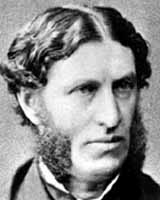
The poem
Light flows our war of mocking words, and yet, Behold, with tears mine eyes are wet! I feel a nameless sadness o'er me roll. Yes, yes, we know that we can jest, We know, we know that we can smile! But there's a something in this breast, To which thy light words bring no rest, And thy gay smiles no anodyne. Give me thy hand, and hush awhile, And turn those limpid eyes on mine, And let me read there, love! thy inmost soul.
Alas! is even love too weak To unlock the heart, and let it speak? Are even lovers powerless to reveal To one another what indeed they feel? I knew the mass of men conceal'd Their thoughts, for fear that if reveal'd They would by other men be met With blank indifference, or with blame reproved; I knew they lived and moved Trick'd in disguises, alien to the rest Of men, and alien to themselves--and yet The same heart beats in every human breast!
But we, my love!--doth a like spell benumb Our hearts, our voices?--must we too be dumb?
Ah! well for us, if even we, Even for a moment, can get free Our heart, and have our lips unchain'd; For that which seals them hath been deep-ordain'd!
Fate, which foresaw How frivolous a baby man would be-- By what distractions he would be possess'd, How he would pour himself in every strife, And well-nigh change his own identity-- That it might keep from his capricious play His genuine self, and force him to obey Even in his own despite his being's law, Bade through the deep recesses of our breast The unregarded river of our life Pursue with indiscernible flow its way; And that we should not see The buried stream, and seem to be Eddying at large in blind uncertainty, Though driving on with it eternally.
But often, in the world's most crowded streets, But often, in the din of strife, There rises an unspeakable desire After the knowledge of our buried life; A thirst to spend our fire and restless force In tracking out our true, original course; A longing to inquire Into the mystery of this heart which beats So wild, so deep in us--to know Whence our lives come and where they go. And many a man in his own breast then delves, But deep enough, alas! none ever mines. And we have been on many thousand lines, And we have shown, on each, spirit and power; But hardly have we, for one little hour, Been on our own line, have we been ourselves-- Hardly had skill to utter one of all The nameless feelings that course through our breast, But they course on for ever unexpress'd. And long we try in vain to speak and act Our hidden self, and what we say and do Is eloquent, is well--but 't#is not true! And then we will no more be rack'd With inward striving, and demand Of all the thousand nothings of the hour Their stupefying power; Ah yes, and they benumb us at our call! Yet still, from time to time, vague and forlorn, From the soul's subterranean depth upborne As from an infinitely distant land, Come airs, and floating echoes, and convey A melancholy into all our day. Only--but this is rare-- When a belov{'e}d hand is laid in ours, When, jaded with the rush and glare Of the interminable hours, Our eyes can in another's eyes read clear, When our world-deafen'd ear Is by the tones of a loved voice caress'd-- A bolt is shot back somewhere in our breast, And a lost pulse of feeling stirs again. The eye sinks inward, and the heart lies plain, And what we mean, we say, and what we would, we know. A man becomes aware of his life's flow, And hears its winding murmur; and he sees The meadows where it glides, the sun, the breeze.
And there arrives a lull in the hot race Wherein he doth for ever chase That flying and elusive shadow, rest. An air of coolness plays upon his face, And an unwonted calm pervades his breast. And then he thinks he knows The hills where his life rose, And the sea where it goes.
Dear Professor, I am a student of English Literature, and I have written this piece on a poem by Matthew Arnold : 'The Buried Life'. Could you please give me your opinions about it? It`s as follows: I have chosen The Buried Life by Matthew Arnold, because of its philosophical tune and the optimistic ending of it, something unlike a typical Arnold poem. In the opening, the speaker is aware of a something in his…
Read the whole commentDear Professor,
I am a student of English Literature, and I have written this piece
on a poem by Matthew Arnold : 'The Buried Life'. Could you please give
me your opinions about it?
It`s as follows:
I have chosen The Buried Life by Matthew Arnold, because of its
philosophical tune and the optimistic ending of it, something unlike a
typical Arnold poem.
In the opening, the speaker is aware of a something in his saddened
breast that even his loved one's gay smiles are no anodyne. He then
addresses his beloved, asking fervently to let him read her inmost soul.
He complains of the human heart. That even Love is incapable to
reveal people's hearts to each other; that they conceal their feelings and
thoughts lest they would be ignored or blamed by others. So everyone
lives behind a disguise and hides oneself there.
In that moment, he invites both himself and the loved one to exempt
of them and not let the spell benumb their hearts and make them dumb,
instead have their lips unchained.
Every Man keeps his genius self from his capricious play in this
distracted world. Man's life is resembled to a river that flows
indiscernibly in the heart. We move not seeing the stream in our hearts, even
though driving on it eternally. But in the whips and scorns of time, we
tenderly desire into our beating hearts, our original course- whence our
life comes and where it goes. Though never do we practice it deep
enough.
We have been on many tracks and never on our own line, never have
been ourselves and if we try, unable we are to express the nameless¹
feelings in our breasts. And it's all in vain. We won't demand then the
stupefying power from the nothingness of the hours. They still benumb us
time to time, bringing a melancholy into all our day.
The interminable hours abides until a loved one's hand in ours
rescues us. With her caressing voice, the lost pulse of feeling stirs up in
the just-grown-plain heart, and what we mean we say; and it's a time
that you hear your life's flow in your heart smoothly.
Thereupon, a cooling calmness pervades his breast; he has none of the
former ambiguities and thinks that he knows the hills where life-the
river, rose and the sea where it pours.
_______________________________________________
1. Nameless is used twice in the poem, indicating an emphasis on
man's strange, unpredictable, and impulsive life and temperament.
Bearing in mind the Victorian era- the time of production of the
poem, we get a sense in finding that 'behind the satisfaction in the
industrial and political preeminence of England during the period, they also
suffered from an anxious sense of something lost, a sense too of being
displaced persons in a world made alien by technological changes which
had been exploited too quickly for the adaptive powers of the human
psyche. '
(The Norton Anthology of English
Literature, p.1891, Abrams, et al)
That lost something is what we easily recognize in The Buried Life By
Arnold. The speaker in the poem fails to understand the people around
him, accusing them of hypocrisy. He generalizes this theme and
distinguishes that within himself as well. He finds out that no one can
express his true self and if he does try, it is drown at red ink. An
intermittent strain of gloominess will now and then haunt him and the
nothingness wags human heart. The only redeemer is a beloved who frees him. Her
Love can not only rescue our very miserable from world's abyss, but can
also give him a cognition and knowledge of his own path in life, and
answer him where he is supposed to go- though Arnold never answers the
question in the poem.
Considering his significant temperament of resignation and his alien
attitudes in not standing people because they act not by their true
selves, how can this person find love in another? He does emphasis on the
importance of love in life, but he refrains to elaborate on it. 'A
loved-voice caressed our world-deafened ear' he remarks. But is he sure
enough he won't include his loved one to his black image of others after
the enchantment of love fades away?
By his own logic, as Melancholy comes to man time to time, I would
say that his very love is not to abide much in his heart and it is doomed
to decay, although it might amuse him for some very short time,
As I said it's philosophical, but a philosophy that is not
convincing, at least to me.
Source:
The Norton Anthology of English Literature, Sixth edition, Abrams, et al
The Buried Life
Arnold, while writing this poem, had been affected by the Victorian age, nevertheless, the suffering of human nature and the suffering of lost love has conquerd him from head to toe. there is no mention of such in this analysis, which gives me a hint that this analysis focuses only on the materialistic world at which Arnold lived!