The poem
I work all day, and get half-drunk at night. Waking at four to soundless dark, I stare. In time the curtain-edges will grow light. Till then I see what's really always there: Unresting death, a whole day nearer now, Making all thought impossible but how And where and when I shall myself die. Arid interrogation: yet the dread Of dying, and being dead, Flashes afresh to hold and horrify.
The mind blanks at the glare. Not in remorse -- The good not done, the love not given, time Torn off unused -- nor wretchedly because An only life can take so long to climb Clear of its wrong beginnings, and may never; But at the total emptiness for ever, The sure extinction that we travel to And shall be lost in always. Not to be here, Not to be anywhere, And soon; nothing more terrible, nothing more true.
This is a special way of being afraid No trick dispels. Religion used to try, That vast moth-eaten musical brocade Created to pretend we never die, And specious stuff that says No rational being Can fear a thing it will not feel, not seeing That this is what we fear -- no sight, no sound, No touch or taste or smell, nothing to think with, Nothing to love or link with, The anaesthetic from which none come round.
And so it stays just on the edge of vision, A small unfocused blur, a standing chill That slows each impulse down to indecision. Most things may never happen: this one will, And realisation of it rages out In furnace-fear when we are caught without People or drink. Courage is no good: It means not scaring others. Being brave Lets no one off the grave. Death is no different whined at than withstood.
Slowly light strengthens, and the room takes shape. It stands plain as a wardrobe, what we know, Have always known, know that we can't escape, Yet can't accept. One side will have to go. Meanwhile telephones crouch, getting ready to ring In locked-up offices, and all the uncaring Intricate rented world begins to rouse. The sky is white as clay, with no sun. Work has to be done. Postmen like doctors go from house to house.
The narrator here wakes up early and thinks somberly about death and his belief that there is nothing beyond it. Yet, he finds himself still worried and unable to take comfort in his own reason while outside his bedroom, the world moves on, uncaring. The title refers to a poem announcing the dawn which is ironic in that it would normally be more cheerful, but it may also refer to his dawning realization of his insignificance to the world around him.
Larkin suffered from ‘death dread’, a disabling, obsessive fear, not just of dying but of being dead, of oblivion, and the inevitability of that. I too suffer from death dread due, I think, to having been told too young, and on the death of my beloved grandfather, that death was ‘as if you’ve never been born’. The only comfort for sufferers is to name the condition and to know others who have been there, especially in the night as Larking describes, so this poem is enormously helpful to us. Chris Marsh
With every dawn we are one day closer to death. And it amazes me how I continue to survive.
Where I live, the sound of the Muazen calling for morning prayers reminds me of that. A time of reflection...if you can.
But I prefer the stillness of the night.
Larkin was my librarian, Amis my author; neither is here now. How am I supposed to think? Or write?
So I choose to love
While I, too, have had similar fears to the ones expressed by Larkin in this poem, I am fortunate enough to believe that there is life after death. It may not be completely rational and it is not a sure thing, but to be so certain that there is nothing beyond this life?! That I can't understand. Did Larkin think that he was capable of grasping the totality of the universe to such an extent that he was certain that this is it? I think that's arrogant. At the very least, be agnostic and admit that you don't know. There are more things on Heaven and earth than are dreamt of in your philosophy, Philip.
Larkin was quite apt in discribing and cataloging the mental tricks that humans utilize to hide from the fear of death. Paul, in Comment 4 has fallen prey to the "religion defense", which is so prevalent in the United States today.
No trick dispels. Religion used to try,
That vast moth-eaten musical brocade
Created to pretend we never die,
Unfortunately, religion, like rationalism or any other mind game, cannot dispel the primal fear on non-existence that Larkin so aptly describes.
i thought that philip was being very negative and that the only way that we as humans keep on living is hope, not death!!!
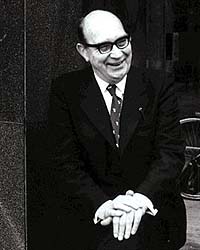
Philip Larkin was quite young when he died 63yrs old. His hands in his photograph look to be arthritic, I wonder what else he suffered from. By the look of him he probably died of a heart attack. Sometimes one has a premonition of death and this poem seems to have been written in a mood of depression. The desperation of trying to hold on to life, the fear of meeting the Grim Reaper face to face. Personally I think…
Read the whole commentPhilip Larkin was quite young when he died 63yrs old. His hands in his photograph look to be arthritic, I wonder what else he suffered from. By the look of him he probably died of a heart attack. Sometimes one has a premonition of death and this poem seems to have been written in a mood of depression. The desperation of trying to hold on to life, the fear of meeting the Grim Reaper face to face. Personally I think preparation for the inevitable is more soothing than trying to deny it and wishing in vain you could stop the clock. Useless wringing of hands and futile regrets and longing. Prepare your will, clean out your garage and attic, put your affairs in order, that way at least you know the people you leave behind will think kindly of you when you die and you will be able to rest in peace. Think of your body as a shell, this is only one phase of life. Just as the caterpiller turns into a chrysalis and then a butterfly, so will our souls break free from the body we no longer need to fly away on the next leg of our journey. Because we have never seen the soul it is hard for some people to believe we have one. But we have you know, and sometimes if you listen very carefully on a quiet summer evening when you can smell the jasmine and honeysuckle or when you are playing with your grandchildren, you can actually hear your soul singing.
I was first introduced to Aubade in late 1985, by a man called Patrick Garland on the death of Larkin. I remember being impressed at his honesty and the straightforward profundity of the poem (nothing cryptic or symbolic). It seemed also in a sense to be a fitting finale and sumnation of his poetic career. For although I am certainly no scholar of Larkin it seemed, in a way, to be the poem all of his previous work…
Read the whole commentI was first introduced to Aubade in late 1985, by a man called Patrick Garland on the death of Larkin. I remember being impressed at his honesty and the straightforward profundity of the poem (nothing cryptic or symbolic). It seemed also in a sense to be a fitting finale and sumnation of his poetic career. For although I am certainly no scholar of Larkin it seemed, in a way, to be the poem all of his previous work had been moving towards. It was written, I believe, around seven years before his death and I am unaware of his having published any subsequent material. I am also not aware of any other poem dealing with the notion of eternal extinction.
Having read, and seen on TV, a good bit of biographical information on Larkin there is good reason to believe that he was something of a loner and a recluse even if he did spend his last few years living with a partner. His relative isolation brought depth and detachment to his work which accounts for a thread of insight running through. But I think that his relatively solitary and unvaried life (I believe as an adult he never left the UK and travelled very little) was also a disadvantage and may have led to a narrow mindedness in certain respects e.g. his collected letters reveal certain rascist undertones.
I think that this mindset was the driving force behind his adult views of the religious and spiritual realm which he simply dismissed as a 'great moth-eaten, musical brocade/created to pretend we never die'. I have to join forces with Paul and disagree with Nash on this respect. For to believe that this world and universe with all its beauty and symmetry is merely a meaningless accident requires much more faith than a belief in some kind of design.
Furthermore, even in primitive and ancient cultures, the world through, there is evidence in belief in god or gods and this includes belief in life after death. Even respected medical journals such as The Lancet don't rule out an afterlife.
I think Chris Marsh is dead(!) right about this one. It is about that affliction - dread of death. However, I don't think of it as a disease from which one suffers. I think it is just one of the common experiences consequent on being human. Consciousness meeting the knowledge of one's own mortality. In the night, it is quite capable of seizing you violently for a few awful seconds. Larkin expresses it brilliantly:-…
Read the whole commentI think Chris Marsh is dead(!) right about this one. It is about that affliction - dread of death. However, I don't think of it as a disease from which one suffers. I think it is just one of the common experiences consequent on being human. Consciousness meeting the knowledge of one's own mortality. In the night, it is quite capable of seizing you violently for a few awful seconds.
Larkin expresses it brilliantly:-
Most things may never happen: this one will,
And realisation of it rages out
In furnace-fear when we are caught without
People or drink.
Furnace fear - that's it exactly.
It's no good writing in and saying that belief in the hereafter will solve the problem. Of course it will. Larkin speaks for all those of us who are unable to swallow that trick - "the vast moth-eaten musical brocade" and the fact that he speaks for us and names the dread openly is courageous and therapeutic.
Incidentally, I believe that dread of death can probably be managed by direct contemplation of death itself. A friend of mine tried it for one and a half days and exhausted himself but has never since worried about death or awful accidents. I shall try it if ever dread of death becomes a problem for me. As it is I think it is a mark of one's own humanity and one's own consciousness. An unflinching reading of the poem is enormously helpful. Larkin is a good comrade in arms.
An aubade is a poem about lovers separating at dawn. Here, the persona is being separated from his lover, life. However I prefer the lingerie
The last two lines are perhaps the most shockingly naked part of this poem for me and they remind me of how I realized the brutal nature of death many years ago: not only am I to perish, be gone, but life in this world will go on as if nothing ever happened. A few may mourn, maybe even be seriously saddened but the vast majority, the world, will grind on relentlessly. For work has to be done. The doctor that…
Read the whole commentThe last two lines are perhaps the most shockingly naked part of this poem for me and they remind me of how I realized the brutal nature of death many years ago: not only am I to perish, be gone, but life in this world will go on as if nothing ever happened. A few may mourn, maybe even be seriously saddened but the vast majority, the world, will grind on relentlessly. For work has to be done.
The doctor that announces my death may the very next minute be planning his holiday, go for lunch, pluck his nose and worry about the colour and texture of his faeces.
The postman carries not only news about my death; he carries bills, advertisements about circus in town and the shopping centre’s latest offers.
And all the time I am dead!
Not even when 6 millions perished up the chimney, when the Mongols divided heads from bodies until their arms hurt or when the Turks slaughtered the Armenians did the universe halt for a sentimental second.
THIS POEM BY PHILIP LARKIN IS ESSENTIALLY FULL OF NIHILISM.I THINK IT IS HIS PESSIMISM THAT LEADS HIM TO CONTEMPLATE DEATH.DEATH IS THE PREDOMINATING IDEA OF MANY OF HIS POEMS. WHATEVER THE IDEA OF HIS POEMS IS, HE EXPLAINS THE THINGS IN SO MUCH NIHILISTIC MANNER THAT ONE BEGINS TO FEEL ONE'S LIFE AS FULL OF EMPTINESS.
What this poem has ultimately meant to me is the same fear I have now. That my life will be passed over while I live, that my death will be just another letter in the mail or another doctor's visit. Waking up from a night of revelry or pleasure I wonder at why I'm not out, desperately make a mark on the world.
We fear that our religions are lies propounded by those above us. Rulers who sought a method of eternal control.
And finally, Death comes for us all and it is better to face it head on, screaming in defiance. Than to cower and dread it's coming.
Larkin's Aubade
Whilst I wonder about what has been described as Larkin's didacticism, telling the reader what to think, the we of the poem, it's ironically clear that larkin lives on in this poem and through all his other works,thus performing the trick of the "eternal." Despite his supposed pessimism I would suggest a wry smile at such a reading, if not an outright laugh at the trick posterity has played on both the poet and the reader.
Aubade
The last comment that Larkin somehow, and ironically, has achieved immortality through this piece written about the dread of being dead, rings hollow to me. It is like Woody Allen's remark: "I don't want to gain immortality through my films; I want to gain immortality by not dying." It's just not the same. To me, this poem is also a description of life apart from faith. Of course, this is a very subjective area and different people focus on different bits of evidence pertaining to faith. Anthropology tells us that religion is virtually universal across groups of peoples. Is this just a coincidence or perhaps a true part of who we are? It is certainly worth checking out.