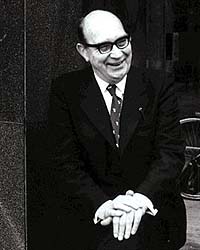
The poem
That note you hold, narrowing and rising, shakes Like New Orleans reflected on the water, And in all ears appropriate falsehood wakes,
Building for some a legendary Quarter Of balconies, flower-baskets and quadrilles, Everyone making love and going shares--
Oh, play that thing! Mute glorious Storyvilles Others may license, grouping around their chairs Sporting-house girls like circus tigers (priced
Far above rubies) to pretend their fads, While scholars manqués nod around unnoticed Wrapped up in personnels like old plaids.
On me your voice falls as they say love should, Like an enormous yes. My Crescent City Is where your speech alone is understood,
And greeted as the natural noise of good, Scattering long-haired grief and scored pity.
I love this poem, simply because it shows Larkin's enthusiam for something! The form is regular, 5 3-line stanzas then one 2 line stanza. The rhyme scheme allows cohension and momentum. Sid himself was a jazz musician, and this seems to be a dedication to him from Larkin. 'That note you hold' could suggest both musically, but also could suggest care and control. 'narrowing and rising' is personification, and has…
Read the whole commentI love this poem, simply because it shows Larkin's enthusiam for something! The form is regular, 5 3-line stanzas then one 2 line stanza. The rhyme scheme allows cohension and momentum. Sid himself was a jazz musician, and this seems to be a dedication to him from Larkin. 'That note you hold' could suggest both musically, but also could suggest care and control. 'narrowing and rising' is personification, and has positive connotations. New Orleans is mentioned; this is the home of Jazz, and could also suggest the power of the note being played. 'Falsehood' --> negative connotations. There are long, flowing sentences which create fluency. The word 'Mute' in the third stanza is a most complex word; this could have both positive and negative connotations. Poor Larkin, got to pity him somewhat; he says 'On me your voice falls as they say love should', showing his detachment from others. Sid obviously means quite a lot to Larkin.
of course 'sid' meant alot to Larkin, he was only interested in a few things and jazz was one of them. His use of enjambment in stanza 3-4 emphasises his passion.
After much pondering, I think that music replaces love in Larkin's life because it requires no commitment and gives him pleasure, therefore it falls upon him like 'an enormous yes'. Larkin feels in control of music, as he does with his poetry. The end to this poem, I think, suggests that 'the natural noise of good' is his jazz music, that makes him feel relaxed and comfortable. Yet I think the last sentence is typical Larkin negativity: 'Scattering long-haired grief and scored pity.' - the music takes pity on him (awww) does this man know the meaning of cheerful? Watchoo reckon?
I think that this line is just perfect. It describes exactly how you feel when an experience such as listening to your favorite piece of music reaches your senses. I love getting enormous yeses!
This is really more of a question than a comment. I love the poem - typically striking that balance between an impulse for joy and passion and the melancholy that those things are only imaginary for him... but I don't understand the part 'Others may license, grouping around their chairs/Sporting-house girls like circus tigers (priced/Far above rubies) to pretend their fads'. It's partly the syntax - how does someone 'pretend' a 'fad'? And is 'license' the verb, as in 'allow'?
And are they 'allowing' the sporting-house girls to do... what? Can anyone throw some light on this? Alastair
@hayley: Dont forget that *some* Jazz "moans". *Some* of it is played to complain. So Larkin might just describe what he believes the musician is trying to say. @Alastair: 'Others may license, grouping around their chairs/Sporting-house girls like circus tigers (priced/Far above rubies)" Maybe this refers to New Orleans as a sin city. "license" could be read as related to alcohol, the girls could be hookers,…
Read the whole comment@hayley:
Dont forget that *some* Jazz "moans". *Some* of it is played to complain. So Larkin might just describe what he believes the musician is trying to say.
@Alastair:
'Others may license, grouping around their chairs/Sporting-house girls like circus tigers (priced/Far above rubies)"
Maybe this refers to New Orleans as a sin city. "license" could be read as related to alcohol, the girls could be hookers, expensive ones.
It could also refer again to the musicians. They group around their chairs: Maybe the owner of the place put chairs on the stage for the Jazzmen but as they play they jump up and live their music. Between them: the chairs.
There are a million ways of reading Larkin. The only thing to remember is that he drafted a lot and carefully thought every word over. So, there must be sense in it somewhere. The question is if we find the interpretation Larkin had in mind... ;-)