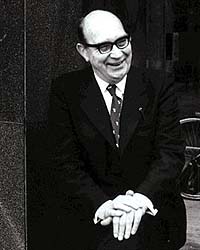
The poem
Groping back to bed after a piss I part the thick curtains, and am startled by The rapid clouds, the moon's cleanliness.
Four o'clock: wedge-shaped gardens lie Under a cavernous, a wind-pierced sky. There's something laughable about this,
The way the moon dashes through the clouds that blow Loosely as cannon-smoke to stand apart (Stone-coloured light sharpening the roofs below)
High and preposterous and separate-- Lozenge of love! Medallion of art! O wolves of memory! Immensements! No,
One shivers slightly, looking up there. The hardness and the brightness and the plain far-reaching singleness of that wide stare
Is a reminder of the strength and pain Of being young; that it can't come again, But is for others undiminished somewhere.
this poem's not bad. at first wut really got my attention was the peeing part. lol and then well in english we had to look for some pre and post 1800 poetry and i like reading stuff that expresses sorrow, depression, or somewhere around that not very much into happy so joyful so i happen onto this pissing and then keep reading on and its nice. the last lines of reflection i really like. though its not too strong there may be just a little bell. i like poems that don't end on a definite tone but end w/ a thought or just "deep". so this is my comment. l8ter
This has to be one of my favourites in the collection. The line that strikes me the most is "There's something laughable about this." It strikes me as though he is bitterly grieving what he once had and has wasted, a common theme in High Windows. I love the elegance of the words that describe the moon and how the moon will always return fuller and more glorious than last time where as he will always stay the way he is. The sad tone of this poem is a lot more viewable than in his other poems as he masks them with bitterness and to put it bluntly "sour grapes" this makes me believe that he is mourning the loss of his youth and isn't as angry but sorrowful to have lost it.
Another wonderful Larkin creation. Virtuosic lyricism combined with pithy musings. Note the rapturous irony mid-poem. In his younger years, the same words would have been passionate; now, the tone is rejected, though the sentiment behind it is supported, even envied.
i am struggling to cope with the language in this poem but my thought on it are the the moon is important strewth mate what a bonanza
The way the moon dashes through the clouds that blow
Loosely as cannon-smoke to stand apart
....awesome what else do you need to say
This poem is complete jokes!!! we're doing it for our GCSE course work and our class couldn't read past the first line due to the word 'piss'(shows you how mature we are)...and when we finally managed to move on (with a few stifled giggles)...weburst out laughing again with 'there is something laughable abotu this'...our teacher just couldn't control herself. Thank you to Mr. Larkin for giving us a laugh if nothing else!!!
Sad Steps was the first Larkin poem that i ever studied, and after a shaky start, i have grown to love it! I think it is really clever how Larkin takes such a mundane experience - needing to go for a piss, and is able to turn it into an experience in which the persona, and the reader, end up reflecting on life and its value. The poem moves rapidly away from its colloquial and amusing beginning, in which the words…
Read the whole commentSad Steps was the first Larkin poem that i ever studied, and after a shaky start, i have grown to love it!
I think it is really clever how Larkin takes such a mundane experience - needing to go for a piss, and is able to turn it into an experience in which the persona, and the reader, end up reflecting on life and its value.
The poem moves rapidly away from its colloquial and amusing beginning, in which the words 'groping' and 'piss' stand out - It moves from it's relaxed conversational opening to a profound poem of reflection.
The persona's emotional reaction to the sight of the moon is startling, as the poem describes .
'startled' triggers elaborate thoughts about the significance and electric nature of youth - somthing which the persona has left behind.
The heavy curtains described symbolise the persona's distance from the emotions of youth, which he sees as 'immensements!'.
The moon, symbloising his lost youth, is described by Larkin in both a beautiful and harrowing way. It may be the 'Lozenge of love' but the line 'Wloves of memory' suugests that the moon does not only conjur up happy youthful memories for the persona, but also reminds him of the things that he has lost through aging -perhaps memories are eating away at him- he is reminded of his lack of ability to feel emotion and love as acutly as the young do - his ability to really live and feel.
The structure of the poem conveys its sad, reflective nature. Each stanza is like another sad step away from life, towards death, and the 'wide stare' of the moon epitimises the strength of the romantic emotions that the speaker has lost in the eclipsing darkness of getting old.
The Philips: Sidney and Larkin
Compare to Larkin's inspiration, Sir Philip Sidney's Sonnet With how sad steps User Rating: 7.0 /10 (3 votes) 0 Print friendly version 0 E-mail this poem to e friend 0 Send this poem as eCard 0 Add this poem to MyPoemList With how sad steps, O moon, thou climb'st the skies! How silently, and with how wan a face! What! may it be that even in heavenly place That busy archer his sharp arrows tries? Sure, if that…
Read the whole commentCompare to Larkin's inspiration, Sir Philip Sidney's Sonnet
With how sad steps
User Rating:
7.0 /10
(3 votes)
0 Print friendly version
0 E-mail this poem to e friend
0 Send this poem as eCard
0 Add this poem to MyPoemList
With how sad steps, O moon, thou climb'st the skies!
How silently, and with how wan a face!
What! may it be that even in heavenly place
That busy archer his sharp arrows tries?
Sure, if that long-with-love-acquainted eyes
Can judge of love, thou feel'st a lover's case:
I read it in thy looks; thy languished grace
To me, that feel the like, thy state descries.
Then, even of fellowship, O Moon, tell me,
Is constant love deemed there but want of wit?
Are beauties there as proud as here they be?
Do they above love to be loved, and yet
Those lovers scorn whoom that love doth possess?
Do they call 'virtue' there - ungratefulness?
HUH?
This poem isn;t by Larkin, it's by Sir Philip Sidney.