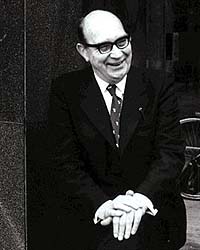
The poem
That Whitsun, I was late getting away: Not till about One-twenty on the sunlit Saturday Did my three-quarters-empty train pull out, All windows down, all cushions hot, all sense Of being in a hurry gone. We ran Behind the backs of houses, crossed a street Of blinding windscreens, smelt the fish-dock; thence The river's level drifting breadth began, Where sky and Lincolnshire and water meet.
All afternoon, through the tall heat that slept For miles inland, A slow and stopping curve southwards we kept. Wide farms went by, short-shadowed cattle, and Canals with floatings of industrial froth; A hothouse flashed uniquely: hedges dipped And rose: and now and then a smell of grass Displaced the reek of buttoned carriage-cloth Until the next town, new and nondescript, Approached with acres of dismantled cars.
At first, I didn't notice what a noise The weddings made Each station that we stopped at: sun destroys The interest of what's happening in the shade, And down the long cool platforms whoops and skirls I took for porters larking with the mails, And went on reading. Once we started, though, We passed them, grinning and pomaded, girls In parodies of fashion, heels and veils, All posed irresolutely, watching us go,
As if out on the end of an event Waving goodbye To something that survived it. Struck, I leant More promptly out next time, more curiously, And saw it all again in different terms: The fathers with broad belts under their suits And seamy foreheads; mothers loud and fat; An uncle shouting smut; and then the perms, The nylon gloves and jewellery-substitutes, The lemons, mauves, and olive-ochres that
Marked off the girls unreally from the rest. Yes, from cafés And banquet-halls up yards, and bunting-dressed Coach-party annexes, the wedding-days Were coming to an end. All down the line Fresh couples climbed aboard: the rest stood round; The last confetti and advice were thrown, And, as we moved, each face seemed to define Just what it saw departing: children frowned At something dull; fathers had never known
Success so huge and wholly farcical; The women shared The secret like a happy funeral; While girls, gripping their handbags tighter, stared At a religious wounding. Free at last, And loaded with the sum of all they saw, We hurried towards London, shuffling gouts of steam. Now fields were building-plots, and poplars cast Long shadows over major roads, and for Some fifty minutes, that in time would seem
Just long enough to settle hats and say I nearly died, A dozen marriages got under way. They watched the landscape, sitting side by side - An Odeon went past, a cooling tower, And someone running up to bowl - and none Thought of the others they would never meet Or how their lives would all contain this hour. I thought of London spread out in the sun, Its postal districts packed like squares of wheat:
There we were aimed. And as we raced across Bright knots of rail Past standing Pullmans, walls of blackened moss Came close, and it was nearly done, this frail Travelling coincidence; and what it held stood ready to be loosed with all the power That being changed can give. We slowed again, And as the tightened brakes took hold, there swelled A sense of falling, like an arrow-shower Sent out of sight, somewhere becoming rain.
i am studying this at school at the moment, i thoughourly enjoy it!!!!
I'm glad you enjoy this poem K8, it's such a visual poem, I cant help but visualise the train carriage with its buttoned seats, watching the hedges zoom past. You'll have to excuse me if I'm wrong, as I dont have any notes with me, but the final stanza I find particularly interesting. Throughout the poem Larkin has shown his negative perception of marriage; in the final stanza he calls this 'being changed', hardly…
Read the whole commentI'm glad you enjoy this poem K8, it's such a visual poem, I cant help but visualise the train carriage with its buttoned seats, watching the hedges zoom past. You'll have to excuse me if I'm wrong, as I dont have any notes with me, but the final stanza I find particularly interesting. Throughout the poem Larkin has shown his negative perception of marriage; in the final stanza he calls this 'being changed', hardly another positive image of marriage. The last two lines are so complex, it took me a while of studying them to try and draw anything from them at all. In the penultimate line, there are the words 'arrow shower'. Arrow = negative, yet shower = positive. And then 'becoming rain', becoming = positive, rain = negative. I'd love to know anyone else's thoughts on these final lines, as I find them particularly interesting. (and yes, I do have a life! :P)
Hi, the last two lines are part of an extended metaphor throughout the poem referring to a bow and arrow(stanza 2 "curve" = bow)the reference to an arrow shower shows the poets uncertainty about the future of the couples marriage - where will it(marriage or the arrows) end up. Also the word "rain" could be negative (dreary and gloomy) and yet rain is in itself a positive thing...it makes things grow (in the case of marriage children would be produced). So in summary the last two lines show that although the poet is cynical about marriage he also accepts that there may be some chance of prosperity. Hope this helps you Jenny C.
I too am studying larkin this year. The word 'aimed' releases the rich image of the arrow-shower and the rain, I feel that the happy aggression implied in this action represents the ceremonial shot into the future. There is also I feel the idea of fertility in the image of 'rain.' The 'somewhere' makes the sentence vague and desolate as we are excluded from the wedding-couples ultimate fulfilment. This is my notion on what the final two lines mean. I'm happy to be corrected or given a different perspective!
This poem is referred to in a poignant manner in a brilliant book by Charles Chadwick, It's All Right Now,
another gift from England to the United States.
Dear everyone, I am teaching this poem in India for MA class and these are some of my observations: That Larkin's Poetics derives itself from a curious perspective towards looking at things in a negative manner. Yet realism calls for observing the positive side as well and thus the compounding and contrasts used in his poetry. As far as the Whitsun Weddings go: the third stanza from last, depicts Larkin's perceptive…
Read the whole commentDear everyone,
I am teaching this poem in India for MA class and these are some of my observations:
That Larkin's Poetics derives itself from a curious perspective towards looking at things in a negative manner. Yet realism calls for observing the positive side as well and thus the compounding and contrasts used in his poetry.
As far as the Whitsun Weddings go: the third stanza from last, depicts Larkin's perceptive perspective, he views the marriage in a strange paradox of funeral happiness and religious wounding. The contrast catches the exact moment of the couples' faces, amplifying the effect of the image. We can compare this technique to the cinematic technique of zooming in, which amplifies the effect of whatever is being shown.
hey i like the poem so does jack slinglesby lol we r doing an essay in english on it n its abit challenging!! bye xx
My father first intorduced me to this poem a few years' ago. After he had read it to me he wept at the desolation of its images. Larkin was not one of life's optimists....
This is one of my favourite modern poems (generally I'm more of a nineteenth century poetry person!) I think "the last confetti and advice were thrown" is one of the neatest and most evocative examples of syllepsis I've ever come across. I also love the lines: "and none
Thought of the others they would never meet
Or how their lives would all contain this hour" because it's very simple on the face of it and yet it stays with you and you can spend an awfully long time mulling over this idea!
we are being forced to study this against our will by an evil slave-driver with a cough *cough cough* our teacher is trying to convince us that larkin is not boring.
Hello, I read what you had all said and it really helped me, I must say that I was quite confused when I read the poem (and I still am, unfortunately)!! Is there a known reason for larkin's pessimistic view on weddings? If somebody could explain the 5th stanza (see below), I really would appreciate it. Marked off the girls unreally from the rest. Yes, from cafés And banquet-halls up yards, and bunting-dressed…
Read the whole commentHello, I read what you had all said and it really helped me, I must say that I was quite confused when I read the poem (and I still am, unfortunately)!! Is there a known reason for larkin's pessimistic view on weddings? If somebody could explain the 5th stanza (see below), I really would appreciate it.
Marked off the girls unreally from the rest.
Yes, from cafés
And banquet-halls up yards, and bunting-dressed
Coach-party annexes, the wedding-days
Were coming to an end. All down the line
Fresh couples climbed aboard: the rest stood round;
The last confetti and advice were thrown,
And, as we moved, each face seemed to define
Just what it saw departing: children frowned
At something dull; fathers had never known
I don't understand either the meaning of "sun destroys / the interest of what's happening in the shade" (3rd stanza)..
Could somebody help me? Thank you very much!
Sarah.
I think it's also worth noting in the last stanza the passive: 'There we were aimed.' and other uses of the passive. I can't help but feel that there are connotations of a higher force compelling these actions, which is an interesting enough notion in itself when we're discussing Larkin's poetics; especially if you take these in conjunction with poems like 'Ambulances' and 'Here', which, in my opinion seem very strongly linked with the nihilist and perhaps absurdist* mood of the time, which was recently coming to light.
* Branch of existential philosophy explored by Albert Camus in 'L'étranger', 1942.
There is an interesting reference to Philip Larkin's views on love in the film 'Four Weddings and a Funeral'. Unfortunately people tend to dwell on the Auden poem John Hannah reads at the funeral rather than the director's, Richard Curtis, interesting interpretation of Larkin's intended meaning in The Whitsun Weddings. Just before Charles (Hugh Grant) fully realises his love for Carrie, Matthew (John Hannah) is…
Read the whole commentThere is an interesting reference to Philip Larkin's views on love in the film 'Four Weddings and a Funeral'. Unfortunately people tend to dwell on the Auden poem John Hannah reads at the funeral rather than the director's, Richard Curtis, interesting interpretation of Larkin's intended meaning in The Whitsun Weddings.
Just before Charles (Hugh Grant) fully realises his love for Carrie, Matthew (John Hannah) is shown wearing Philip Larking glasses which has not happened at all throughout the rest of film, nor does it happen again, giving his short speech authority. When Charles runs out after Carrie, proving his love for her, it begins to rain- '...an arrow-shower / Sent out of sight, somewhere becoming rain.'
I think that by watching this part of the film, it may help to give people who find it hard to make sense of this poem an interesting understanding of its meaning.
A moving film and a powerful poem.
It may be useful to take a look at what Larkin himself said about his experiences which inspired him to write this poem...It is not negative, but simple curiosity. He wrote:
'You couldn't be on that train without feeling the young lives all starting off, and that just for a moment you were touching them. Doncaster, Retford, Grantham, Newark, Peterborough, and at every station more wedding parties. It was wonderful, a marvellous afternoon.' (From Haffenden (1980) as cited in Tolley 1997.)
This to me suggests that Larkin is not being cynical at all.
Hmm.
This poem is soooo long who the hell would wanna read this.. except those who have no life and leave comments.(see above)
if you wanna read a good poem, look at Carol Ann Duffy, who is a bit more Optimistic and not so depressing.