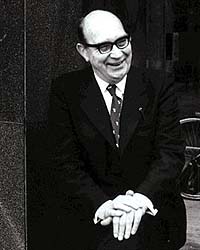
The poem
They fuck you up, your mum and dad. They may not mean to, but they do. They fill you with the faults they had And add some extra, just for you.
But they were fucked up in their turn By fools in old-style hats and coats, Who half the time were soppy-stern And half at one another's throats.
Man hands on misery to man. It deepens like a coastal shelf. Get out as early as you can, And don't have any kids yourself.
I have grown to appreciate this poem: what appears a merely frivilous poem contains a darker, more sinister undercurrent; Larkin entwines farce with real concern (First two lines in last stanza).
I particularly like Larkin's portrayal of life's cyclical, here monotinous nature, conveyed structurally by his repetitive ab ab ryhme scheme.
As I am reaching mature age, have 2 mature age children, I love this poem, it is so apt, you really don`t mean too, but don`t realise how much influence you have over them. Thankfully I have two children who tell me what they feel, they have read this and love it also.
this poem was in a way very negative about our parents i think (my opinion) ;)
The title "This Be The Verse" refers to Robert Louis Stevenson's "Requiem":
This be the verse you grave for me:
Here he lies where he longed to be;
Home is the sailor, home from sea,
And the hunter home from the hill.
Larkin definitely hits the mark. For what its worth, read a quote the other day, not sure who wrote it, but it might fit with the vibe.
"You will never truly mature as a person until you forgive your parents"
Sugggestion: New ritual that every child (regardless of religion) can opt participate in on their 16th birhtday. No pomp and ceremony, 5 minute conversation in which they express forgiveness for parental mistakes and stupidity.
Larkin taps into a fundamental psychological process for the transmission thoughts and feelins and behaviours across the generations. In Transactional Analysis Larkin is describing the creation of life scripts - just a little more succinctly.
The poem is sardonic and resigned. Every son and every dad will know the underlying sentiments to be true. Parents can't help but pass on themselves to their children, and children fully realise that only when they themselves mature. All children both resent and feel inadequate when compared to their parents, hence the "here's some extra" line. This poem only sank with me when I had children! Larkin never had children, but there you go.
i do think that larkin creates a persona in "this be the verse" and almost mocks it; to say he is going to far, i think, is the point although larkin never had kids himself i still believe this to be a comical personal that larkin aims to mock and so the poem should not be taken too literally.
«Man hands on misery to man»
this is sooooooo true my mom and dad have fuxd up soooooooo much and i think even though i am only 15 i can respect good poetry and i think that larkin is one of the BEST and thats why i am doing my school report on my HERO on him because his poems hit me where it hurts and feels good at the same time.......... YA KNOW?!?!
I think Larkin was pessimistic about the future generations of american youth and more importnatly, he foresaw the gradual and progressive degradation of the family unit in american society. He uses a vulgarity as means for evoking a sense of reality and, ironically, he highlights how such liberal usage of vulgarities even in the most sacred places,(poetry) can show us how moral values are slowly being eroded. In…
Read the whole commentI think Larkin was pessimistic about the future generations of american youth and more importnatly, he foresaw the gradual and progressive degradation of the family unit in american society. He uses a vulgarity as means for evoking a sense of reality and, ironically, he highlights how such liberal usage of vulgarities even in the most sacred places,(poetry) can show us how moral values are slowly being eroded. In the second stanza, he seems to say, more and more, parents are looked up by their children as role models but the irony of all this is that while they are "sterns" at home (pun on the word stern, which is also used in nautical travelling,) they act like mere hypocrites outside, betraying their own teachings. Children of today will never learn from their role models and thus, "man hands on misery. " Finally, I think the title of the poem, "This be The Verse" is extremely apt and startling, for it reflects a crazed culture in today's society in dire need for a salvation, hence, the religious undertone.
simple but quality, thanks!c
Thank you for you work! Good Luck.
Looking for information and found it at this great site…
simple but quality, thanks!>
this one is simple & nice.
This is a great tutorial thanks!D
This is a point directed at the people who seem to think that Larkin 'foresaw the gradual and progressive degradation of the family unit in american society.' Hello? Have you not read the rest of the poems in the anthology, High Windows. Larkin & his poems were so quintessentially english it is unbelievable. One of themes running throughout the anthology is that of 'englishness'. Get your facts right before you start commenting!
As I was reading "The Reading Group" by Elizabeth Noble, she made reference to this poem. Being American I hadn't heard of Philp Larkin. What a great poem for teenagers! Perfect.
I think Philip Larkin has written a very provokative poem. Although he mentions a problem that exists infinitely, his ideas to stop the problem are crazy and impossible to realise.
But I think he wants to reach other things. It´s enough when the new generations educate their children in a different, better way.
In the first stanza, he describes his issue. I agree that our parents fill us with their faults because we learn from then. But I don´t think that they´re doing it intentionnally.
Finally I don´t like the poem because either the message or the poet is crazy. But I like that he provokes to wake up the people.
In my opinion it is a good poem but I don't agree with all the aspects he mentions.
I can understand that he was discontented with the conversative views of his parents but he can't say that it 's better not to have children anymore.
I think the poem fits with the time of " Flower Power"
but not with our generation because todays parents respect and accept their childrens decision and often let let them find their own way.
I guess the poem embodies the thoughts of a whole generation and gives an impression of the 1970s. Larkin's about my parents' age, but i can get easily into the subject. Although i'm not into free love and not having children, i can follow what he says about strictness and the old-fashioned attitude. These are problems that are and always will be present.
The poem "This Be The Verse" by Philip Larkin of the year 1988 is about the old generation which have tochange their attitude towards the new generation. Philip Larkin wants to warn his generation and he wants that the parnets get out of their old rules. In my opinion Philip Larkib didn't think enough about what he says in his poem. I don't agree with his suggestions , for example about the parents: Your parents…
Read the whole commentThe poem "This Be The Verse" by Philip Larkin of the year 1988 is about the old generation which have tochange their attitude towards the new generation. Philip Larkin wants to warn his generation and he wants that the parnets get out of their old rules.
In my opinion Philip Larkib didn't think enough about what he says in his poem. I don't agree with his suggestions , for example about the parents: Your parents often want the best for you and they don't want to fill the kids with the faults,like he mentions in line 3 and 4. In addition to that he talks about the tqo sides which the old generation has in his opinion. He speakes about the whole people but I think that's too general. Furthermore he wants to protect the world by not having any kids. But I think, you can't protect the world in this way because there aren't any new generation. In any case, the poem "This Be The Verse" is too pessimistic and naive!
Larkin describes in the poem "This BE the verse" the situation of the youth in the 70s. He tells us how hard the relationship was between parents and youth.
In his view the solution for this problem was "having no children".
Because of this I don´t like the poem. Also he describes the time just as a bad time.
Larkin speaks to all of the youth about his problems.
He forgot that there were youth who had a good relationship with their parents. They didn´t have any problems in this time.
Also, I can´t believe that Larkin had this entire time a bad relationship with his parents.
In my opinion Philip Larkin is right in the one hand but also wrong in the other.
He is right because, in his tme, the parents were oldfashioned and stricter then today. Also the young people in the 1970s wanted to break free from the old rules of their society.
But today´s parents became more liberal. Of course there are rules to keep but not as many and not as strict ones than in former times. Of course they make mistakes but everyone makes some and that´s not a reason for don´t having kids anymore.
I think there's much truth in this poem because as you grow up with your parents you might immitate their mistakes. I think it's necessary to stop this vicious circle. People need to avoid the mistakes the generations before them did and think up new ideas to make the world be a better place.
I understand Larkin's way of thinking. In the 1960's the teens were very discontented with their parent's authority so they rebeled with a "Flower Power" revolution. Larkin emphasizes that all the faults of someone are passed to the next generation and because of that he advises the young people not to have children themselves.
I do not really like the poem. It is right that the personality of someone is influenced by his family and friends, but you have to take the challenge and make it better than your parents. The solution is not to stop having kids.
In my opinion, the poem fits with the 70s but not with our generation because our upbringing has changed. Today we have more liberties and we are multicultural. It may be that the upbringing was 'soppy-stern' in the past and maybe these kind of parents still exist today, but in general we have a better education at school and we think more critically about things. And the biggest difference is that we are allowed or forced to think critically about our world and our opinions aren't supressed like in the 70s. But I also like the poem because you can see how discontented the people were in the 70s and how they tried to change things.
I don't really like the poem. Maybe it's true in some parts, like that the parents brought you up like they were. But just because one person thinks that everything your parents have done is bad, it's not true. I think every person should seriously think about whether they want to have kids or not.
First of all, I want you to know, that I really like the poem. The first line is sensational and very good. “This Be the Verse” has a pleasant sound with a kind of aggressive touch. However, I think that the last stanza is too pessimistic. That’s why I don’t agree with it. In my opinion if you want to change the world, you have to convince other people. You won’t have any success if the people don’t follow your advice. After all, children are something special and it could also be an aim to raise them in a completly different way. Finally they are our future. In any case, I appreciate the poem because it always fits with the time.
I think some of you are missing the intentional irony in this poem. It is meant to be humorous! Yes, we are all f--ed up and doomed to go on to do the same to our own children---but the tone keeps it from being as harsh and negative as some of you seem to take it, adding a sense of acceptance and forgiveness.
As cliched as this is, the English sense of humour is integral to the last stanza. Larkin is being intentionally dry , not pessimistic. The last line is like a friendly warning to the next generation from a middle-aged man.
This poem encapsulates a sense of teenage unrest and disatisfaction which is almost mirrored in a more subtle fashion in the Whitsun Weddings. While I could spend time from a literary perspective discussing the importance of this poem, Larkin for his part by telling us that this BE the verse is almost daring us to comment upon a universal truth, its a broken down version of what we all feel, presented in a slick…
Read the whole commentThis poem encapsulates a sense of teenage unrest and disatisfaction which is almost mirrored in a more subtle fashion in the Whitsun Weddings.
While I could spend time from a literary perspective discussing the importance of this poem, Larkin for his part by telling us that this BE the verse is almost daring us to comment upon a universal truth, its a broken down version of what we all feel, presented in a slick syle, displaying the arrogance of youth, almost before we have learned the lessons which time and poems such as an arundel tomb demonstrate. Larkin connects with everyone throught this poem, literary background or not, which is why though cliched it is one of my favourite Larkins. He is one of us.