The poem
Who hath his fancy pleased With fruits of happy sight, Let here his eyes be raised On Nature's sweetest light; A light which doth dissever And yet unite the eyes, A light which, dying never, Is cause the looker dies.
She never dies, but lasteth In life of lover's heart; He ever dies that wasteth In love his chiefest part: Thus is her life still guarded In never-dying faith; Thus is his death rewarded, Since she lives in his death.
Look then, and die! The pleasure Doth answer well the pain: Small loss of mortal treasure, Who may immortal gain! Immortal be her graces, Immortal is her mind; They, fit for heavenly places-- This, heaven in it doth bind.
But eyes these beauties see not, Nor sense that grace descries; Yet eyes deprived be not From sight of her fair eyes-- Which, as of inward glory They are the outward seal, So may they live still sorry, Which die not in that weal.
But who hath fancies pleased With fruits of happy sight, Let here his eyes be raised On Nature's sweetest light!
This song was written to what is now the tune of the Dutch national anthem. Its content is a monologue by William I of Orange. Sidney met William in 1577 to congratulate him on the birth of his first daughter on behalf of Queen Elizabeth. The song to seems to me to address not a lady, but the portrait of a lady, who has died but whose (eternal) beauty is shining from this portrait. The only way for the reader/onlooker to get to her, therefore, is to die too, which is precisely what the poem argues. I am now looking into the question whether the portrait is one that has any relation to his visit to William of Orange (via the tune of the song).
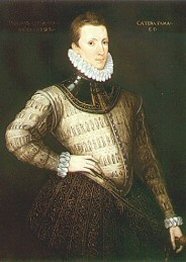
Sidney
Further to my earlier comment: Sidney was actually present at the baptism of Willem's daugther (not his first though, but the second by his third wife,Charlotte de Bourbon, and named after Queen Elizabeth I, on whose behalf Sidney attended). The mother died in 1582, and soon became a legend as an exemplary woman and wife. A painted and an engraved portrait of Charlotte were made in 1581. Could she (or rather her portrait) be the subject of the poem to the tune of Wilhelmus van Nassau?