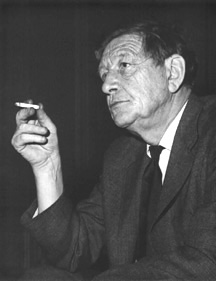
The poem
I
He disappeared in the dead of winter: The brooks were frozen, the airports almost deserted, The snow disfigured the public statues; The mercury sank in the mouth of the dying day. What instruments we have agree The day of his death was a dark cold day.
Far from his illness The wolves ran on through the evergreen forests, The peasant river was untempted by the fashionable quays; By mourning tongues The death of the poet was kept from his poems.
But for him it was his last afternoon as himself, An afternoon of nurses and rumours; The provinces of his body revolted, The squares of his mind were empty, Silence invaded the suburbs, The current of his feeling failed; he became his admirers.
Now he is scattered among a hundred cities And wholly given over to unfamiliar affections, To find his happiness in another kind of wood And be punished under a foreign code of conscience. The words of a dead man Are modified in the guts of the living.
But in the importance and noise of to-morrow When the brokers are roaring like beasts on the floor of the Bourse, And the poor have the sufferings to which they are fairly accustomed, And each in the cell of himself is almost convinced of his freedom, A few thousand will think of this day As one thinks of a day when one did something slightly unusual. What instruments we have agree The day of his death was a dark cold day.
II
You were silly like us; your gift survived it all: The parish of rich women, physical decay, Yourself. Mad Ireland hurt you into poetry. Now Ireland has her madness and her weather still, For poetry makes nothing happen: it survives In the valley of its making where executives Would never want to tamper, flows on south From ranches of isolation and the busy griefs, Raw towns that we believe and die in; it survives, A way of happening, a mouth.
III
Earth, receive an honoured guest: William Yeats is laid to rest. Let the Irish vessel lie Emptied of its poetry.
In the nightmare of the dark All the dogs of Europe bark, And the living nations wait, Each sequestered in its hate;
Intellectual disgrace Stares from every human face, And the seas of pity lie Locked and frozen in each eye.
Follow, poet, follow right To the bottom of the night, With your unconstraining voice Still persuade us to rejoice.
With the farming of a verse Make a vineyard of the curse, Sing of human unsuccess In a rapture of distress.
In the deserts of the heart Let the healing fountains start, In the prison of his days Teach the free man how to praise.
I had to do a research paper on this poem and I love the way he words things, it shows the way he really feels about Yeats.
This poem is awesome. It's like his final goodbye to Yeats. It has become time to let him go and this poem is his way of doing that. Auden is the best poet I have seen in my poetry class.
This poem is not overly flattering, it is more a commentary on how Yeats will be perceived after his death. What is interesting is that Auden was at times quite critical of Yeats. Refer to "The Table Talk of W.H. Auden," by Alan Ansen, where he calls Yeats a Fascist and though Auden recognises Yeats's talent, he is not personally a fan. "I have to give a talk on Yeats before the MLA in Detroit. You know the more I…
Read the whole commentThis poem is not overly flattering, it is more a commentary on how Yeats will be perceived after his death. What is interesting is that Auden was at times quite critical of Yeats. Refer to "The Table Talk of W.H. Auden," by Alan Ansen, where he calls Yeats a Fascist and though Auden recognises Yeats's talent, he is not personally a fan. "I have to give a talk on Yeats before the MLA in Detroit. You know the more I read him, the less I like him . . . No, I couldn't launch an open attack on him. This is supposed to be some kind of celebration, after all. I wouldn't mind his crazy mythology if he took it more seriously. And all right, I wouldn't mind it's being a hoax if he tipped us a wink at the end." Auden could possibly refer to his critics accusing Yeats of constantly changing his politics. His politics are important because Yeats was an Irish Nationalist, during the Great War. Auden refers to his critique of Yeats in the poem, "Let the Irish vessel lie/ Emptied of its poetry." It is interesting how Auden reconcils his opinions of Yeats in this poem. Having said this, I of course see Yeats talent, but I also see his and Auden's challenges when it comes to inspiring social change in politics through their poems.
This poem is very flattering to Yeats, and anyone that understands Yeats' poetry can clearly see that Auden has (by referring to Yeats in present tense) given Yeats credit for living beyond the grave "out of [his] body" and no longer in a "natural form" ("Sailing to Byzantium"). Auden's tone comments on the Modern Condition--not Yeats' poetry. Leslie is a novice.
this poem is super confusing in the way it is introduced and described.
You guys are all so amateur. You have no idea what this poem is even about. First of all it's an elegy written in memory of W.B. Yeats. To be consistent with the ideal elegiac poem, Auden has given his poem a dark and somber tone. He reinforces this attitude with references to WWII, which was just starting around the time Auden wrote this poem. In the Second portion of his poem, he is using an apostrophe, directly…
Read the whole commentYou guys are all so amateur. You have no idea what this poem is even about. First of all it's an elegy written in memory of W.B. Yeats. To be consistent with the ideal elegiac poem, Auden has given his poem a dark and somber tone. He reinforces this attitude with references to WWII, which was just starting around the time Auden wrote this poem. In the Second portion of his poem, he is using an apostrophe, directly addressing Yeats, and stating that "poetry is a way of expressing sadness and suffering," In his last part of the poem, he has changed his writing style to imitate that of Yeats (which is hardly a critique) and in the last stanza speaks of healing and comfort, acceptance if you will.