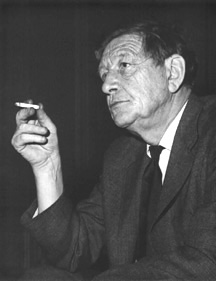
The poem
Law, say the gardeners, is the sun, Law is the one All gardeners obey To-morrow, yesterday, to-day.
Law is the wisdom of the old, The impotent grandfathers feebly scold; The grandchildren put out a treble tongue, Law is the senses of the young.
Law, says the priest with a priestly look, Expounding to an unpriestly people, Law is the words in my priestly book, Law is my pulpit and my steeple.
Law, says the judge as he looks down his nose, Speaking clearly and most severely, Law is as I've told you before, Law is as you know I suppose, Law is but let me explain it once more, Law is The Law.
Yet law-abiding scholars write: Law is neither wrong nor right, Law is only crimes Punished by places and by times, Law is the clothes men wear Anytime, anywhere, Law is Good morning and Good night.
Others say, Law is our Fate; Others say, Law is our State; Others say, others say Law is no more, Law has gone away.
And always the loud angry crowd, Very angry and very loud, Law is We, And always the soft idiot softly Me.
If we, dear, know we know no more Than they about the Law, If I no more than you Know what we should and should not do Except that all agree Gladly or miserably That the Law is And that all know this If therefore thinking it absurd To identify Law with some other word, Unlike so many men I cannot say Law is again,
No more than they can we suppress The universal wish to guess Or slip out of our own position Into an unconcerned condition. Although I can at least confine Your vanity and mine To stating timidly A timid similarity, We shall boast anyway: Like love I say.
Like love we don't know where or why, Like love we can't compel or fly, Like love we often weep, Like love we seldom keep.
- emphasises inquiry more than conclusion - eighth stanza contains strange grammar which leads to confusion - detached tone - to say that law is ‘like love’ is to say that human love is as fallible as human law -written just after ‘Sep, 1’, in 1939 -1st stanza, sun representative of the ‘laws of nature’, AABB rhyme giving lighter tone - Gardeners follow sun because it controls growth, sun effects the daily outcomes…
Read the whole comment- emphasises inquiry more than conclusion
- eighth stanza contains strange grammar which leads to confusion
- detached tone
- to say that law is ‘like love’ is to say that human love is as fallible as human law
-written just after ‘Sep, 1’, in 1939
-1st stanza, sun representative of the ‘laws of nature’, AABB rhyme giving lighter tone
- Gardeners follow sun because it controls growth, sun effects the daily outcomes of a gardeners work
- 2nd stanza, AABB rhyme,
-grandfather’s say their wisdom should be the law, however they are actually ‘impotent’ and ‘shrilly scold’ –not seen as the law by the ‘grandchildren’
-not ‘wisdom’ but ‘senses’- physical, sensual experiences of life
- 3rd stanza, ABAB rhyming pattern changes giving a more hymnal feel, religious overtones
-‘priest’, ‘priestly’, ‘unpriestly’, repeated emphasises their sense of self importance
- scathing irony, the people are ‘unpriestly’ not ‘ungodly’ and the law is ‘my priestly book/my pulpit and my steeply’. The priest seems to be saying that his word is law, rather than god’s.
-4th stanza, ABCACC
- judge ‘looking down his nose’ s condescending to the court
-says the law is definite and unchangeable
- ‘clearly and most severly’- internal rhyme, gives humourous effect
- syntax is convoluted and repetitive ‘law is...’ but doesn’t say what law actually is
-sounds potentially meaningful, but eventually ‘law is the law’, which is uninformative
-humorous reflection on the judicial profession
-5th stanza, AABBCCA
-‘scholars’ say that the law is not definite and beyond definition
-changes ‘places and by times’
-law is current, accepted, social conventions- ‘clothes men wear’
-sixth stanza, AABCB
- repetition at the start of the lines, gives a dismissive feel- ‘others say, others say’
-