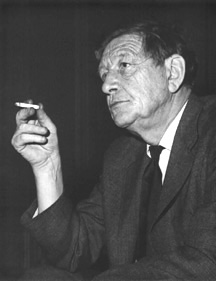
The poem
O what is that sound which so thrills the ear Down in the valley drumming, drumming? Only the scarlet soldiers, dear, The soldiers coming.
O what is that light I see flashing so clear Over the distance brightly, brightly? Only the sun on their weapons, dear, As they step lightly.
O what are they doing with all that gear, What are they doing this morning, morning? Only their usual manoeuvres, dear, Or perhaps a warning.
O why have they left the road down there, Why are they suddenly wheeling, wheeling? Perhaps a change in their orders, dear, Why are you kneeling?
O haven't they stopped for the doctor's care, Haven't they reined their horses, horses? Why, they are none of them wounded, dear, None of these forces.
O is it the parson they want, with white hair, Is it the parson, is it, is it? No, they are passing his gateway, dear, Without a visit.
O it must be the farmer that lives so near. It must be the farmer so cunning, so cunning? They have passed the farmyard already, dear, And now they are running.
O where are you going? Stay with me here! Were the vows you swore deceiving, deceiving? No, I promised to love you, dear, But I must be leaving.
O it's broken the lock and splintered the door, O it's the gate where they're turning, turning; Their boots are heavy on the floor And their eyes are burning.
This poem reminded me of the long-forgotten Jedi warriors and the battle against the Sith...
o what is that sound
drumming sets up an iretated effect which greatly assists the drama and suspense of the poem
The repetition of the last word in the second lines in each stanza, for example "drumming, drumming" and "wheeling, wheeling", emphasises the affect of the Nazi soldiers slowly getting closer to the house and in turn heightens the feeling of anxiety.
The most memorable aspect of this particular poem is the continuous repetition throughout the poem, "dear", "so cunning so cunning". The rhythm of the poem resembles a nursery rhyme, however throughout the poem the marching of the approaching soliders can be heard in the rhyme. This is achieved through repetiton "Wheeling, Wheeling", "this morning, this morning". Two personas can be recognised is this poem and the…
Read the whole commentThe most memorable aspect of this particular poem is the continuous repetition throughout the poem, "dear", "so cunning so cunning". The rhythm of the poem resembles a nursery rhyme, however throughout the poem the marching of the approaching soliders can be heard in the rhyme. This is achieved through repetiton "Wheeling, Wheeling", "this morning, this morning". Two personas can be recognised is this poem and the use of "dear" suggests to me that one is male and the other female, possibly married. The use of the questions "Why are you kneeling" shows a duelogue between the two characters. The act of deception is sguggested in this poem "Were the vows you swore decieving decieving?", suggests the breakage of vows, therefore giving the poem an immensely sad undertone.
The repetition gives the poem a 'nursery ryhme' feel. However the use of the words 'thrills', 'wounded', 'cunning' and 'decieving' gives the poem an increasingly chilling atmosphere. The words he repeats in the poem i believe give them more power and meaning. For instance, 'drumming, drumming', makes it seem more continous and that the drumming/military march is getting closer than if it was unrepeated. Also 'is it?…
Read the whole commentThe repetition gives the poem a 'nursery ryhme' feel. However the use of the words 'thrills', 'wounded', 'cunning' and 'decieving' gives the poem an increasingly chilling atmosphere.
The words he repeats in the poem i believe give them more power and meaning. For instance, 'drumming, drumming', makes it seem more continous and that the drumming/military march is getting closer than if it was unrepeated. Also 'is it? is it?' sounds like the narrator is pushing for an answer other than just asking a simple question. Auden uses the line 'Why are you kneeling?' This could have several meanings, for instance it could mean that they are kneeling in respect or it could mean that they have suffered so much terror or hurt that their knees have buckled under so much pressure that they cant stand anymore.
This poem expresses life in 1934, and the foreseeing of the events that will happen, the marching of the boots echos when the nazis came for the jews during the Holocaust. "Down in the valley drumming, drumming?" suggests the soldiers coming, expressing the feeling of terror and panic.
This poem has a particular form and structure. The first line of each stanza starts with "O", with a song like quality, and the second line is always a question with repetition of the last word. There is a particular sound to the rythm of the poem that builds suspense and also a sense of time as if its running out. The poem shows a man leaving the love of his life as he thinks the cause of the resistance is more important to him that the woman. Although he says he promises to love her, he still leaves her. "No, I promised to love you dear, / But i must be leaving."
The poem is also very grpahic in terms of terror and panic. "Their boots are heavy on the floor and their eyes are burning."
The poem contains two characters; one who questions and one who answers. The character that answers the questions seems to take things that would be worrying such as the "drumming, drumming" of the soldiers and show them to be insignificant by using the word "only". Even though the coming of the soldiers would tell the characters that war is imminent, the character that answers seems unconcerned.
O What is that Sound
'O What is that Sound'? It's the cries of those civilians, fighting facism, questioned because so few did listen and many who did chose to ignore. The cautiousness of those awaiting their deaths is conveyed from the first line with 'drumming, drumming', not only consistent with the sound of a heart beat, implying fear but also with that of soldiers sterdy boots; marching into battle. Another aspect of war illustrated by Auden is the hopeless fear of being left by a loved one. The desperate tone inferred with 'O where are you going? Stay with me here!' and repetition of 'deceiving' following the mention of sworn vows are consistent with the archetypical notions of desertion.
My perception of this poem is that it is about the 18th century war and the soldiers involved. Fuller comments that this poem is the 'archetypal dream of desertion', I agree with this comment as it seems that the other character is leaving their lover behind to face the soldiers alone. The war ballad uses the ABAB rhyme scheme and repetition to give the poem speed as if the soldiers are getting closer. I think that…
Read the whole commentMy perception of this poem is that it is about the 18th century war and the soldiers involved. Fuller comments that this poem is the 'archetypal dream of desertion', I agree with this comment as it seems that the other character is leaving their lover behind to face the soldiers alone. The war ballad uses the ABAB rhyme scheme and repetition to give the poem speed as if the soldiers are getting closer. I think that the character speaking in the poem is pleading for people to stay and try to fight against the soldiers and prevent the Holocaust 'O where are you going? Stay with me here!' The symbolism associated with 'Why are you kneeling?' could be that of people in prayer, or even kneeling in respect. The repetition of the last word in the second line of each stanza emphasizes the fear that is felt by the speaker such as 'drumming, drumming' and 'deceiving, deceiving' It seems as if there is no hope left for the characters at the end as the lock breaks and the door splinters. Auden deliberately leaves some of the poem ambiguous, an example of this would be ‘but now I must be leaving’, the character could be leaving to fight or leaving to run away from the soldiers.
O What is that Sound
Auden wrote this poem to make a stand against fascism and the looming threat of the future. The title has an apostrophe to God, "O" and this shows irony as the poem centres around the Nazis sending Jews to concentration camps. The title highlights the immoral act of the Nazis and how this is such a merciless and hellish act.
"drumming, drumming" accentuates the noise of the Nazi boots marching on duty. The repetition shows the sheer noise and fear that the Nazis evoked. The negative mood is furthered, "Only the sun on their weapons". The pathetic fallacy shows that the weapons only have some hope and prospect, not the millions of Jews.
The poem shows a man leaving the love of his life in the second part of the poem " No, I promised to love you, dear, But i must be leaving". the cause of the resistance is more important to him than the girl he loves. It is not specific enough to know whether the man is leaving to go and fight for his country. Or he could be deserting his wife in the terror. The vows that are made in marriage seem not to matter when…
Read the whole commentThe poem shows a man leaving the love of his life in the second part of the poem " No, I promised to love you, dear, But i must be leaving". the cause of the resistance is more important to him than the girl he loves. It is not specific enough to know whether the man is leaving to go and fight for his country. Or he could be deserting his wife in the terror. The vows that are made in marriage seem not to matter when it comes to values of your country and to fight for your country comes before anyone. There are many reasons why hes is kneeling " Why are you kneeling?" This could show that he is kneeling as a sign of respect to the soldiers. It could show that their kneels have buckled under stress and the terror. They could also be kneeling in prayer and desperation.
Characters
There are two speakers in this poem, as Auden admits himself. The whole poem is a duologue, with the first two lines in each stanza being questions (asked by speaker one) and the latter two lines answers (said by speaker two). As the poem progresses, speaker one's sense of desperation heightens. So much so that in stanza eight, speaker one pleads "Stay with me here!", with speaker two replying "I must be leaving."…
Read the whole commentThere are two speakers in this poem, as Auden admits himself. The whole poem is a duologue, with the first two lines in each stanza being questions (asked by speaker one) and the latter two lines answers (said by speaker two). As the poem progresses, speaker one's sense of desperation heightens. So much so that in stanza eight, speaker one pleads "Stay with me here!", with speaker two replying "I must be leaving." This shows the contrast between the two characters, speaker one seems distraught, uncertain and asks questions in every stanza. Speaker two seems more level headed and calm. He or she appears to have all the answers and replies to the questions abruptly. This conflict of emotions between characters in the poem reflects the confusion of war. Speaker one is clearly distressed at seeing the soldiers, whereas speaker two is dealing with this more rationally.
There is a very strong sense of rhythm throughout this poem which is strongly reflected by the image laden language like "drumming, drumming" creates. The rhyming pattern is very regular which is very reminiscent of military marching and discipline. At the start of the poem the language is rather sedate and calm. Phrases like "only the scarlet soldiers, dear" set the reader at ease. However, as the poem progresses the language becomes more and more panicked. Words like "suddenly" build tension and the constant use of "why" adds layers to the panic. The final metaphor "their eyes are burning" shows the malicious intent that is seen by the narrator.
The significance of the word "Sound" is important in the poem. Not only the sound of the "drumming, drumming" which creates a rythm throughout the poem and conveys the sense of a funeral march or a dirge. This slow and steady rythm picks up pace and reflects a heart beating faster and faster as the soldiers draw nearer and nearer, "and now they are running".
"sound" also conveys the idea that nobody is listening to Auden who in his poam is fore shadowing the events of the holocaust, particualrly the round up of Jews who were often in hiding, the peom conveys the danger and paranoia at this time.
The poem is remeniscent of a nursery rhyme, thus the rhythmic pace and use of a rhyme scheme. This reflects the female character [Who asks questions] 'childlike' personality, as she is naive and unaware of the soldiers approach. By doing so enables readers to sympathise with her by the end, as she is left alone "But I must be leaving". We wouldn't leave a child alone, as they depend on nurture and attention, therefore it is a saddened image of her husband leaving her.
question??
i have a question in line 29 and 30 it says
"O where are you going? Stay with me hear
Were the vows you swore deceiving, deceiving?"
what are those `
question
who speaks the last two lines of the poem?how do you know?
plz answer this question
The regular pace of the poem contributes to the sense of inevitability at the end.
English
Is "Only the sun on their weapons, dear, As they step lightly." a metaphor?
poem
this poem is not tooo hard