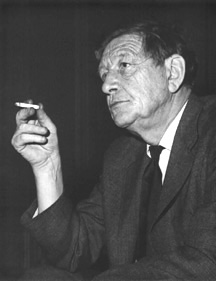
The poem
Say this city has ten million souls, Some are living in mansions, some are living in holes: Yet there's no place for us, my dear, yet there's no place for us.
Once we had a country and we thought it fair, Look in the atlas and you'll find it there: We cannot go there now, my dear, we cannot go there now.
In the village churchyard there grows an old yew, Every spring it blossoms anew: Old passports can't do that, my dear, old passports can't do that.
The consul banged the table and said, "If you've got no passport you're officially dead": But we are still alive, my dear, but we are still alive.
Went to a committee; they offered me a chair; Asked me politely to return next year: But where shall we go to-day, my dear, but where shall we go to-day?
Came to a public meeting; the speaker got up and said; "If we let them in, they will steal our daily bread": He was talking of you and me, my dear, he was talking of you and me.
Thought I heard the thunder rumbling in the sky; It was Hitler over Europe, saying, "They must die": O we were in his mind, my dear, O we were in his mind.
Saw a poodle in a jacket fastened with a pin, Saw a door opened and a cat let in: But they weren't German Jews, my dear, but they weren't German Jews.
Went down the harbour and stood upon the quay, Saw the fish swimming as if they were free: Only ten feet away, my dear, only ten feet away.
Walked through a wood, saw the birds in the trees; They had no politicians and sang at their ease: They weren't the human race, my dear, they weren't the human race.
Dreamed I saw a building with a thousand floors, A thousand windows and a thousand doors: Not one of them was ours, my dear, not one of them was ours.
Stood on a great plain in the falling snow; Ten thousand soldiers marched to and fro: Looking for you and me, my dear, looking for you and me.
every night i read this poem before i sleep. i put my book in my hand and it is covered in cry. it is very sad poem it tells me of my mother who had three legs, i think it is nice. i want to be a jew. this shall be good fun, please marry me auden. love sophie graham
Refugee Blues
What is this poem about? The sad and terrible plight of being a Jew in the wrong place at the wrong time. Obviously, as a refugee, the speaker of the poem has lost his home, his country and his identity. The melancholy feeling comes through strongly in the blues - a sad song, made famous by American negroes about this time. The poem begins by introducing a city: a large one, with 10 million people in it. Some have…
Read the whole commentWhat is this poem about? The sad and terrible plight of being a Jew in the wrong place at the wrong time. Obviously, as a refugee, the speaker of the poem has lost his home, his country and his identity. The melancholy feeling comes through strongly in the blues - a sad song, made famous by American negroes about this time.
The poem begins by introducing a city: a large one, with 10 million people in it. Some have the luxury of living in a mansion; this is directly contrasted with the rest who are living in most disgusting conditions, 'holes'. There is not even a 'hole' for this couple - they are beneath the usual poverty line, they have nothing. The problem set up in the first two lines, of accommodation, is brought into the first person in the last line of the stanza and the grim reality of having nothing is made even more poignant by him talking to his wife (we presume) - 'my dear'. However, the conversational tone of 'my dear' almost makes it sound as though he's talking to us. The repetition of the sentiment, of having no room for 'us', makes it sadder.
The next stanza shows how they are exiled from their own country and cannot return. They can see it in a map, can look at it in an atlas - but cannot return. They are resigned to this fate when they say 'We cannot go there now'. How upsetting is it to leave all you have, everything you know and not be able to return to it?
The tree is an interesting symbol in the next stanza. The tree is in a cemetery, a place where you bury the dead. However, the tree can go through nature's cycle and seem dead at certain times of the year but can be re-born, can grow again. It's natural for things to be given a new chance every year in nature, to bloom again. However, this is contrasted with man-made documents that, once lost, can never be recovered: 'Old passports can't do that, my dear'.
They then go to three places where they need help. The consul, presumably at an Embassy, treats them badly and violently bangs the table and makes a ridiculous statement: 'If you have no passport you're officially dead!' Can't he see that they are there in front of him, alive, looking at him? The speaker's calm and controlled response of 'we are still alive' makes the reader like the speaker more than the insensitive violence of the consul; we side with the speaker in sympathy.
The committee was no good. They offered a temporary help of a 'chair' but telling them to come back 'next year' (a terrible half rhyme) is a way of stating that they shouldn't come back at all. The desperation is creeping into the tone of the speaker now: 'But where shall we go today?' They need help now. Next year is way too late; tomorrow isn't even any good. Help is needed today.
They are doing things properly and at the public meeting, their next stop, they are demonised and stereotyped as a group of thieves. The Christian versus Jew argument is apparent here when the committee member says 'they' will steal our 'daily bread'. Part of the Lord's prayer is 'Give us this day our daily bread' The calm acceptance of this slur makes the speaker of the poem seem better when he states 'He was talking about you and me'.
Symbolism is thick in the next stanza and the thunder that is Hitler coming to kill all the Jews is a drastic change in tone; it's threatening, ominous, deadly.
The next few stanzas refer to him observing the world with a new perspective: it's wrong that animals are treated better than humans and they they wear smart clothes and have doors opened for them (metaphorically they have had all the doors shut on them). The fish are free because they have no rules, no religion, no politics - nature is better than the conditions they find themsleves in. Even the birds are free to sing as happy as they like. All this freedom is tantalisingly close and yet they are trapped, exiled and demoralised by the laws they cannot control or live with.
The huge sympathy we feel for this couple are bult up even mopre in the last two stanzas: the hopes and dreams of just having one room in a building made up of a thousand floors is awful. This ois contrasted with the fact they are exposed on a 'great plain' in freezing conditions in the 'falling snow' with ten thousand soldiers looking for just the two of them. They have not only not been helped by anyone but people want to kill them - for being Jewish.
Loved the poem, thanks for the great analysis
my dear welldone
sophia you are wrong. the last few lines have spelling mistakes.correct it thats all and update it again. no problem. sophia plz read the commentary properly.
my dear welldone
sophia u r wrong. last few lines hav spelling mistakes. correct it and update again. sophia read it again. u r not clear with it still
nice poem,bt difficult 2 understand