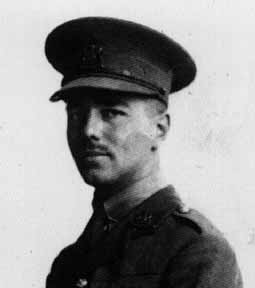
The poem
He sat in a wheeled chair, waiting for dark, And shivered in his ghastly suit of grey, Legless, sewn short at elbow. Through the park Voices of boys rang saddening like a hymn, Voices of play and pleasure after day, Till gathering sleep had mothered them from him.
About this time Town used to swing so gay When glow-lamps budded in the light-blue trees And girls glanced lovelier as the air grew dim, -- In the old times, before he threw away his knees. Now he will never feel again how slim Girls' waists are, or how warm their subtle hands, All of them touch him like some queer disease.
There was an artist silly for his face, For it was younger than his youth, last year. Now he is old; his back will never brace; He's lost his colour very far from here, Poured it down shell-holes till the veins ran dry, And half his lifetime lapsed in the hot race, And leap of purple spurted from his thigh. One time he liked a bloodsmear down his leg, After the matches carried shoulder-high. It was after football, when he'd drunk a peg, He thought he'd better join. He wonders why . . . Someone had said he'd look a god in kilts.
That's why; and maybe, too, to please his Meg, Aye, that was it, to please the giddy jilts, He asked to join. He didn't have to beg; Smiling they wrote his lie; aged nineteen years. Germans he scarcely thought of; and no fears Of Fear came yet. He thought of jewelled hilts For daggers in plaid socks; of smart salutes; And care of arms; and leave; and pay arrears; Esprit de corps; and hints for young recruits. And soon, he was drafted out with drums and cheers.
Some cheered him home, but not as crowds cheer Goal. Only a solemn man who brought him fruits Thanked him; and then inquired about his soul. Now, he will spend a few sick years in Institutes, And do what things the rules consider wise, And take whatever pity they may dole. To-night he noticed how the women's eyes Passed from him to the strong men that were whole. How cold and late it is! Why don't they come And put him into bed? Why don't they come?
sad poem. contrasting pre war life with post war life. end rhyme. graphic language. intends for audience to sympathise with disabled man
Shouldn't have, not shouldn't of.
im not sure the character(hes fictional) is asking for sympathy i think hes reflecting on his past and realising that he joined up for all the wrong reasons and mourning that he was taken in by the propaganda. he doesnt sound a very nice man, a bit like a grumpy child: why dont they come?, but who can blame him after all the dreadful things he has seen?
I think philip from Bangladesh needs to be shot in the face i mean come on the poem is a represention of the commitment people like that have for their country and they deserve all the respect in the world for that. Where is the compassion
This poem is one of which shows traumatised man, this is all i can conjur from this piece of "poetic art"
I have just studied this poem at school & I have just completed an essay on it. I found the poem very moving, & I think the poem serves Owens purpose well. His aim was to shock his readers into realising the terrible conditions of war, & how easily young men were sacrificed... It is very well written, with lots of graphic language.
I also am currently studying this poem, and I don't understand how anyone could think he purely joined the army to earn attention. Certainly it is a factor, but mainly men as young as 11 were told to lie about their age in order to be drafted off. The man Owen tells us about, was unaware of the horrific things that would happen to him when he was there, as he referred it to a football match and praised any…
Read the whole commentI also am currently studying this poem, and I don't understand how anyone could think he purely joined the army to earn attention. Certainly it is a factor, but mainly men as young as 11 were told to lie about their age in order to be drafted off. The man Owen tells us about, was unaware of the horrific things that would happen to him when he was there, as he referred it to a football match and praised any 'blood-smears' to be proof that he was there and giving his all. But when he comes back, just one man who brings him fruit can say thank you?
The purpose of this poem is to make us feel guilty, and we should. We don't remember those who gave their lives for us. We should be ashamed.
This powerful and well written poem proves that.
i have been truly appauled by what Phillip from Bangladesh has said. however, it's safe to assume that he is just an innocent little boy who doesn't appreciate literiture at its best. I'm studying this poem in preperation for my A2 exams. as it partly sorrounds W.Owen i thought i'd read some more his stuff i haven't read yet. and i say, this poem is truly amazing. It touches upon a lot ofwar time situations and…
Read the whole commenti have been truly appauled by what Phillip from Bangladesh has said. however, it's safe to assume that he is just an innocent little boy who doesn't appreciate literiture at its best.
I'm studying this poem in preperation for my A2 exams. as it partly sorrounds W.Owen i thought i'd read some more his stuff i haven't read yet. and i say, this poem is truly amazing.
It touches upon a lot ofwar time situations and tackles them head on by 'observing' (if you will) a character presented by Owen.
I agree with Ruth that he is reflecting on his past and is realising that he signed up for the wrong reasons. this is very brave of Owen, as the Propoganda coming from the papers at the time would be appauled by this, and try to keep such literiture underfoot.
one part of the poem that struck me was the fourth line in:
"Voices of boys rang saddening like a hymn"
this could suggest he's insensitive to the sounds of youth, which was stolen from him by the war. Or it could simply tie in with theme of religion on the front line. As often priests would come to front line to try and and give soldiers hope. anyone who has read BIrdsong by Sebastian Faulks would be aware of this
got to write an essay on this poem and 2 other: charge of the light brigade and rule britannia. this 1 is definely the best. its my hw :( only in year 9 (age 13) lot of people online doing this for coursework! lol
the poem..
Im doing an essay on it too y9 :( .. Phillip from bangladesh.. how would you like it if you had no legs and no arms and someone came up to you and said.. 'We need to shoot you cuz' youve got no arms and legs' .. Me thinks you should get a life :D x
Disabled by Wilfre owen is a powerful poem which explores the reult of war. It tells the story of a young soldier who lost his limbs in war and due to this, he think of himself as 'ugly'. It's a melanchollic poem as the reader reads about the man quietly waiting for darkness to come wanting to go to bed. :(