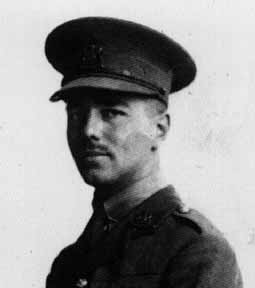
The poem
It seemed that out of the battle I escaped Down some profound dull tunnel, long since scooped Through granites which Titanic wars had groined. Yet also there encumbered sleepers groaned, Too fast in thought or death to be bestirred. Then, as I probed them, one sprang up, and stared With piteous recognition in fixed eyes, Lifting distressful hands as if to bless. And by his smile, I knew that sullen hall; With a thousand fears that vision's face was grained; Yet no blood reached there from the upper ground, And no guns thumped, or down the flues made moan. "Strange, friend," I said, "Here is no cause to mourn." "None," said the other, "Save the undone years, The hopelessness. Whatever hope is yours, Was my life also; I went hunting wild After the wildest beauty in the world, Which lies not calm in eyes, or braided hair, But mocks the steady running of the hour, And if it grieves, grieves richlier than here. For by my glee might many men have laughed, And of my weeping something has been left, Which must die now. I mean the truth untold, The pity of war, the pity war distilled. Now men will go content with what we spoiled. Or, discontent, boil bloody, and be spilled. They will be swift with swiftness of the tigress, None will break ranks, though nations trek from progress. Courage was mine, and I had mystery; Wisdom was mine, and I had mastery; To miss the march of this retreating world Into vain citadels that are not walled. Then, when much blood had clogged their chariot-wheels I would go up and wash them from sweet wells, Even with truths that lie too deep for taint. I would have poured my spirit without stint But not through wounds; not on the cess of war. Foreheads of men have bled where no wounds were. I am the enemy you killed, my friend. I knew you in this dark; for so you frowned Yesterday through me as you jabbed and killed. I parried; but my hands were loath and cold. Let us sleep now . . ."
(This poem was found among the author's papers. It ends on this strange note.)
*Another Version*
Earth's wheels run oiled with blood. Forget we that. Let us lie down and dig ourselves in thought. Beauty is yours and you have mastery, Wisdom is mine, and I have mystery. We two will stay behind and keep our troth. Let us forego men's minds that are brute's natures, Let us not sup the blood which some say nurtures, Be we not swift with swiftness of the tigress. Let us break ranks from those who trek from progress. Miss we the march of this retreating world Into old citadels that are not walled. Let us lie out and hold the open truth. Then when their blood hath clogged the chariot wheels We will go up and wash them from deep wells. What though we sink from men as pitchers falling Many shall raise us up to be their filling Even from wells we sunk too deep for war And filled by brows that bled where no wounds were.
*Alternative line --*
Even as One who bled where no wounds were.
The poem recounts a dramatic meeting in Hell between a soldier and the enemeny, No?
I belive here we still Owen at his most powerful, despair and hoplessness seem to be all he has left. He disscusses in this poem moral corruption and the pure and senseless sacrifice that is war. Genius!
anlyses poem strang meeting by wilfred owen
This is a good poem by the poet but it is quite difficult to understand at times whether the poet is himself dead or has escaped from the battle field.A great part of imagination has been done as someone dead speaks in Hell....
It could be that he is both dead and has escaped from the battlefield, perhaps he is portraying death as an escape. The ambiguity here could be intentional.
From my understanding, Owen has conveyed an emotional and expressive view on battle and fighting, where people are lying around dead, and there is so much blood and distraught thoughts in the atmosphere. He comes across a stranger who is suffering "a thousand pains that vision's face was grained" -destroyed. An interesting epic poem based on the first world war.
I believe it is a poem about 2 dead people talking about war. they were enemies when alive, and equals when dead.
i am a year student and have read the poem and find it confussing to read at frist but now undarstand what wilfred was writing
hey im studying this poem and my teacher reli helped me understand, owen portrays the picture fo two soldiers in hell.. or maybe just dead, they were enermies in real life infact the character owen talks through in this poem killed the man he meets in hell or perhaps they met in life. owen talk about hell or death being an escape from war "Yet no blood reached there from the upper ground, And no guns thumped, or…
Read the whole commenthey im studying this poem and my teacher reli helped me understand, owen portrays the picture fo two soldiers in hell.. or maybe just dead, they were enermies in real life infact the character owen talks through in this poem killed the man he meets in hell or perhaps they met in life. owen talk about hell or death being an escape from war "Yet no blood reached there from the upper ground,
And no guns thumped, or down the flues made moan! there is no war no pain no more death. this could also be referenced to owens earlier peom ducle et decorum est and in both they talk about hell being a place free from war and pain, kinda ironic hey. "Here is no cause to mourn" this poem reminds me of what plato said about war. "Only the dead have seen the end of war" infact the whole conversation in this poem seem to add to that idea of death and war.
hope that helps
This is a very impressive war poem, even more frightening that the others I’ve read so far, maybe because it takes the reader into the dark underground world of Hell. Somehow, it made me think of Paradise Lost, because of the description of the place and the feeling of hopelessness the reader can experience. It is a very effective way Owen found to convey his anti-war message once more. a) First of all, I would say…
Read the whole commentThis is a very impressive war poem, even more frightening that the others I’ve read so far, maybe because it takes the reader into the dark underground world of Hell. Somehow, it made me think of Paradise Lost, because of the description of the place and the feeling of hopelessness the reader can experience. It is a very effective way Owen found to convey his anti-war message once more.
a) First of all, I would say the poem is full of underlying messages for the reader to find out, so analysing this work is extremely complex. Does this poem refer to a dream? My first impression was that the first soldier had died and gone to Hell. However, a second look can give me an idea of a terrible nightmare that a soldier had after killing the enemy in a battle. How many? It could have been many, or just one. The point is that the first soldier, the one that starts the poem, regrets taking part in that slaughter.
For example, in line 4, when he says “Yet also there encumbered sleepers groaned”, it makes me understand that men in Hell were restlessly sleeping, as well as he was when the nightmare started. Also, at the end, when the second soldier told him “Let us sleep now”, it can be interpreted as if the first speaker didn’t belong in Hell (yet) and it was time for him to go back to sleep and let the rest do the same.
b) The title of the poem tells us the main idea of it, which is the meeting between a soldier (maybe Owen himself) and the enemy he had recently killed, who was now in Hell, trying to get some rest after such a terrible death. Paradoxically, he called him “strange friend”. Indeed, even that creepy place seemed to be better that the trenches out there. At least there was no blood and no guns thumped. Both soldiers had fought in opposite sides, but they don’t seem to be enemies any more, since the two agree on the fact of war being cruel and pointless and that no glory or honour could be found after fighting of dying for your country. Both soldiers had the same hopes, dreams and intentions, but they were all shattered by the horrors of war. They are both victims of the same situation
c) Wilfred Owen is very effective showing what fighting in a war, killing others and dying for that reason is no passport to Heaven, but maybe the opposite. This dreadful image of life leads the reader to meditate whether going to war is worth it. In the first stanza, the author describes the tunnels and caves that lead him to Hell, which resembles a huge dorm room full of soldiers who died for the same reasons, not having a pleasant rest, but troubled and distressful. The dead soldier’s monologue (from line 14), tells about his unsuccessful search of beauty, his achievements in life, and the memory he might have left among those he knew. Now that he is dead, he feels like he needed time to tell the truth about war. I mean the truth untold,
The pity of war, the pity war distilled. He regrets being dead, so now it is the living soldier’s turn to do something about it. His mission would now be making public what has been hidden in order to stop the war from being something usual for the human kind. The world can not just go on forgetting the horrors and the price that so many innocents had to pay, pretending nothing ever happened. Now men will go content with what we spoiled…They will be swift with swiftness of the tigress. Owen is able to claim the courage, mystery, wisdom, mastery to combat the march from progress and finally when the retreat can go no further, when much blood had clogged their chariot wheels, to bring life-giving water from sweet wells and reveal truths that lie too deep for taint.
Finally, there is evidence of a concerted effort to universalize the poem for readers of diverse experience
d) Language here is essential. Each word must serve a specific purpose beyond the creation of basic meaning. Owen uses lots imagery that clearly help the reader to have an idea of what soldier’s Hell is like: profound dull tunnel, sullen hall, …granites which titanic wars had groined. Also, through his masterly use of words he can convey the feeling of hopelessness and anguish that can be experienced in that macabre place: encumbered sleepers groaned, …and stared With piteous recognition in fixed eyes, Lifting distressful hands, by his dead smile, etc.
On first reading, the Strange meeting was between the dead soldier and the man who killed him."I am the enemy you have killed my friend." Owen suggests that they met again in those 'sullen halls', and was recognised. It is a poem to be read many times.
I am a senior about to graduate from high school, and this poem was one of my last assignments. At first, I did not understand what was going on in the poem, just that a strange meeting was going to occur. But after rereading this poem a couple of times, somethings popped out to me. And so I began to break the poem down into stanzas and then line by line. This way I got the complete understanding of what this poem is trult about.
ive had an insight; strange meeting is too ambiguous to be either set in the traditional christian hell, less likely still to be a conversation with a living foe. i put it that owen is describing an alternate version of himself. this is very advanced thinking for the time, for such ideas, familiar to ourselves, belong to the realm of quantum theory and it may have been difficult for owen to formulate an idea rather ahead of his time. admittedly the reflection, the mirror-image was used by earlier fantasy authors (lewis carroll etc) but the thought would have very diffcult to encapsulte.
strange meeting by wilfred owen is a reflection of modernity and traditionality both combined on the existential parameters of mystery and mastery which is a symbolic conditioning of humanism and mannerism as well. the poetic angularity of clue intonates and connotates the parameters on reformed governance rules in a imaginative confluence of ideas on the interface of multi-culturalism and pluralism in the same tone…
Read the whole commentstrange meeting by wilfred owen is a reflection of modernity and traditionality both combined on the existential parameters of mystery and mastery which is a symbolic conditioning of humanism and mannerism as well. the poetic angularity of clue intonates and connotates the parameters on reformed governance rules in a imaginative confluence of ideas on the interface of multi-culturalism and pluralism in the same tone and tenor of cohesive literary investigation and stratification of oneness . thus the poet in this thought exhilerating modernistic upsurge transcreates inspiration to the humanity at large in all perspectives and rejuvenating principles of art and criticism.all the nuances of modern poetry is being followed this poem as an eye-opener and effulgence of inter-human relationship.the note of fortification of poetic thought in modern context is embedded in totality in this strangeness of strange meeting where the poet himself is involved in its fullest exactitude.
I believe the poem is an interesting portrayal of the futility of war. The two men, when mortal were made imperative enemies due to their opposing sides in battle, but once they have overcome death, they see a new and logical perspective, that all men are brothers, and the war that had opposed them in life, has brought them together in death, as they both realize the impotence that war had brought upon them
A meeting between two enemies who find that once the war no longer applies to them in any context now they are dead (in hell?) they can recount their experieces in this 'Strange Meeting'
poem
this poem is very useful today this world man this strength
Strange Meeting
symbolic conditioning of humanism and mannerism as well. the poetic angularity of clue intonates and connotates the parameters on reformed governance rules in a imaginative confluence of ideas on the interface of multi-culturalism and pluralism in the same tone and tenor of cohesive literary investigation and stratification of oneness . thus the poet in this thought exhilerating modernistic upsurge transcreates…
Read the whole commentsymbolic conditioning of humanism and mannerism as well. the poetic angularity of clue intonates and connotates the parameters on reformed governance rules in a imaginative confluence of ideas on the interface of multi-culturalism and pluralism in the same tone and tenor of cohesive literary investigation and stratification of oneness . thus the poet in this thought exhilerating modernistic upsurge transcreates inspiration to the humanity at large in all perspectives and rejuvenating principles of art and criticism.all the nuances of modern poetry is being followed this poem as an eye-opener and effulgence of inter-human relationship.the note of fortification of poetic thought in modern context is embedded in totality in this strangeness of strange meeting where the poet himself is involved in its fullest exactitude.
Strange meeting
I am grateful for the inclusion of alternative versions here. Before the 1914-18 war, it was commonly doubted that Christ sweat blood before his crucifixion. However 'foreheads of men have bled where no wounds were' refers to the similar experience of men about to go 'over the top', who also sweat blood in anticipation of their own ordeal. Finding this alternative line: 'Even as One who bled where no wounds were.'…
Read the whole commentI am grateful for the inclusion of alternative versions here.
Before the 1914-18 war, it was commonly doubted that Christ sweat blood before his crucifixion. However 'foreheads of men have bled where no wounds were' refers to the similar experience of men about to go 'over the top', who also sweat blood in anticipation of their own ordeal.
Finding this alternative line:
'Even as One who bled where no wounds were.'
--- shows all the more clearly that Owen had this comparison in mind when he wrote. References to biblical events and figures are common in his poetry, but the capitalisation makes the intention of the line absolutely clear, whereas in the commonly printed version it is clear only to those who know both the bible and the 1914-18 war well.
need help
Please , i need help from who intrested in the poet
strange meeting
strange meeting by wilfred owen is a poem about the First War.its about a soldier make a contact with the spirit of a dead soldier's soul. its excitting to read but hardly to really understand it.
title
The title of the poem "Strange Meeting" is very appropriate because we find so many strange things in this poem.
interest
the poem was so fanstactic that people will need to read and put into practice and then for the student who are learning should read it because it is part of their waec or neco jce thaks once again.
English
The poem depicts the horror of war.previously, the concept of war and the sacrifices of the soldiers were glorified but Owen shows that war is destructive and brutal.it is just kept alive by the politicians for their own benefits.
owen really tries to wipes the hollow romantic sentiments that even today we attributed to the concept of war.the poem is a great critique on chauvinistic and overtly political complacence that we have regarding our state govt. and soldiering while marginalizing the fundamental microcosm of humanity as well as the macrocosm of mankind.
Strange Meeting is a ras clat joke man. The man like 200 years old and instead a dodge bullet he a right 1 damn poem. Comment dun!!!!!
Chin Lee
HaStrange Meeting His very very loooonggg, nah ma poor eyes canknot reed the whole ting tong walla bing bong.
Strange Meeting
Really wondaful poem but i need more notes on it.
comments
this poem tells about futility of war .In his youth he goes after women and when he wanted to achieve in life , he was killed.
strange meeting
Wilfred Owen in his strange meeting talks about war and its effects.The persona came out from a battle field and went into a different world where he had an encounter with a strange person who upon smiling the persona realized he was in hell.upon a short conversion we got to know they were both at the battle field and ..................................
he is very good poem
comment
the poem depicts the lethal nature of our government. the complete lack of regard for the lives of the so many great men whose strenghts could have been more valuable elsewhere but strangely disabused by the call to war.