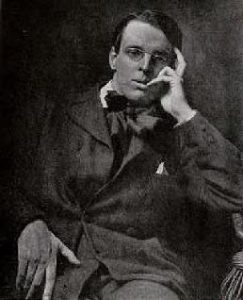
The poem
Turning and turning in the widening gyre The falcon cannot hear the falconer; Things fall apart; the centre cannot hold; Mere anarchy is loosed upon the world, The blood-dimmed tide is loosed, and everywhere The ceremony of innocence is drowned; The best lack all conviction, while the worst Are full of passionate intensity.
Surely some revelation is at hand; Surely the Second Coming is at hand. The Second Coming! Hardly are those words out When a vast image out of Spiritus Mundi Troubles my sight: somewhere in sands of the desert A shape with lion body and the head of a man, A gaze blank and pitiless as the sun, Is moving its slow thighs, while all about it Reel shadows of the indignant desert birds. The darkness drops again; but now I know That twenty centuries of stony sleep Were vexed to nightmare by a rocking cradle, And what rough beast, its hour come round at last, Slouches towards Bethlehem to be born?
Yeats actually saw the end of the world, and wrote about it. Metaphorically and physically. Much like C.S. Lewis saw the garden of eden and wrote about it in his book "Perelandra".
For me, this poem is about breaking away from the 'ceremony of innocence' and all the 'worst' people who are "full of" misdirected "passionate intesity". Its about comming to terms with your purpose in life no matter how hard it may be to break free. You may heave felt lonley in the "desert" staring up for some direction; you may not know what you have to do, but you recognize the need for a "second comming" and you are determined to do so. "its hour come round at last" It's time for a rebirth (...bethelhem to be born) Jesus birthplace /muhammad recived messages from god) metaphore.
I'd take a dimmer view of the vision presented in Yates' poem. Remember that the world had just seen the first World War, a flu epidemic of enormous proportions, and political turmoil. Everything was falling apart, and he was trying to show how impossible it seemed to reconcile it. He was proved right--things got substantially worse before they got better. The only comfort I can find in this poem is that others have seen and felt the anguish of a world seemingly ripping itself at the seams. Misery loves company, and there's plenty of both.
In my point of view, Yeats was "asking" if it was the second coming of the devil, not Jesus. This is simply because of all the chaos the world went through. Yeats must have been very depressed about the World Wars and the Great Depression.
(He lived through WW1 and the Great Depression as a kid. Later on in his old age, he died just before WW2 ended.)
yeats is the most complicated poet ever the meanings behind his words are just too complicated and numerous for my liking no one should be subjected to the torture of having to study yeats his poems should be read by people who appreciate his work not students stretched to breaking point with stess already without some complicated dead person making life even harder its craaaazy.
poetry-No, I have to disagree with your statement that Yeats is some dead guy with poetry that tortures people.
The only reason why poets like Yeats exist is to warn people of what may happen. In this poem when he is try to tell the world not to continue as it is or we'll be fighting with sticks and stones in the 4th world war which Einstein said many years back.
By the way, if you think that a dead man's work is usless, think of all the stuff you learnt. Be it Pythagora's theoem or the English language we freely converse in, it was someone who came up with it and has been dead for centuries. I hope you get a gist of what i'm trying to convey.
Z0oming Out!
Don't you think that Yeats could mean that the world doesn't need another Christ? That the supposed saviour was a beast and now it's about to reborn again as was prophesied? Of course this is just an interpretation, one of many, yet taking into account that Yeats had doubts pertaining to his faith it could be true. Especially when we bear in mind that the World War I, which Yeats experienced, was started by Christians, the followers of Jesus. Therefore, could the one whose followers did so much evil be good himself?
Just so the rest of the nerds (like myself) know, if you find yourself interested in this poem, you should read Things Fall Apart by Chinua Achebe. Between the two exsists a great demonstration of parallelism. As a matter of fact, Achebe derived the title of his novel from Yeats's poem; however, to whom it may concern, when reading the novel, it should either be followed or proceeded by another of its kind: Heart of Darkness by Joseph Conrad.
In my utterly subjective view, Yeats was being just a little sarcastic about the reaction of many to unfolding world events as being the dawn of the end of time. "Surely some revelation is at hand; Surely the Second Coming is at hand. The Second Coming!" Egad, right? Of course, everything bad that happens must mean it's the end of the world. Every generation has believed they are living in the "end times" because…
Read the whole commentIn my utterly subjective view, Yeats was being just a little sarcastic about the reaction of many to unfolding world events as being the dawn of the end of time.
"Surely some revelation is at hand;
Surely the Second Coming is at hand.
The Second Coming!"
Egad, right? Of course, everything bad that happens must mean it's the end of the world.
Every generation has believed they are living in the "end times" because -well- they have been. It will end somewhere (all things do) and probably due to our own folley. Yeats is referring to it as something he'd just as soon not hear again - or, at least, not right then - because it *is* troubling.
But, he also makes reference to a cycle of human history that may be universally accepted as true:
"Turning and turning in the widening gyre
The falcon cannot hear the falconer;
Things fall apart; the centre cannot hold."
Throughout history, mankind has seemed focused and progressive until he strayed so far from the voice of the "falconer" that he believed he was equal to the falconer, and in so doing managed only to tear down the wonderful accomplishments made to that point, imposing his own "will" on his fellow man, regardless of the worth of that being imposed upon. (cf. the destruction of the Library of Alexandria, the Armenian genocide, the medieval Crusades, etc.) All that was left was to return to "center" and start over.
One might think of himself as the falcon, flying farther and farther out from the falconer until he cannot hear the voice of reason.
It is a warning, but perhaps not as literal as one might think.
After studying The Second Coming for a while, I just realised that Yeats has, "lost faith" in Christianity.
2000 years of Christianity has not made the world any better. People are still largely at war with each other, bringing forth our own destruction/ammegeddon.
Respectfully, I disagree. He struggled with his faith, certainly, but it seems to me that what he's "lost faith" in is mankind's ability to think critically and act rationally. The fact that he places it in the context of the Second Coming is a stroke of genius. To me, it seems more of a warning that arrogance and intolerance will inevitably lead to the downfall of mankind, as it has in every cycle or "turning in…
Read the whole commentRespectfully, I disagree. He struggled with his faith, certainly, but it seems to me that what he's "lost faith" in is mankind's ability to think critically and act rationally.
The fact that he places it in the context of the Second Coming is a stroke of genius. To me, it seems more of a warning that arrogance and intolerance will inevitably lead to the downfall of mankind, as it has in every cycle or "turning in the widening gyre" of human history heretofore, when the voice of reason (the "falconer") has been effectively drowned out by fanaticism - political, religious or otherwise.
The actions of zealots are much too often confused with the (usually moderate) message of any religion. Terrorist acts can't be confused with the tenets of Islam, for example. They are the acts of fanatic extremists performed in the name of Islam, when reason suggests that the real motives are political.
Likewise, Christianity can't be judged by the actions of the extremists in its ranks. Extremists do not have a corner on the "truth" or the tenets of any religion, nor do they represent all adherents of that religion. In their arrogance, they simply think they do.
Yeats is writing from a familiar Christian perspective, but the message is universal. Its concern is with those cycles of human history and their inevitable outcome. It's a call for a return to reason.
I just want so say that I agree with L. Robinson. Your views are really interesting and, what's important, accurate. Best wishes to all!
This poem was recommended to me by my professor while I was reading Bernard Shaw's play "Heartbreak House." She recommended it because she said it described the coming of the Superman (in the Nietzschean sense). I didn't even think of a Christian reading of this poem. The body of a lion and the head of man fits with Nietzsche's description of what the intermediate stage between man and Superman will look like, so I think that's where Yeats got the idea. It's an eerie image for sure, a super-human being coming to supplant us as we have supplanted the animals...
The falcon (people of faith) cannot hear the falconer (God), and when this line of communication is broken, everything is shifted from order to chaos. Yeats explains that innocence will be lost. Those who are morally sound will lack their convictions and those who are not will become zealous in their work. Yeats explains that when this awkward shift occurs, that surely this has heralded the second coming. He then explains that a powerful being will be raised up to bring the world back into order.
what exactly does Yeats by 'ceremony of innocence'? and why are the desert birds 'indignant' in this context?
It is my belief that Yeats is taking a more negative view of the world due to the atrocities that are accuring in the world at the time. Yeats had just been through the experience of WWI which the world had no precident with and the beginning of the great depression in not only the U.S. economy but in the world-wide economy. I believe that Yeats is speaking with the voice of a man who is now dissapointed in mankinds…
Read the whole commentIt is my belief that Yeats is taking a more negative view of the world due to the atrocities that are accuring in the world at the time. Yeats had just been through the experience of WWI which the world had no precident with and the beginning of the great depression in not only the U.S. economy but in the world-wide economy.
I believe that Yeats is speaking with the voice of a man who is now dissapointed in mankinds negligence in the warnings of the scripture set forth by the teachings of christianity as well as many other religions whose basic rules are, "Thou shalt not kill", "Love thy neighbor", and the Golden Rule of "Treat others as you would like to be treated"
It is my belief that at the time that Yeats wrote this poem he was in the mindset of negativity and regret.
P.S. please forgive the spelling errors as I am not the best of spellers.
This beautiful poem was mentioned on the Buffy the Vampire Slayer spin-off series "Angel". The episode, ironically titled "Slouching Towards Bethlehem" is a gem. If you have seen this episode, and would like to discuss the series, this poem, or the use of the poem in the series, please email me. I would be delighted!
i dont really know nothing about poetry but i am intreged to find out i am very much into the way words can be strung together to have a powerful impact on your mind i.e poetry and song writng.
i read the second coming for the first time last night and i was wasted on all kinds of drugs it was gr8 oot yer nut lod fife techno mafia!!!!!
In regards to the Writer from AP, True- One should read Things Fall Apart by Chinue Achebe- and may be can make comparisons with Yeat's Poem Chinue Achebe novel, did in some form answered William Butler's Second Coming. Where there is a brake down in communication or in a culture, things don't hold true anymore. On the other hand, one can also see it in terms of the evolution of the human race- or the world- We as…
Read the whole commentIn regards to the Writer from AP,
True- One should read Things Fall Apart by Chinue Achebe- and may be can make comparisons with Yeat's Poem
Chinue Achebe novel, did in some form answered William Butler's Second Coming. Where there is a brake down in communication or in a culture, things don't hold true anymore.
On the other hand, one can also see it in terms of the evolution of the human race- or the world-
We as in humans come from a place of authentic peace, but as we are born into the world, we go through chains of change, elvolving from one culture to the other- turning and turing, in circles
the falconer in this sense- is our true creator, and we the falcon not hearing anymore the true word of reason, or peace that puts things in perspective- (as human are now seperated from our true source, and as such cannot hear our true nature, the voice of our creator) because of the events of the world, the culture(s) we are born into- war is projection of what we (humans have caused), mare anachy is losed upon the world- the effects of war- suffering amongst our fellow humans, because of the total neglect of people who should care- total ignorance of who we are is preceeded by our actions towards one another- we hate, we kill, we lie to one another, because we no longer connect with our true self or the falconer-
Things fall apart, the center cannot hold- there were changes going on around the world at that time- and still does in this time,
And then the second coming, the age of reasoning,
We are coming to terms spritually of who we are,
Christ comes to save the world in respect to christain teaching- Being again, will rekindly us to our true nature of peace- where the centers holds true- And Christ is coming again, to wake the dead-
- for those who are dead, in the sprite, there is an wakening- the second coming of Christ, would do just that- to wake us all up from our deep sleep,
At the same time, this poem can also hint on the slow progression of the THIRD WORLD CONTINENT- the chaos in the so called dark continent- mirrors the beast- or the Lion with slow thigh- and head of a man- which is why Things Fall Apart was written- to answer that sublime question possed in the poem-
i suggest reading Conrad's Heart of Darkness, but make sure you read Chinue Achebe's Things Fall Apart, because all is not true in Conrad's book.
L. Robinson: I'm interested in your opions and wish to talk more with you.If you'd like to,please send me e_mail.([email removed])
THIS POEM WAS VERY INTERESTING. IT TALKS OF HOW THE SECOND COMING IS AT HAND. IN THE BIBLE WHEN CHRIST RETURNS (SECOND COMING)AN ENORMOUS BEAST ( A SPHINX, BODY OF A LION AND HEAD OF MAN) WILL COME TOO. IN THIS POEM, YEATS TALKS OF THE BEAST, ANTICHRIST, TAKING OVER AND BEING BORN IN BETHLEHEM. IT REALLY MAKES YOU THINK. i DEFINATELY THINK THAT WORLD WAR I HAD SOMETHING TO DO WITH HIM WRITTING THIS POEM. *REMEMBER-ANYTIME IN POETRY, WHEN A POET USES AN EXCLAMATION POINT(!) THIS IS IMPORTANT. FOCUS ON WHAT THE POET IS SAYING AT THIS MOMENT. TRY NOT TO THINK THE POEM IS TOO HARD FOR YOU. READ IT MANY TIMES AND THEN FOCUS ON EVERY LINE. I PROMISE IT WILL GET EASIER.
MAKE POVERTY HISTORY
I believe Yeats is confused about religion and essentially believes all religions are based on the same ideas. he blends them in this poem, which reflects his view that saviours are needed for the human race who cannot live without something to worship. Individuals are insignificant.
I think it's interesting to note that "lines 4-8 refer to the Russian Revolution of 1917." (My professor mentioned this, and it is also noted in several different anthology notes: from 7th Edition Norton Anthology, volume B, in my case.)
i think wb yeats is a great writer who is heavily in fluenced by the first world war and the great turmoil of the environment around him. according to his complicated design and vision about future he could put all his experiences in akind of belief system. and i think it's amazing. it's a pleasure to read his poetry in my literature classes..
This poem is very intricate, personal and deeply satisfying. It, to me, makes sense and for that this poem is very powerful. I feel Yeats is trying to express what he feels about the world in some philospohical form that trains his imagination. It is a beautiful piece of literature and a joy to one and all.
...wonderful poem...
its very interesting!!
how i wonder how could i interpret it...
W.B.Yeats Second coming
I do not know much about English poetry. I have never been to any English speaking country. I’m not even fluent in this language as it’s not my first foreign language. Nevertheless I like reading English poems because I humbly confess, that I just do not know any better poetry at all. Well, truth comes even before patriotism in my heart. This is a poem about fear and despair and chaos. Certainly atrocities of World…
Read the whole commentI do not know much about English poetry. I have never been to any English speaking country. I’m not even fluent in this language as it’s not my first foreign language. Nevertheless I like reading English poems because I humbly confess, that I just do not know any better poetry at all.
Well, truth comes even before patriotism in my heart.
This is a poem about fear and despair and chaos. Certainly atrocities of World War I had great influence on poet’s mind and most certainly this ominous allegories taken from the Bible concerned the vision of world existing after this terrible event.
So much you can read in Wikipedia.
But as I’m concerned, the most striking verses in this poem are not about a beast slouching towards Bethlehem. Not even about this new revelation and inevitable second coming. The most important and the most terrifying at the same time are the verses: 7-th and 8-th.
“The best lack all conviction, while the worst
Are full of passionate intensity”.
This is what I also fear. Many decades after Yeats’ “Second coming” was written. After many wars and a war even more horrible then the one of which Yeats was an observer, after some years of instable peace and breakable (as we may behold) prosperity, I see the same symptoms in our contemporary world. I see the same weakness in myself.
“The best lack all conviction, while the worst are full of passionate intensity”.
The wheel of history is said to be turning and turning around (as most wheels generally do). We accept this fact. Something happened in the past. Something will happen in the future. Things are just always the same. It’s just the way things do.
Tempus fugit. But people do not change.
This is, I believe, the reason for Yeats’ Apocalypse to happen. Our lack of conviction, that we can change ourselves, not only our toys. The way we give free hand not to the best of us, but to the worst. The way we accept. And do nothing.
“Second coming” was written nearly 90 years ago. It could have been written yesterday.
this poem compels us to think that is the world standing on the verge of destruction ? if yes than we should be ready to face the 3rd world war...... !
it's great poem, when i read it, i felt affected and i imagine about the condition when the poet write it
The first line of “The Second Coming” presents the metaphor of a spinning gyre. Gyres, generally, are circular or spiral forms — like vortexes or tornadoes. Gyres are spindles or bobbins made of two cones that meet internally. The smallest point of each cone enters the broad base of the other, so that when the end of the thread is tugged, it will alternately unwrap from each direction. Everyday gyres are tools used to allow the consistent feeding of thread into a sewing apparatus.