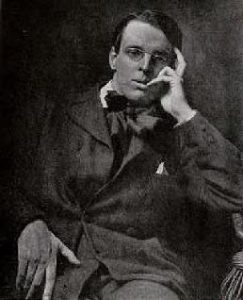
Biography
Irish poet, dramatist and prose writer, one of the greatest English-language poets of the 20th century. Yeats received the Nobel Prize for Literature in 1923. Between the Celtic dreams of THE WANDERINGS OF OISIN (1889) and the intellectual, often obscure poetry of the 1930s, Yeats produced a tremendous amount of works. In his early career Yeats studied William Blake's poems, Emanuel Swedenborg's writings and other visionaries, but later he began to confront reality with a new directness - and disillusionment. Central theme in Yeats's poems is Ireland, its history, folklore and contemporary public life.
William Butler Yeats was born in Dublin. His father was a lawyer turned to an Irish Pre-Raphaelite painter. In 1867 the family followed him to London and settled in Bedford Park. In 1881 they returned to Dublin, where Yeats studied the Metropolitan School of Art. He met there the poet, dramatist and painter George Russell (1867-1935), who was interested in mysticism.
Reincarnation, communication with the dead, mediums, supernatural systems and Oriental mysticism fascinated Yeats through his life. In 1886 Yeats formed the Dublin Lodge of the Hermetic Society and took the magical name Daemon est Deus Inversus. The occult order also attracted Aleister Crowley.
Read the full biography
As a writer Yeats made his debut in 1885, when he published his first poems in The Dublin University Review. In 1887 the family returned to Bedford Park, and Yeats devoted himself to writing. He visited Mme Blavatsky, the famous occultist, and joined the Esoteric Section of the Theosophical Society, but was later asked to resign. In 1889 Yeats met his great love, Maud Gonne (1866-1953), an an actress and Irish revolutionary who became a major landmark in the poets life and imagination. However, she married in 1903 Major John MacBride, and this episode inspired Yeats's poem 'No Second Troy'. "Why, what could she have done being what she is? / Was there another Troy for her to burn." MacBride was later executed by the British.
Yeats was interested in folktales as a part of an exploration of national heritage and for the revival of Celtic identity. His study with George Russell and Douglas Hyde of Irish legends and tales was published in 1888 under the name Fairy and Folk Tales of the Irish Peasantry. Yeats assembled for children a less detailed version, IRISH FAIRY TALES, which appeared in 1892. (see also Wilhelm Grimm.) THE WANDERINGS OF OISIN AND OTHER POEMS (1889), filled with sad longings, took its subject from Irish mythology.
In 1896 Yeats returned to live permanently in his home country. He reformed Irish Literary Society, and then the National Literary Society in Dublin, which aimed to promote the New Irish Library. In 1897 he met Isabella Augusta, Lady Gregory, with whom he founded the Irish Literary Theatre. Yeats worked as a director of the theatre to the end of his life, writing several plays for it. His most famous dramas were CATHLEEN NI HOULIHAN (1902) and THE LAND OF HEART'S DESIRE (1894).
Ezra Pound, whom Yeats met in 1912, became his fencing master and secretary in the winters of 1913 and 1914. Pound introduced Yeats to Japanese Noah drama, which inspired his plays. In early 1917 Yeats bought Thoor Ballyle, a derelict Norman stone tower near Coole Park. After restoring it, the tower became his summer home and central symbol in his later poetry. In 1917 he married Georgie Hyde-Lee - they had a son and a daughter. However, before the marriage Yeats had proposed to Maud Gonne, but he was also obsessed with Gonne's daughter Iseult, who turned him down. During their honeymood Yeats's wife demonstrated her gift for automatic writing. Their collaborative notebooks formed the basis of A VISION (1925), a book of marriage therapy spiced with occultism.
The change from suggestive, beautiful lyricism toward the spare and tragic bitterness was marked in Yeats poem 'September 1913' in which he stated: "Romantic Ireland's dead and gone." During the civil war Irish Free State soldiers burned many of Yeats's letters to Maud Gonne when they raided her house. At the start of the war Yeats went to Oxford, but then returned to Dublin, becoming a Senator in the same year. As a politician Yeats defended Protestant interests and took pro-Treaty stance against Republicans. Maud Gonne's son, Sean MacBride, was imprisoned without trial under emergency legislation that Yeats had voted for.
In 1932 Yeats founded the Irish Academy of Letters and in 1933 he was briefly involved with the fascist Blueshirts in Dublin. While in Mallorca Yeats became seriously ill. He tried to meet Robert Graves who refused to see him. In his final years Yeats worked on the last version of A VISION, which attempted to present a theory of the variation of human personality, and published THE OXFORD BOOK OF VERSE (1936) and NEW POEMS (1938). Yeats died in 1939 at the Hôtel Idéal Séjour, in Menton, France. In 'Under Ben Buiben,' one of his last poems, he had written: No marble, no conventional phrase; On limestone quarried near the spot By his command these words are cut: Cast a cold eye On life, on death. Horseman; pass by! Yeats's coffin was taken in 1948 to Druncliff in Sligo, but there is some doubt as to the authenticity of the bones. "The mystical life is the centre of all that I do and all that I think and all that I write."
On Brown Penny
On The Second Coming
On The Stolen Child
On The Lake Isle Of Innisfree
On Easter, 1916
On He Wishes For The Cloths Of Heaven