The poem
I
I saw a staring virgin stand Where holy Dionysus died, And tear the heart out of his side. And lay the heart upon her hand And bear that beating heart away; Of Magnus Annus at the spring, As though God's death were but a play.
Another Troy must rise and set, Another lineage feed the crow, Another Argo's painted prow Drive to a flashier bauble yet. The Roman Empire stood appalled: It dropped the reins of peace and war When that fierce virgin and her Star Out of the fabulous darkness called.
II
In pity for man's darkening thought He walked that room and issued thence In Galilean turbulence; The Babylonian starlight brought A fabulous, formless darkness in; Odour of blood when Christ was slain Made all platonic tolerance vain And vain all Doric discipline.
Everything that man esteems Endures a moment or a day. Love's pleasure drives his love away, The painter's brush consumes his dreams; The herald's cry, the soldier's tread Exhaust his glory and his might: Whatever flames upon the night Man's own resinous heart has fed.
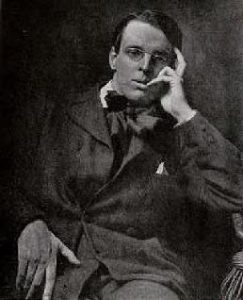
William Butler Yeats is considered one of the greatest modern poets of the English language. His poem “Two Songs from a Play” acts as a beautiful glimpse into his artistry. The poem contains evocative imagery with references to ancient dramas. It suggests pagan and Christian allegories and uses meter and rhyme effectively. “Two Songs from a Play” conveys a message about man’s relationship with religion through time:…
Read the whole commentWilliam Butler Yeats is considered one of the greatest modern poets of the English language. His poem “Two Songs from a Play” acts as a beautiful glimpse into his artistry. The poem contains evocative imagery with references to ancient dramas. It suggests pagan and Christian allegories and uses meter and rhyme effectively. “Two Songs from a Play” conveys a message about man’s relationship with religion through time: the two songs represent the two faith traditions of Christianity and paganism, woven together in one play and in similar myths. Passivity exists towards religion that is rooted in the consuming nature of human and divine love. Finally, this poem reflects Yeats’ accomplished style and ultimately succeeds as a poem on literary grounds.
“Two Songs from a Play” is written in iambic tetrameter. Its title refers to a play called The Resurrection. The poem begins by alluding to a pagan myth about the death and resurrection of the god Dionysus. According to myth, Dionysus was ripped apart by the Titans at Hera’s command. His heart alone remained unharmed, and the goddess Athena brought it to Zeus, Dionysus’ father. Zeus swallowed the heart, and later re-begot Dionysus with a mortal woman, Semele. Athena is the “staring virgin” of the opening line. The word “staring” implies inaction; Athena witnessed Dionysus’ death wide-eyed but motionless. The word “staring” can also mean something glaringly obvious. The virgin is very obvious and visible – perhaps too visible. Like Christ later on in the poem, her presence is perhaps unwanted.
The virgin stands, moreover, on the spot of Dionysus’ death. It is noteworthy that the word used is “stand.” The later Christian allusions in the poem reinforce an idea that the virgin resembles the holy women, including Christ’s virgin mother, who stood at Christ’s place of death. Like the poem’s virgin, they stared in forced inactivity. Thus begins the poem’s weaving of pagan and Christian divinity. This theme is reflected in the second line, where the word “holy” describes Dionysus. In the post-Christian era, this word often implies a connection to the Christian church. It is rarely considered a modern description for the forgotten Roman gods. It also suggests a desire to emphasize the sanctity of the gods or God.
In this opening line, the speaker of the poem says “I saw” the event occur. This implies that the speaker was present, although this mythical event would have occurred thousands of years before the author’s life. This opening is intended to draw readers into the poem by placing them with the speaker at the actual scene. The speaker could represent the narrator for the unexplained play. This phrase occurs just before the word “staring.” Like the “staring virgin,” the speaker’s main purpose is observation. An almost mystical sense allows the speaker to remain outside of time, observing the panorama of humanity. Observation is the focal action of the first line, and its theme will continue until the poem’s end as the speakers continues to view mankind. Finally, the alliteration of “saw – staring – stand” unites the sound and sense of the first line.
The poem first breaks its iambic pattern in the second line, with “out of his side.” A trochee on “out of” gives force to the savage image of a still-beating heart ripped from the god’s side. The virgin returns to her “staring” passivity, however, in the fourth line. She “lay the heart upon her hand.” It is hard to imagine a less exciting expression of her action. This line can sound dull, even vapid, alone. In the context of the series of three lines describing her actions, however, a pattern is discernible. Each line shares the same beginning and together they form a sing-song pattern. As with the words “I saw,” these lines create a sense that this poem is a story told, literally a song within a play. Their chanting rhythm also fosters the feeling of mysticism in the poem.
The virgin’s lifeless actions also carry a deeper significance. They reinforce the sanctity of the dying god. The virgin treats the heart with respect. She lays it in her hand to evoke a careful reverence. This theme of renewed reverence continues throughout the poem. The virgin then carries the heart away while it is still beating. This line reveals that Dionysus was not fully dead when Athena bore his heart to Zeus. This presents a first difference between Christ and Dionysus, because Christ was wholly dead before his resurrection.
Next, the Muses sing about the pagan belief in Magnus Annus, a vast and repetitive cycle of the years. Magnus Annus reinforces the idea of a pattern of humanity viewed outside of time by an observer. They sing “at the spring,” the time of year when Christ’s resurrection occurred. These words suggest the Christian-pagan allegory; the Muses essentially state that the vast, repeating cycle of time is epitomized at a spring-time occurrence: Easter.
The final line of the first stanza echoes the title and fully states the poem’s theme: two tales of a divine death and re-birth are woven and compared in the “play” of human experience. A spondee occurs on “God’s death,” lending weight to these words. This stress is important because the poem states that the divine death does not receive enough emphasis. Throughout the first stanza, the speaker has insisted on returning reverence to the divine death. The poetic stress returns some due import to these words.
Another sense of the last line views the word “play” as a game or childish amusement. “God’s death” is nothing but a false game in this sense. The speaker decries this attitude. The first stanza is united by its consistent rhyme scheme: ABBACDDC. The other stanzas will follow the same pattern to achieve cohesiveness.
The first four lines of this stanza use images from ancient Greek literature to continue the pagan imagery, but these images apply to the Christian God as well. The first line of the second stanza evokes an image of the sun. “Another Troy” will “rise and set,” just as the sun rises and sets. The sun symbolizes divinity. This implies that a second divine death is necessary. Similarly, the second line uses the word “lineage,” which denotes royalty or nobility. Like the setting sun, this divine lineage will die. A trochee occurs in the fourth line of the second stanza. The emphasis on the word “drive” gives power and motion to the verb.
The next four lines are increasingly ambiguous, but they contain hints of Christianity to contrast with the pagan imagery of the first four lines. The “fierce virgin” could represent both Athena and Mary, the Virgin Mother of Christ. A spondee on “fierce” suggests warlike tendencies which fit Athena better than Mary, who was known for her meekness and humility. Mary is also known, however, for the incredible suffering which pierced her during her life, winning her the title “Lady of Sorrows.” Fierceness can imply stamina and endurance for suffering, both of which fit Mary arguably better than any other woman in Christian tradition. The adjective thus fits both women, and continues the weaving of Christian and pagan tradition.
Similarly, the Christ story includes an important star, and occurred during the reign of the Roman Empire. That the “Roman Empire stood appalled” especially enforces the Christian influence, as the Messiah was expected to shatter the established order and win salvation from the oppressive power of Rome. Despite expectations, Christ did not use military might against Rome, but rather brought a spiritual salvation. Thus both “peace and war” were “dropped,” leaving Christianity’s entirely new social order. This new order superseded the pagan traditions that preceded it, just as the Christian influence in this poem follows the pagan metaphors.
The final line of the second stanza differs from the poem’s metrical pattern. It is one of only two lines in the poem that adds an extra syllable. Both lines mention the “fabulous darkness” ushered in by Christianity. The jarring difference in this last line’s meter echoes the chaotic sense of this formless darkness.