The poem
His chosen comrades thought at school He must grow a famous man; He thought the same and lived by rule, All his twenties crammed with toil; 'What then?' sang Plato's ghost. 'What then?'
Everything he wrote was read, After certain years he won Sufficient money for his need, Friends that have been friends indeed; 'What then?' sang Plato's ghost. ' What then?'
All his happier dreams came true - A small old house, wife, daughter, son, Grounds where plum and cabbage grew, poets and Wits about him drew; 'What then.?' sang Plato's ghost. 'What then?'
The work is done,' grown old he thought, 'According to my boyish plan; Let the fools rage, I swerved in naught, Something to perfection brought'; But louder sang that ghost, 'What then?'
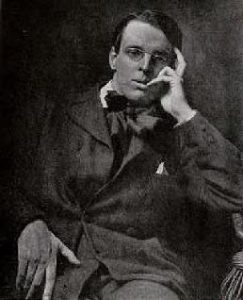
W.B. Yates, apparently from his poem, "What Then," was a concieted young man who felt himself superior from an early age. He applied himself and proofed his point, and that of others. His early years were productive of good, well respected writings. He was read widely, made money, and won prizes; the Nobel among them. Friends were more friendly still. He found in life, if not the exact things he wanted, then fine…
Read the whole commentW.B. Yates, apparently from his poem, "What Then," was a concieted young man who felt himself superior from an early age. He applied himself and proofed his point, and that of others. His early years were productive of good, well respected writings. He was read widely, made money, and won prizes; the Nobel among them. Friends were more friendly still. He found in life, if not the exact things he wanted, then fine substitutes. He finished his life-work, grew old, feeling he had fulfilled his ambitions. He maintained his own integrity and lived life to his own liking. He cared little what others thought; that was their concern--not his. But with all his wonderous art, in the end it seemed to him to have come to naught. Being without true religion, and lacking in superstition--there was no satisfaction. And like Plato, the philospher--Yates wondered what was it all about? What was the point? Wouldn't everything come to naught?
Response
I have been reading this poem to graduating seniors in my English Lit classes for years. Yes, it does, in a way, mirror the life of Yeats, but the message underlying the poem is more than autobiographical. This not only tells about the successful person, but also tells the reason for that success. It is the constant echo in his mind, the question that drives the man, the never ending search, the never ending mind set to not accept the status quo, but always to seek the next step in life, the next hurdle, the next accomplishment. "What Then?" is just another way of saying "what's next for me?"
Literature
I think this poem is essentially Romantic, in its view of life as a quest towards a higher goal. Perfection is practically unattainable, but we must nevertheless believe in the perfectability of the soul. Schiller, in an essay on poetry, expresses the view that mankind sees in Nature what it lacks in itself, ie, stability and perfection. Human lives are always in a state of flux. At the same time, we are also…
Read the whole commentI think this poem is essentially Romantic, in its view of life as a quest towards a higher goal. Perfection is practically unattainable, but we must nevertheless believe in the perfectability of the soul. Schiller, in an essay on poetry, expresses the view that mankind sees in Nature what it lacks in itself, ie, stability and perfection. Human lives are always in a state of flux. At the same time, we are also ennobled by the fact that this flux makes our lives a constant quest, a striving, towards perfection.
The quest for perfection is a theme that Yeats dwells on in several of his later poems. In "An Acre of Grass", for instance, he first resignedly accepts that "Neither loose imagination,/ Nor the mill of the mind/ Consuming its rag and bone,/ Can make the truth known.", and then goes on to subvert his own assertion, praying for "an old man"s frenzy", so he can "pierce the clouds" in a moment of mystical vision.
"What then", however, seems to be pessimistic about the possibility of ever bringing "something to perfection". It is at the very moment that the narrator makes this inflated assertion that the voice of Plato"s ghost undercuts it, singing louder than before, "What then?" Perfection is never a state of stasis - it is a process towards ever-greater goodness, and therefore when the poet asserts that he has brought something to perfection, as if his life"s tasks are at an end, Plato"s ghost repeats his question all the more loudly.
Yeats, near the end of his life, following a Steinach operation, was filled with a renewed vitality, a desire never to rest. It is this desire that takes the form of Plato"s ghost and repeats the question to the restful aspects of his psyche.
Tim Mocarski, above, makes an interesting observation, that the repeated question could be the very reason behind the narrator"s success in life. The poet"s life seems to epitomize the Socratic notion of "Eudaimonia", or the good life; one of self-examination, virtue and philosophical enquiry. However, this is only implicit. Only after a secondary examination can one find anything positive in the ghost"s insistent question. I feel that, primarily, the repeated structure of bold assertion undercut by a question that is never quite answered, reflects a deep-seated insecurity and pessimism in the poet"s mind. That the questioning nature of his mind has served a good purpose is only secondary. In fact, whether what has been achieved is at all of any worth, is questionable. The poem might be seen as a Modernist statement of the futility of human existence, ala "Waiting For Godot". Despite material and personal acquisitions, the question of "what then is the use, or meaning of it all?", or "what next", remains, particularly when faced with the inescapable reality of death, as Yeats was at the late stage in his life when this poem was written.
A further question is, why is the ghost that of Plato? Most obviously, because Plato is one of the best known philosophers in the history of Western civilization, and therefore, the ideal person to voice a philosophical question. Also, many of Plato"s Socratic dialogues follow the same rhetoric of question and answer that the poem itself follows. Most importantly perhaps, the cornerstone of Plato"s metaphysics is the belief that beyond this life of shadows, lies a realm of permanence - "the form of the good". Thus, the ghost being that of Plato"s, is perhaps reminding the poet that all that he feels he has achieved in life ultimately amounts to mere shadows.
"What then" is essentially the voice of an old man, reflecting on what he has achieved in his life, and wondering, faced with imminent death, what will come next. The same question, that in Tim Mocarski"s view has propelled his life forward, now thwarts him, for who can know what follows death?
(excuse the bizarre use of double inverted commas everywhere, instead of single inverted commas. Some weird issue with SQL that I cannot figure our)
Wits
What does this word mean here- Capital letter?