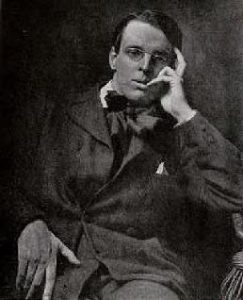
The poem
Where dips the rocky highland Of Sleuth Wood in the lake, There lies a leafy island Where flapping herons wake The drowsy water-rats; There we've hid our faery vats, Full of berries And of reddest stolen cherries. Come away, O human child! To the waters and the wild With a faery, hand in hand, For the world's more full of weeping than you can understand.
Where the wave of moonlight glosses The dim grey sands with light, Far off by furthest Rosses We foot it all the night, Weaving olden dances, Mingling hands and mingling glances Till the moon has taken flight; To and fro we leap And chase the frothy bubbles, While the world is full of troubles And is anxious in its sleep. Come away, O human child! To the waters and the wild With a faery, hand in hand, For the world's more full of weeping than you can understand.
Where the wandering water gushes From the hills above Glen-Car,. In pools among the rushes That scarce could bathe a star, We seek for slumbering trout And whispering in their ears Give them unquiet dreams; Leaning softly out From ferns that drop their tears Over the young streams. Come away, O human child! To to waters and the wild With a faery, hand in hand, For to world's more full of weeping than you can understand.
Away with us he's going, The solemn-eyed: He'll hear no more the lowing Of the calves on the warm hillside Or the kettle on the hob Sing peace into his breast, Or see the brown mice bob Round and round the oatmeal-chest. For be comes, the human child, To the waters and the wild With a faery, hand in hand, from a world more full of weeping than you.
I am not an expert on poetry least of all Yeats, though I do admire the beauty of The Two Trees. My knowledge of The Stolen Child (also) comes from Loreena McKennitt's musical rendition of it. I believe faeries existed and exist as creations of the human mind to explain the inexplicable or at times to blame others for human action. In this poem it is interesting that the faeries have a perception of the world as a…
Read the whole commentI am not an expert on poetry least of all Yeats, though I do admire the beauty of The Two Trees. My knowledge of The Stolen Child (also) comes from Loreena McKennitt's musical rendition of it.
I believe faeries existed and exist as creations of the human mind to explain the inexplicable or at times to blame others for human action. In this poem it is interesting that the faeries have a perception of the world as a painful place and this motivates them to spare children that pain by removing them from the human world. I see in this poem a metaphor for the all too frequent stealing of childhood "The Stolen Child"
by parents and other abusive adults who have themselves been abused and have had their childhood (and their inner "child" stolen.
I believe that the peom is a metaphor about a child's wish to grow up too quickly and experience the real world. The fairies are trying to show the child the "magical" world of childhood is much better than a "world full of weeping." I would be interested in other interpretations of this poem's true meaning.
We have been studying poetry for almost six years in the department. The common belief among my students is that Yeats'Child is Ireland. they say the poem is a longing for "homeland", Ireland. It was stolen in Yeats' time and to my students' comments it is still lost or stolen. They say Yeats would write poems of similar emotions if he were alive today.
I agree with the nationalism comments, but I'm not entirely sure that he was referencing colonialism. (Remember, he was a Protestant Irishman, and so closer to the British than the Catholic Irish who tended to protest more.) I'm of the opinion that the Ireland he missed was more cultural than factual/literal, and more a childhood dream than any type of reality. Perhaps he missed his memories of Ireland. I'm basing…
Read the whole commentI agree with the nationalism comments, but I'm not entirely sure that he was referencing colonialism. (Remember, he was a Protestant Irishman, and so closer to the British than the Catholic Irish who tended to protest more.) I'm of the opinion that the Ireland he missed was more cultural than factual/literal, and more a childhood dream than any type of reality. Perhaps he missed his memories of Ireland.
I'm basing this on the idealized, fantasic wording of the poem. Faeries are not precisely common, everyday phenomena, and he liberally laces the poem with mythology/folklore references gleaned from childhood stories and superstitions. Adding to this poem his other works, you can tell that he's obsessed with the supernatural and mythological. He's trying to recapture something.
He wrote a compendium of Irish folklore, called Mythology, in which he records fragmented tales. They're told in an almost childlike manner, often playing with choronology and typical story format (no clear beginning-middle-end) in ways that children often unconsciously do. The fact that he chose Irish myths, and went back to Ireland to listen to children's stories as an adult, seems to indicate to me a sense of lost childhood and the lost "ideal" Ireland that one could sense as a child, when one could believe more in faerie than British opporessors and revolts. Of course, as an Irish American, I'd love to turn this into a manifesto of anticolonial rage, but I'm reading it as a quasi-Freudian attempt to recapture childhood through fantasies.
I dont know mch of Yeats, but I think his an exceptional poem "The Stolen Child". Ive heard also the song of this poem by Loreena McKennitt, I recommend it. Talking about the poem, I think Ian McKenna has a similar idea to mine. The faeries in this poem, probably try to save kids in suffering, they stole them to prevent the kid being "stolen" by others, when a kid is mistreated he is "stolen". Another reason why I like this poem is about the faerie talk, I find faeries quite interesting, and this might sound childlish, but I belive they are real.
Does anyone know other poems related to faeries?
Irish folklore, says that faeries stole not only children but also adults. They stole them deep into the forest, where according to the folklore faeries live. They made people join them in a series of dances. I recommend Gary Stadler's song "The Dance of the Wild Faeries" which explains all this. All though the poem is a metaphor, i think this information could be useful.
My opinion on this poem is that Yeats is trying to see child abduction through the eyes of the said child. (Harry, age 13)
I find that when one eats peas before going to bed, it helps quicken the digestive system so one awakes fully refreshed!
Although I agree with most of the previous comments below, I do think there is also a rather darker side to the faeries. During the beginning of the poem, the faeries describes the beauty of faeryland in comparison to the misery of the human world. Once the child has agreed to leave his old life though, the faeries begin to describe his losses, "he'll hear no more the lowing Of the calves on the warm hilside, Or the kettle on the hob, Sing peace into his breast, Or see the brown mice bob, Round and round the oatmeal chest."
Everyone has his own interpretation, my own being that the child was tricked into sacraficing his human life.
There are four typos in the last lines.
Come away, O human child!
To to [ the ] waters and the wild
With a faery, hand in hand,
For to [ the ] world's more full of weeping than you
can understand.
Away with us he's going,
The solemn-eyed:
He'll hear no more the lowing
Of the calves on the warm hillside
Or the kettle on the hob
Sing peace into his breast,
Or see the brown mice bob
Round and round the oatmeal-chest.
For be [ he ] comes, the human child,
To the waters and the wild
With a faery, hand in hand,
from a world more full of weeping than you. [no period] [ can understand ]
This poem, I have noticed is so different in it's meaning for everone who reads it, depending mostly on their own life experiences. It seems to me that since the faeries are the ones speaking in the poem, it is not they who wish to steal the child but it is they who view the child as stolen. The Faeries for me, represent the thing that calls to each of us at night when we are quiet which knows that there must be…
Read the whole commentThis poem, I have noticed is so different in it's meaning for everone who reads it, depending mostly on their own life experiences.
It seems to me that since the faeries are the ones speaking in the poem, it is not they who wish to steal the child but it is they who view the child as stolen. The Faeries for me, represent the thing that calls to each of us at night when we are quiet which knows that there must be something better in this world than the dissapointing reality of suffering and hardships that we have come to accept as inevitable. The small pleasures we find in the "human" world (as mentioned in the last stanza) serve only to lull us into complacency and in order to find this better place, we know in our hearts that it may be necessary to abandon them. Whether the poem ends in suicide or simply a new mindset is something my friends and I have been mulling over for a long, long time. There has also been a suggestion that the faerie may actually have something to do with the use of absinthe and it's hallucinagenic properties (I'm not inclined to agree with this however). As I said, this poem is very susceptible to interpretation based on ones own experiences but I really feel as though Yeats is using the faerie mythology from his own childhood to put a name and face to the things within our own selves that want constantly to lure us away from reality and toward a more ideal life.
To me this poem is almost Keatsean. just an in Ode to the Nightingale Keats wanted to escape from the world of pain and sorrow in to the magical wonderland of the bird similarly the fairies in Yeast's poem want to take the child away from this land of "fever and fret". What, according to me, is remarkable in The Stolen Child and also marks a departure from Keats's poem is that the fairies also speak about the sorrows that the child will face once he leaves the mortal world. while, for keats the coming back to the world is not a happy experience, Yeats focuses on the fact that it is good to make an escape to a fairy land but earthly bindings cannot be totally negated.
interpretation
“Come away, O human child! To the waters and the wild With a fairy, hand in hand, For the world's more full of weeping than you can understand.” This quote is by William Butler Yeats in his poem” The Stolen Child”. In this poem Yeats speaks of a fairy who coaxes young children into going with her to the Fairy kingdom. She does this because the world these children are living in is depriving them of their childhood.…
Read the whole comment“Come away, O human child! To the waters and the wild
With a fairy, hand in hand, For the world's more full of weeping than you can understand.” This quote is by William Butler Yeats in his poem” The Stolen Child”. In this poem Yeats speaks of a fairy who coaxes young children into going with her to the Fairy kingdom. She does this because the world these children are living in is depriving them of their childhood. This loss of innocence is a central idea to the poem. Yeats goes about detailing and emphasizing this idea through two main literary techniques: one being vivid imagery and the other being repetition of key terms and phrases within each stanza. The symbolism of the fairy is also an important part of the poem, despite (or perhaps because of) the ambiguity relating to its literal meaning.
Poem as Nationalistic
I think Sriparna raises a good point about how "Yeats focuses on the fact that it is good to make an escape to a fairy land but earthly bindings cannot be totally negated." We've been studying Yeats in relation to his involvement in the Irish Literary Revival and the politics of the time, and maybe the "earthly bindings" could be viewed as the presence of English rule in Ireland. Yeats saw the English hegemony as…
Read the whole commentI think Sriparna raises a good point about how "Yeats focuses on the fact that it is good to make an escape to a fairy land but earthly bindings cannot be totally negated." We've been studying Yeats in relation to his involvement in the Irish Literary Revival and the politics of the time, and maybe the "earthly bindings" could be viewed as the presence of English rule in Ireland. Yeats saw the English hegemony as holding back the development of an Irish Literary tradition, and Edward Said argued that Nationality was "recoverable at first only through the imagination" so Yeats could be beginning to recover an Irish Nationality but also recognising that it must be achieved in the real world also.
According to me all the above posted comments are correct. I think here the fairy lures the human child to an island of dreams where their innocence will never be lost through the differant pressures and expectations towards them from the rest of the world and promises the child that he will get more happiness there than the smaller amount as expected from the world. On the flip side it can also be said that it is the silent desire of the poet himself to escape to such a world.
The Stolen Child by Yeats
All of the earthly images are lovely - things that keep a person from leaving the earth. He is telling us about the suffering and weeping but showing us the simple homey beauty of existence here. His ambivalence is what makes it a poem of such strength and beauty.