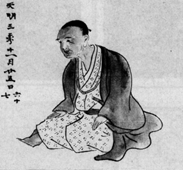
Biography
Yosa Buson was a Japanese haiku poet and painter. He ranked second only to Matsuo Bashoa, Japanese master of haiku, among poets of the Edo or Tokugawa period (1600-1868).
Buson was born in a suburb of Osaka, Japan, and apparently lost both parents while he was still young. In 1737 he moved to Edo (now Tokyo) to study painting and haiku poetry in the tradition of Basho. After the death of one of his poetry teachers in 1742, he toured northern areas associated with Basho and visited western Japan, finally settling in Kyoto, Japan, in 1751.
Particularly active as a painter between 1756 and 1765, Buson gradually returned to haiku, leading a movement to return to the purity of Basho's style and to purge haiku of superficial wit. He married about 1760. In 1771 he painted a famous set of ten screens with his great contemporary Ike no Taiga, demonstrating his status as one of the finest painters of his time. Buson's major contribution to haiku is his complexity and his painter's eye. Buson's technical skill as an artist is reflected in the visual detail of his poetry.
Read the full biography
The poetry group that he formed published its first book in 1772. His haiku poems show a more objective, pictorial style than Basho's humane, wide-ranging work. While Basho taught, "Master technique, then forget it," Buson's technique is less transparent and his poems more consciously composed. He was a poet of enhanced sensibility and evocation. In 1776 his group built a Bashoan (Basho house) for gatherings. Also, his daughter married that year, although this unhappy marriage grieved Buson. Despite his poetic brilliance, Buson was remembered more as a painter until essays by modern Japanese writers Masaoka Shiki and Hagiwara Sakutaro revived his reputation. Besides haiku, he wrote longer verse influenced by both Chinese and Japanese classics.
Source: Blyth, R. H., A History of Haiku, 2 vols. (1971, 1976); Henderson, Harold G., ed., Introduction to Haiku (1958, repr. 1983).
On Harvest moon
On Listening to the moon