Biography
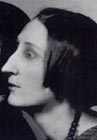
Edith Sitwell (September 7, 1887 - December 9, 1964) was a British poet and critic.
Edith Sitwell was born in Scarborough, Yorkshire, of aristocratic but eccentric parentage of Lord George Sitwell and ex-socialite Lady Ida Sitwell of Renishaw Hall. She would later claim that she was descended from the Plantagenets. She had two younger brothers, Osbert and Sacheverell Sitwell. Her relationship with her parents was stormy at best, especially when her father locked her into an iron frame to "correct" her supposed spine deformation. In her later autobiography she said that her parents had always been strangers to her.
Sitwell left for London at the age of twenty-five with the governess Helen Rootham. In London she moved into a fourth-floor flat in Pembridge Mansions, Bayswater. She published her first poem The Drowned Suns in the Daily Mirror in 1913 and between 1916 and 1921 edited Wheels, an annual poetic anthology.
Read the full biography
She became a proponent and supporter of innovative trends in English poetry and opposed what she considered the conventionalism of many contemporary backward-looking poets. She was an unusual sight herself, having angular features resembling Queen Elizabeth I and being six feet (183 cm) tall, but mainly because she often dressed in an unusual manner with gowns of brocade or velvet or gold turbans with jewelled bracelets. Her flat became a meeting place for people that would later become the so-called Bloomsbury group.
She was most interested by the distinction between poetry and music, a matter explored at 1923 in Façade, published in 1922, and set to music by William Walton, with many poems being most esoteric in manner. The performance of the Façade was performed behind a curtain with a hole in the mouth of a painted face and the words were recited through the hole with the aid of a megaphone. The public received the first performance with bemusement with less than favourable critiques from luminaries like Noel Coward; she would not speak with Coward for the next forty years.
She reputedly also disliked D.H. Lawrence because she thought that the author had used the Renishaw Hall as a model in Lady Chatterley's Lover. She never married, but made poet Dylan Thomas her protégé. She received a Royal Society of Literature medal in 1933.
During World War II, Sitwell retired to Renshaw with her brother Osbert and wrote under the light of oil lamps. She knitted clothes for their friends who served in the army. One of the beneficiaries was young Alec Guinness, who received a pair of seaboot stockings.
In 1948 Sitwell toured USA with her brothers and recited her poetry in a large gold dress. She became a DBE in 1954. In 1955 she converted to Roman Catholicism. She also wrote a biography of Queen Elizabeth and afterwards called her "the old bore". In her 70's she was confined to wheelchair. Her last poetry reading was in 1962. Edith Sitwell died in 1964 at the age of 77.
This article is licensed under the GNU Free Documentation License and uses material adapted in whole or in part from the Wikipedia article on Edith Sitwell.
On Answers
On Bells Of Gray Crystal