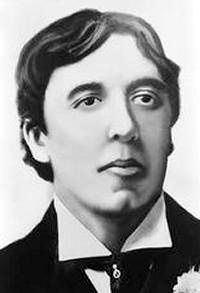
Oscar Wilde

Portrait of Oscar Wilde
Oscar Wilde 1854–1900
1854Born

Oscar Wilde (1854-1900), Irish poet and dramatist whose reputation rests on his comic masterpieces Lady Windermere's Fan(1892) and The Importance of Being Earnest (1895). Among Wilde's other best-known works are his only novel The Picture of Dorian Gray(1891) and his fairy tales especially "The Happy Prince."

Wilde was born on October 16, 1854 in Dublin to unconventional parents - his mother Lady Jane Francesca Wilde (1820-96), was a poet and journalist. His father was Sir William Wilde, an Irish antiquarian, gifted writer, and specialist in diseases of the eye and ear. Wilde studied at Portora Royal School, Enniskillen, County Fermanagh (1864-71), Trinity College, Dublin (1871-74) and Magdalen College, Oxford (1874-78).

In 1878 Wilde received his B.A. and in the same year he moved to London. His lifestyle and humorous wit soon made him the spokesman for Aestheticism, the late 19th century movement in England that advocated art for art's sake. He worked as art reviewer (1881), lectured in the United States and Canada (1882), and lived in Paris (1883). Between the years 1883 and 1884 he lectured in Britain. From the mid-1880s he was a regular contributor for Pall Mall Gazette and Dramatic View. In 1884 Wilde married Constance Lloyd (died 1898), and to support his family Wilde edited in 1887-89 Woman's World. In 1888 he published The Happy Prince and Other Tales, fairy-stories written for his two sons. Wilde's marriage ended in 1893. He had met an few years earlier Lord Alfred Douglas, an athlete and a poet, who became both the love of the author's life and his downfall.

Read the full biography

Wilde made his reputation in the theatre world between the years 1892 and 1895 with a series of highly popular plays. Lady Windermere's Fan (1892) dealt with a blackmailing divorcée driven to self-sacrifice by maternal love. In A Woman of No Importance (1893) an illegitimate son is torn between his father and mother. An Ideal Husband (1895) dealt with blackmail, political corruption and public and private honor. The Importance of Being Earnest (1895) was about two fashionable young gentlemen and their eventually successful courtship. Before his theatrical success Wilde produced several essays. His two major literary-theoretical works were the dialogues "The Decay of Lying" (1889) and "The Critic as Artist" (1890).

Although married and the father of two children, Wilde's personal life was open to rumors. His years of triumph ended dramatically, when his intimate association with Alfred Douglas led to his trial on charges of homosexuality (then illegal in Britain). He was sentenced to two years hard labor for the crime of sodomy. Wilde was first in Wandsworth prison, London, and then in Reading Gaol. During this time he wrote De Profundis (1905), a dramatic monologue and autobiography, which was addressed to Alfred Douglas.

After his release in 1897 Wilde in Berneval, near Dieppe. He wrote "The Ballad of Reading Gaol", revealing his concern for inhumane prison conditions. Wilde died of cerebral meningitis on November 30, 1900, penniless, in a cheap Paris hotel at the age of 46.

From readers

What readers say about Oscar Wilde

  1. On SYMPHONY IN YELLOW

    “i love this poem, my guess is that the symphony in yellow i the celebration of when the spring comes. the first line "an omnibu across the bridge crawls like a yellow butterfly" i think this could be the transporting of newly cut straw cuz of the yellow thing. this poem swallows me up and makes me…”

  2. On Poem: To My Wife - With A Copy Of My Poems

    “A metaphor is implied in the second stanza as the author's poems are compared to fallen petals (flowers. In the same stanza, love becomes tangible in the form of his poems. In the last stanza, his poems/love will whisper of life and what is beatiful when winter handens the land above his dead wife.”

  3. On Poem: Impression Du Matin

    “the French title recalls the title of an Impressionist painting. In fact the poem is a description of London at dawn and is based on colours and sounds. Blue , yellow and grey are the dominant colours . they are cold colours and they fit well to the fading of night. The magic atmosphere of blue and…”

  4. On Poem: The Ballad Of Reading Gaol

    “I absolutely love this poem. It's the first Oscar Wilde work I ever read and it remains one of my favorites. I just like the way he examines the similarities between a murderer who kills his lover and all of us who "kill" the ones we love in the sense that we tend to hurt the ones we love the most.…”

  5. On CHARMIDES

    “In the first reading of the epic Charmides, the diction comes across a little stale. However in the many years I have spent in obsessive, constant study over Wilde's dark genius I have come to an understanding of his syncopated and increasingly perpetual word magic. To read his words is to plunge…”

  6. On LE JARDIN

    “This poem is about change; change in seasons as well as from young to old. Beginning with youth, the Lily serves as an innocent and young figure. The sunflower represents adolescence, and finally the privet bush represents old age. The poem concludes with a rose lying on the grass meaning that…”

Where readers gather

Most discussed

  1. No. 55Poem: To My Wife - With A Copy Of My Poems28 comments
  2. No. 16SYMPHONY IN YELLOW12 comments
  3. No. 60Poem: The Ballad Of Reading Gaol5 comments
  4. No. 2REQUIESCAT4 comments
  5. No. 15IN THE FOREST3 comments
  6. No. 44Poem: Apologia2 comments
  7. No. 20Poem: Athanasia2 comments
  8. No. 39Poem: Portia2 comments
  9. No. 1Poem: Sonnet To Liberty2 comments
  10. No. 1CHARMIDES1 comment

All 86 poems

Charmides and Other Poems · 1881 · 25 poems
Poems · 1881 · 61 poems
  1. 1Poem: Sonnet To Liberty2
  2. 2Poem: Ave Imperatrix1
  3. 3Poem: To Milton
  4. 4Poem: Louis Napoleon
  5. 5Poem: Quantum Mutata
  6. 6Poem: Libertatis Sacra Fames
  7. 7Poem: Theoretikos
  8. 8Poem: The Garden Of Eros
  9. 9Poem: Sonnet On Approaching Italy
  10. 10Poem: Ave Maria Gratia Plena
  11. 11Poem: Italia
  12. 12Poem: Sonnet On Hearing The Dies Irae Sung In The Sistine Chapel
  13. 13Poem: Easter Day
  14. 14Poem: Vita Nuova
  15. 15Poem: Madonna Mia1
  16. 16Poem: The New Helen
  17. 17Poem: The Burden Of Itys
  18. 18Poem: Impression Du Matin1
  19. 19Poem: Magdalen Walks
  20. 20Poem: Athanasia2
  21. 21Poem: Serenade (For Music)
  22. 22Poem: La Bella Donna Della Mia Mente
  23. 23Poem: Chanson
  24. 24Poem: Les Silhouettes
  25. 25Poem: La Fuite De La Lune
  26. 26Poem: The Grave Of Keats
  27. 27Poem: Theocritus - A Villanelle1
  28. 28Poem: In The Gold Room - A Harmony
  29. 29Poem: Ballade De Marguerite (Normande)
  30. 30Poem: The Dole Of The King's Daughter (Breton)
  31. 31Poem: Amor Intellectualis
  32. 32Poem: Santa Decca
  33. 33Poem: A Vision1
  34. 34Poem: Impression De Voyage1
  35. 35Poem: The Grave Of Shelley
  36. 36Poem: By The Arno
  37. 37Poem: Fabien Dei Franchi
  38. 38Poem: Phedre
  39. 39Poem: Portia2
  40. 40Poem: Queen Henrietta Maria
  41. 41Poem: Camma
  42. 42Poem: Panthea
  43. 43Poem: Impression - Le Reveillon1
  44. 44Poem: Apologia2
  45. 45Poem: Quia Multum Amavi
  46. 46Poem: Silentium Amoris1
  47. 47Poem: Her Voice
  48. 48Poem: My Voice1
  49. 49Poem: Taedium Vitae
  50. 50Poem: From Spring Days To Winter (For Music)
  51. 51Poem: Tristitiae
  52. 52Poem: The True Knowledge
  53. 53Poem: Under The Balcony1
  54. 54Poem: The Harlot's House1
  55. 55Poem: To My Wife - With A Copy Of My Poems28
  56. 56Poem: With A Copy Of 'A House Of Pomegranates'1
  57. 57Poem: Roses And Rue
  58. 58Poem: Desespoir
  59. 59Poem: The Sphinx
  60. 60Poem: The Ballad Of Reading Gaol5
  61. 61Poem: Ravenna1