Biography
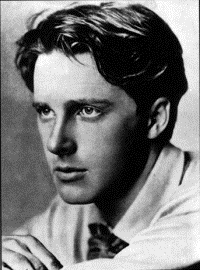
Rupert Brooke (August 3, 1887 - April 23, 1915) was an English poet writing in the period immediately before and during the First World War.
Brooke was born at 5 Hillmorton Road in Rugby, Warwickshire the son of a Rugby schoolmaster, and was educated at Rugby School. He became a fellow of King's College, Cambridge in 1913. Brooke made friends among the Bloomsbury group of writers, some of whom admired his talent, while others, both male and female, were more impressed by his good looks. The poet W. B. Yeats described him as "the handsomest young man in England". Brooke belonged to another literary group known as the Georgian Poets, and was the most important of the Dymock poets, associated with the Gloucestershire village of Dymock, where he spent some time before the war.
Brooke toured the United States and Canada to write travel diaries for the Westminster Gazette and visited several islands in the South Seas. It was later revealed that he had fathered a daughter with a Tahitian woman. He was also romantically involved with the actress, Cathleen Nesbitt.
Read the full biography
His accomplished poetry gained many enthusiasts and followers and he was taken up by Edward Marsh, who brought him to the attention of Winston Churchill, then First Lord of the Admiralty. He entered the army as an officer, as befitted his social class, and took part in the Antwerp expedition in October 1914. He sailed with the British Mediterranean Expeditionary Force on February 28, 1915 but developed septic pneumonia from an infected mosquito bite. He died at 4.20pm on April 23, 1915 off the island of Lemnos in the Aegean on his way to a battle at Gallipoli. As the expeditionary force had orders to depart immediately, He was buried at 11pm in an olive grove on the island of Skyros, Greece. His grave remains there today. Discussion Brooke's poetry gives us a glimpse of a golden era in England just before the First World War. To be more precise, it was a golden time only for the upper classes, who enjoyed the fruits of Britain's imperial dominance: public school education, guaranteed employment (if they desired it) and access to the rich and powerful members of society. The gap between rich and poor was wide during this period, and unrest was beginning to grow among the lower classes. With hindsight it seems obvious that this state of affairs could not last for ever. The war gave a huge shock to this system and, despite the terrible human cost, led eventually to a more equal society. Brooke's generation was the last to enjoy such an unchallenged position of privilege.
His early poetry was classically inspired, with death as its most frequent theme. Later, he wrote more from his personal experience gained in the South Seas and later in his brief military career. The shortness of his life added to his reputation, especially at a time when so many young men were being killed. Amongst his works were five War Sonnets, a sixth sonnet - The Treasure - and The Old Vicarage, Grantchester. Winston Churchill wrote his obituary in The Times of April 26, 1915, saying "he advanced to the brink ... with absolute conviction of the rightness of his country's cause". Brooke's friends complained that the heroic myth of Brooke's patriotic self-sacrifice was deliberately exaggerated to encourage more young men to enlist. Since Brooke's death, the name Rupert has been used as a term of mockery for any young Army officer with a public school education.
The Old Vicarage, built c. 1685 on the site of the 15th century vicarage, had passed from church ownership into private hands in 1820. It was bought in 1850 by Samuel Page Widnall (1825-1894), who extended it and established a printing business, the Widnall Press. In 1910 it was owned by Henry and Florence Neeve, from whom Brooke rented a room, and later a large part of the house. Brooke's mother bought the house in 1916 and gave it to his friend, the economist Dudley Ward. In the 1980s it was bought by Jeffrey Archer.
This article is licensed under the GNU Free Documentation License and uses material adapted in whole or in part from the Wikipedia article on Rupert Brooke.
On The Voice
On The Little Dog's Day
On The Soldier
On The Wayfarers
On Lines Written In The Belief That The Ancient Roman Festival Of The Dead Was Called Ambarvalia